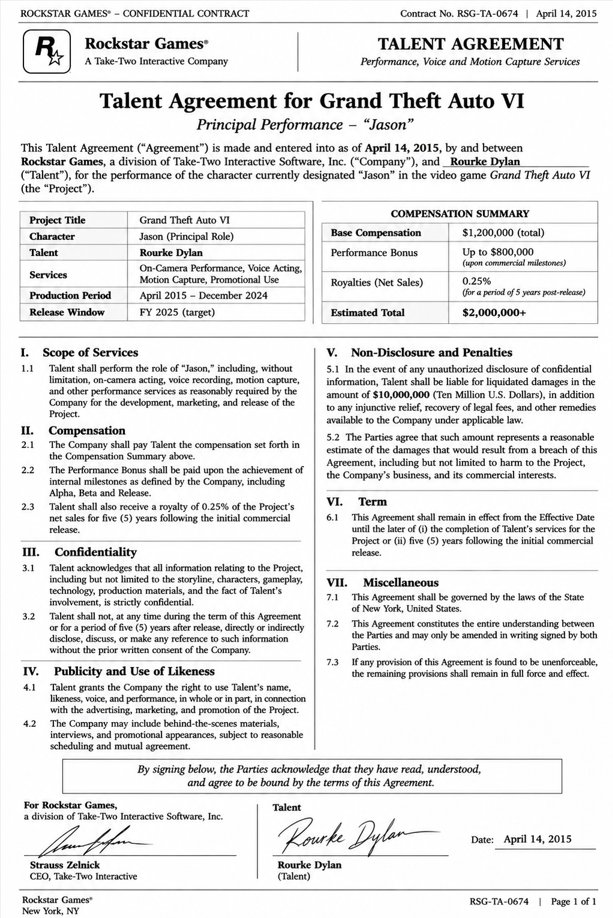
someone just leaked Dylan Rourke's full contract with Rockstar for GTA 6. the man who plays Jason got paid $1.2 million and signed a $10 million NDA to never talk about it
the contract is dated April 14, 2015. they've been working on this game for over 11 years. he was locked in before anyone even knew GTA 6 existed
base pay: $1,200,000 for voice acting, motion capture, performance, and promotional material. that sounds like a lot until you realize GTA 5 made $8 billion
on top of that he gets up to $800,000 in bonuses and 0.25% royalties on net sales for 5 years after launch. if GTA 6 does even half of what GTA 5 did that royalty alone is worth more than the entire base contract
but here's the part that matters. the NDA penalty is $10,000,000. he can't talk about the story, the characters, the tech, the development process, or even confirm he's in the game without Rockstar's permission. ten million dollars if he says one wrong thing in an interview
they paid him $1.2 million to be Jason and charged him $10 million to stay quiet about it. that ratio tells you everything about how Rockstar operates
i've been digging through GTA 6 files with Fable 5.2 since launch day. this contract was just the beginning
More ridiculous spin from Wes Moore's comms team.
Moore did not receive his Combat Action Badge for engaging the enemy in active ground combat.
He received his CAB because he was present during an on-base incident of "indirect fire" in late 2005, when three rockets struck the base, injuring nobody.
This has been widely reported.
The ADL and related organizations have not only stepped up efforts to rewrite the history regarding the 1913 rape and murder of Mary Phagan and the conviction of Leo Frank, based on strong evidence and an in-depth trial, but they've also portrayed him as the face of hate crime victims and lynchings during that period.
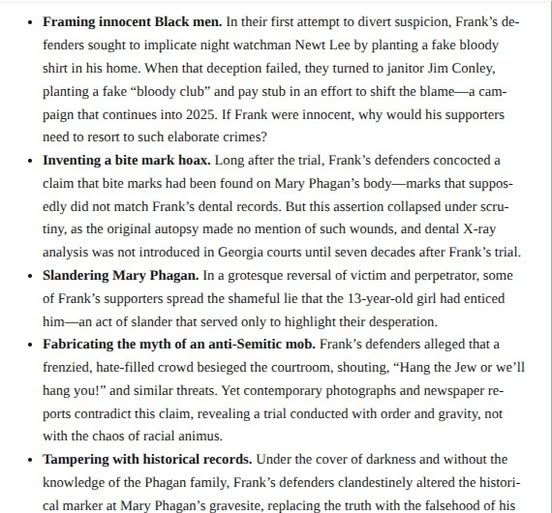
Leo Frank's defense case is the most racist trial I've ever researched and possibly in history. In fact, the defense found the point of view too racist for an all-white jury in the South during Jim Crow. They've claimed for 110 years that the entire case against Frank, the trial, and the conviction were the result of discrimination against Leo Frank.
"Who is Conley? Who was Conley as he used to be and as you have seen him? He was a dirty, filthy, black drunken, lying nigger…Who was it that made this dirty nigger come up here looking so slick? Why didn’t they let you see him as he was?” (5) What could be better calculated to alienate a jury of twelve ordinary decent people?"
Key Dynamics of the Leo Frank Defense Strategy
Legal counsel for Leo Frank tried to paint Conley as a dangerous departure from historical racial norms of the post-Civil War South, arguing that a man of his character and background was capable of committing the murder and shifting the blame.
Prosecutor Hugh Dorsey countered by framing Conley through familiar Southern racial tropes of the "old negro", drawing on minstrel and plantation stereotypes. Dorsey's strategy relied on the racial prejudices of the 1900s Georgia jury, suggesting that Conley lacked the intelligence or capability to fabricate such a detailed account on his own.
The jury ultimately chose to believe the prosecutor's case and Conley's testimony, which accused Frank of the murder of 13-year-old Mary Phagan.
"Just as his lawyer undoubtedly alienated the jury, so too did Frank’s many wealthy Jewish supporters alienate large tranches of the public by persistently playing “the race card”, and drew comments like: “Are we to understand that anybody except a Jew can be punished for crime?” and “It is a bad state of affairs when the idea gets abroad that the law is too weak to punish a man who has plenty of money"
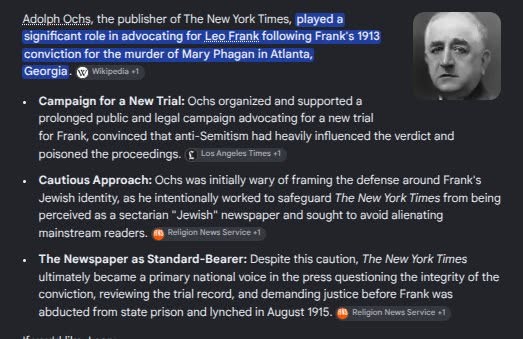
Unsupported claims from the ADL and publisher of the New York Times, Adolph Ochs:
"Following the lynching, leaders of the Knights of Mary Phagan gathered at Stone Mountain, burned a cross, and formally ignited the second rise of the Ku Klux Klan. The bitter controversy surrounding the case also catalyzed the growth of the Anti-Defamation League (ADL), which had been founded in response to the rising antisemitism of the trial. Decades later, modern historical consensus and a posthumous state pardon in 1986 recognized that Frank was innocent."
"No one was more convinced of Frank’s innocence than Adolph Ochs, publisher of the New York Times, and his conviction, no matter how well-intentioned, led to journalistic excesses. Ochs turned the paper of record into a pro-Frank propaganda machine. It printed hundreds of stories that played up facts in his favor. How biased was the Times? Researchers examining recently located files in the paper’s archives discovered a trove of photographs of the Phagan crime scene in which models reenacted the murder in a sequence staged to establish Conley’s guilt.
Factual history about the South and case:
While official records claim there was a period of Klan dormancy following the Enforcement Acts and federal prosecutions in 1871–1872. However, racial terror against Black people in the South peaked during this exact period through "unorganized" (Always suspiciously careful to say unorganized) white mobs, vigilante groups, and state-sanctioned Jim Crow violence. The federal government's official declarations and claims mean nothing when anti-Black racism and racial terror climbed to an all-time high. That is especially true today and in hindsight. Records from the Tuskegee Institute show that from 1890 through 1913, a shocking 2,142 Black individuals were recorded as lynched in the South.
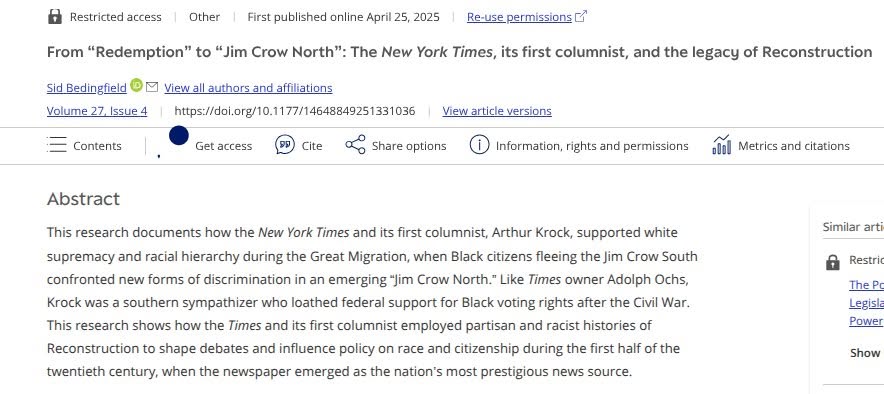
Truth matters. The Mary Phagan case and the Leo Frank conviction and death sentence, overturn, and then lynching by an angry mob was the result of the death sentence being overturned. The effort to rewrite the facts and history started with Adolph Ochs, who purchased the New York Times in 1897. Ochs also played a leading role in years of the New York Times promoting segregation in the North, anti-Black racism, and warning of race wars. The so-called ”Knights of Mary Phagan” also originated from the NYT.
"One might also ask the rather obvious question, “Cui bono?” The ADL and other Jews continued their agitation, and in March 1986 Frank was pardoned. (20) Whatever, the claims – echoed by the ADL and its fellow travellers to this very day – that the trial of Leo Frank was a calculated exercise in racial bigotry contain not a grain of truth, but this is hardly surprising, because the ADL’s prestigious reputation has been manufactured largely by the ADL itself.
For many years the ADL’s remit has stretched way beyond combating “anti-Semitism”, which in any meaningful sense has long since ceased to exist in contemporary America, and has ended up poking its unwanted proboscis into the activities of bona fide political and campaigning organizations for the overt purpose of political and racial gerrymandering.
"When studying the historical relationship between Blacks and Jews, we find that the 1913-1915 Leo Frank case is a turning point—a watershed moment. It is claimed that Leo Frank’s lynching caused Jews to feel more sympathy for the oppressed condition of Blacks in America. They say it compelled Jews to join the Civil Rights Movement and caused them to form the Anti-Defamation League of B’nai B’rith (ADL). They say it led to the rebirth of the Ku Klux Klan as an “anti-Jewish” organization.
In fact, none of that is true. But what IS true is that the Leo Frank case is the first use of “Black anti-Semitism” as a Jewish battle cry, and it marks the beginning of a hundred-year campaign by Jewish leaders to aggressively control and curtail Black progress. Jews insist that Blacks ignore the lengthy history of Blacks and Jews before the case and begin our relationship with them at the moment of Frank’s lynching in 1915—when we presumably were “united” in this tragedy. And if you examine the literature on the Black–Jewish relationship, it most often begins right at the very point of the Leo Frank case—as if nothing of historical significance preceded it.
Also, Leo Frank was not of the rank-and-file Jewish citizenry. As the B’nai B’rith president, he was arguably the most important Jew in the South. Jews considered him as having, in effect, diplomatic immunity within the white rulership of the Jim Crow South, so his arrest, trial, and conviction shocked, offended, and activated Jews at the highest level. And they have sought to exonerate Frank ever since, but at Black people’s expense." See less