Further to the earlier posts on this important market for the economy, finance, and politics:
The global bond market rout shows no signs of slowing.
The UK remains at the center of the selloff, as the 10-year yield surges to 5.07%.
#economy#markets#bonds#middleeastwar
@MebFaber@MorganStanley Sure, but in 2000 gold was at the low point of a 20 year bear market vs the peak of the TMT bubble. Today gold is not at the end of a 20 year bear market however you look at it.
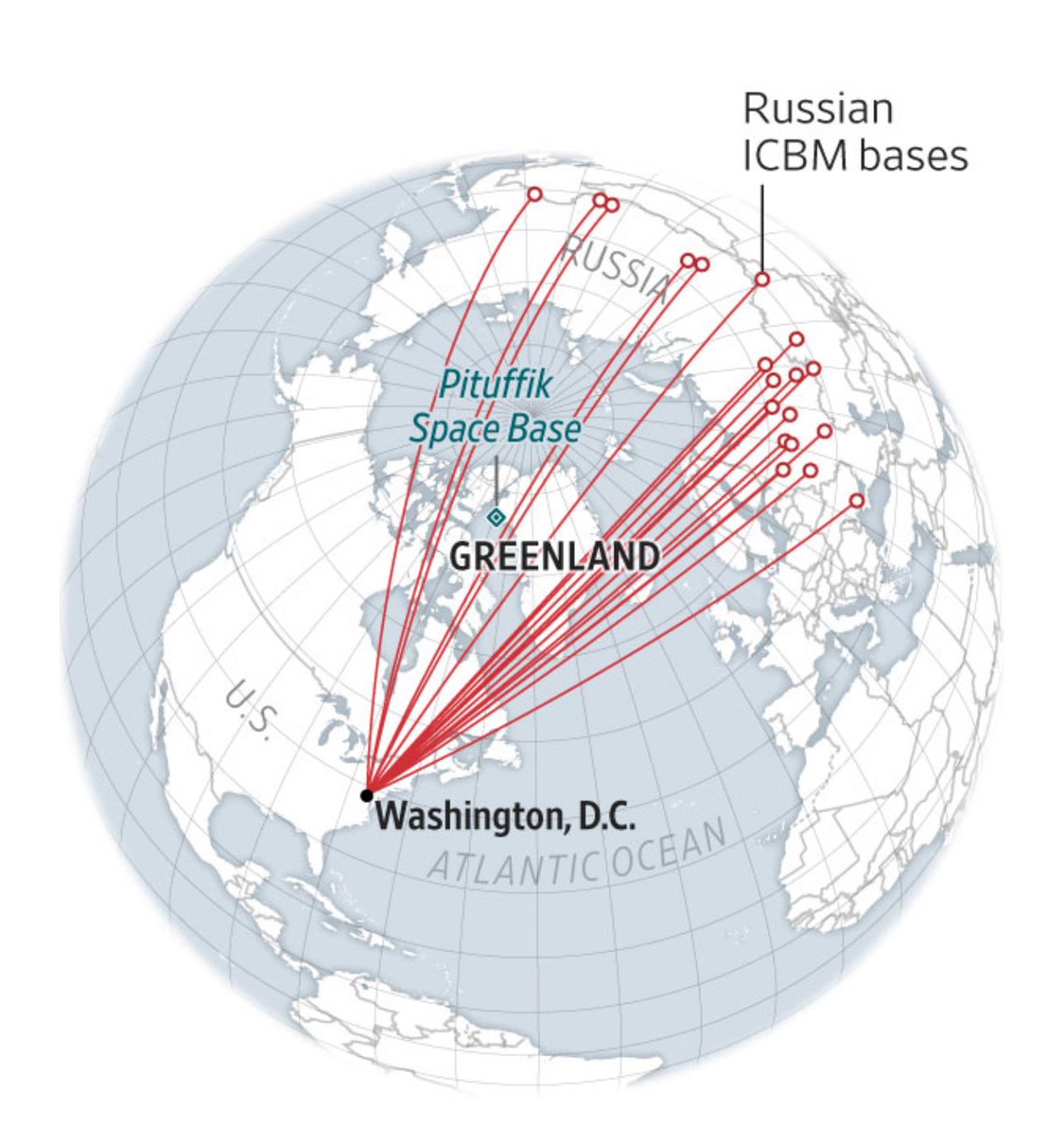
One reason Greenland is strategically important to the US is in fact twofold:
1. It’s the best place to set up anti-missile defenses to intercept ICBMs coming from Russia / China
2. It’s a very good place to set up offensive missile capabilities to threaten Russia / China
The WSJ had a good graphic out a few days ago showing the trajectory of missiles from ICBM sites around Russia to the US would fly overhead or near Greenland, which also happens to be almost directly beneath where those missiles would reach their highest points (“apogee”) which is when they are most vulnerable to interception because they are traveling at their slowest speeds.
If you throw a ball into the air you’ll see the same effect - the ball is slowest at its highest point.
And for an intelligently guided missile capable of trying to evade interception, you have an even better chance to shoot it down from a point directly beneath it since that is the closest path to the missile (i.e. least amount of warning time for the missile to realize an interceptor is coming).
This above is all courtesy of our resident rocket scientist Phil.
The US already has the right to dot Greenland with military installations, and I imagine that extends to intercepting ICBMs. Though Europe might object for some purposes.
🚨🚨Wow. A bombshell moment.
Ed Miliband has just released the price that you're going to pay for offshore wind for the next twenty years.
£95/MWh in 2025 prices. The highest offshore wind price in a decade.
Ed will try to spin that this is cheap. It is not.
Gas power without a Carbon Tax is under £55.
Average electricity price last year (including the Carbon Tax) was roughly £80.
And that £95 for wind is just what we pay for the wind power itself. On top, you also have to pay for all the extra grid, paying wind farms to switch off, and having a very expensive backup power station on standby for a cold, windless day like we had just last week.
And to try and sweeten the deal for the wind developers, Ed has extended the contracts so we're now going to be locked into these prices for TWENTY YEARS.
By DESNZ’s own numbers the contract extension is worth 12% of the strike price to the wind developers, so a true comparison with last year's £82/MWh would be £102/MWh. Wind is getting significantly more expensive, not cheaper.
Ed is locking us into a 10% fixed-rate mortgage because he doesn’t want the volatility of being on a 4% variable.
He is cementing our uncompetitive electricity prices for even longer at a time when the world is becoming more unstable and we need cheap, reliable energy to compete.
Labour promised to cut your bills by £300. This was how Ed Miliband said he was going to do it.
But it has never been clearer that he cares more about his own clean power vanity project than he does about your energy bill.
If had the ear @JDVance@realDonaldTrump@DonaldJTrumpJr@GovRonDeSantis@LeaderJohnThune, I would ask them to take a trillion dollars (since trillions just get thrown around like millions now) and bypass all the protests and regulations and dot the whole country with small nuclear reactors, while also building a brand-new, state-of-the-art grid for everyone. Do this as soon as possible and secure it all from attack with the latest physical and cybersecurity; maybe even create a special Nuclear Defense Force that protects each facility, funded federally.
This is the only hope of getting enough power to keep up with China, and it is the only hope we have as a country to grow enough to ultimately pay off our debt and guarantee long-term security, by not letting power be a limiting factor on our innovation.
@elerianm When the breakout comes the chart suggests it will go vertical. There is a non-insignificant risk of an emergency budget, Bailey re-launching QE at scale, financial repression etc. The only question now appears to be timing.
@VisualCap@StatistaCharts@VoronoiApp An observation: since most people aren’t addicted to opioids the mortality rate for those users must be orders of magnitude higher. Similarly if you don’t use them, far lower.
Ofc, counter-factuals like this don't exist in reality. One may as well argue what GDP or productivity *might* have been projected 15 years into the future *if* Covid hadn't happened or the Banks hadn't gone bust in 2008. It's a pointless exercise.
The UK/EU reset has reignited the claim in much of the media that Britain’s GDP is 4% lower than it would have been but for Brexit, citing the Office for Budget Responsibility (OBR). It was just cited yet again on @GMB Good Morning Britain, as it has all over the place.
But it is not what the OBR said. Since March 2020 the OBR has argued that Brexit will reduce the UK’s long-run potential productivity by approximately 4%. It is not an estimate of an immediate or annual GDP loss — much less one that has already happened — but a long-term reduction in the economy’s productive capacity which will take OVER 15 YEARS to materialize fully.
The OBR argues this on the well-founded economic basis that free trade boosts productivity and trade barriers reduce it over time. Hence the potential long-term hit to GDP because, even with the EU/UK free trade agreement there will be more trade barriers than before.
At no stage does the OBR claim Brexit is a direct 4% annual GDP loss — as the media so often repeats — but a lower growth trajectory over time i/e GDP could be 4% lower than otherwise by 2035.
The OBR projection is based on an assumption of a 15% reduction in trade intensity (exports plus imports as a share of GDP) over time. If that proves pessimistic, the 4% projection will be too high. If optimistic, too low
I want this absurd assertion on my timeline so I can come back to it after the ONS food prices have indeed shown 4 years of negative inflation by 2029.
#Starmer#Brexit#Inflation#UKfood
@DKellerCMT My question now would be why isn't this (technically) similar to the bounce which ended in March '22 or even the one in August '22? Just before the next legs down respectively. (disclosure:- I've now closed longs awaiting a reaction).
@MikeZaccardi For now. You have to ask yourself what happens as the closes from Oct/Nov/Dec roll out of the 200 ma in a rolling 200 days and where that means current prices need to break above. They are all above the current 200ma so that gives you an indication.