Give a computer data, you feed it for a millisecond, teach a computer to search data, you feed it for a millennium. #People1st#EveryoneAI#AI#DeepLearning
Something is very suspicious about the timing of Jensen Huang’s resignation from Nvidia. Why did it take so long for his affair with an alleged Chinese spy to gain traction?
Six months ago, a tiny Brooklyn short-selling shop called Culper Research published a 40-page report laying out the China angle. With zero Wall Street connections, it tracked chips flowing through Singapore and Malaysia to Megaspeed and printed photos of Jensen and Alice together.
But nobody cared. Nvidia’s stock went up.
Even crazier, our own government has known about this since 2025 and Marco Rubio’s office circulated a classified spy memo this spring.
Then suddenly, right on top of the midterms, the story finally became mainstream. The New York Times dropped it on October 29, forcing Jensen to admit to an affair on November 8.
Only then did Nvidia’s board open an investigation.
Then yesterday, the Times struck again with a second affair report involving Nvidia’s VP of healthcare, accelerating the board’s push to oust him right before today’s resignation.
Meanwhile, short sellers had already loaded up on protection for over a week before the stock crashed.
And this is all conveniently coming up the week Anthropic is launching its massive IPO roadshow.
Anthropic and OpenAI make their money keeping AI locked down in centralized, closed models you have to rent by the minute. Meanwhile, Jensen Huang was a loud champion for open-source AI, building the chips so everyday people could run AI on their own computers.
And of course, the Democrats just took power in Congress and many states. And they’re not exactly friendly to AI expansion.
So once again: why is all of this happening right now?
I have a major result to share.
I’ve found conclusive forensic evidence that the top 4 Chinese AI labs—DeepSeek, Moonshot, MiniMax and Ant Group—have built their newest models on NVIDIA’s most advanced Blackwell chips, which are barred from export to China.
This sounds insane, but I discovered that almost every AI model carries a hidden signature of the GPU that trained it. When a model is first set up, the starting values of its weights are laid out in a pattern that depends on the exact GPU. Each combination of GPU and seed number produces a unique pattern—a sort of fingerprint of the hardware used to create the model. Traces of that pattern survive training into the published model.
Again, this evidence isn’t based on any insider information or leaking. It’s based on a forensic analysis of the model weights released by the companies themselves.
I searched more than six trillion combinations of chip layout and seed number and matched them to open-weights models. In doing so, I found conclusive evidence that six Chinese AI models—including DeepSeek-V4-Pro, Kimi K3, and MiniMax-M3—were initialized on NVIDIA Blackwell systems. Four of the models match Grace Blackwell, the GB200 and GB300 parts in NVIDIA’s flagship liquid-cooled rack-scale systems.
I then verified these results on real hardware. Running unmodified PyTorch with the seeds I’d recovered, a Blackwell B300 reproduced DeepSeek-V4-Flash’s untouched starting weights bit for bit, and a rented GB200 reproduced Kimi K3’s to a correlation of 0.999995. A Hopper H100 reproduced none of DeepSeek-V4-Flash’s, and changing the seed by one broke the match. (DeepSeek’s seed is 953049583 by the way.) The method also was verified to match 24 known open-weights models to the hardware that developers said they used.
It is exceedingly unlikely that these results are a coincidence. Across six trillion combinations, the best accidental match should reach only about 8 sigma (i.e., eight standard deviations above what random chance would produce). The real matches range from 49 to 1,385 sigma, and even the weakest single test hits 20.
These were data-center-scale training runs. With some analysis of release schedules and model details, I estimate that the largest, Kimi K3 and DeepSeek-V4-Pro, used 2,000 to 3,000 Blackwell GPUs each. Clusters of this size cost on the order of $150 to $200 million each to buy, and across these labs alone would add up to more than half a billion dollars of export-controlled GPUs, not counting experimental compute or otherwise. It’s quite likely that we see multi-billion dollar expenditure on export-controlled GPUs.
I am highly confident in this result, and it has been independently verified by senior researchers at OpenAI and Anthropic. You can read the full report at https://t.co/YOtzND0Jqk.
There is much more I’ve identified about these models through other forms of checkpoint forensics like this, and will have more to share soon.
Qwen4 is coming.
Deeper knowledge. Richer world understanding. Stronger coding and agentic capabilities.
Built for real-world tasks — from complex coding and knowledge work to front-end builds and professional software workflows.
Qwen4-Max is now in preview on Alibaba’s Token Plan. You can also get early access to the new model on QwenWork, Qoder, Qwen APP, and QwenStudio.
Put it to the test on a real problem. Show us what you build. 👀
Token Plan: https://t.co/LOB2Jdt3Sk
this PDF is a f*cking cheat code for anyone running coding agents
Diogo Almeida, founder of Jev and co-author of InstructGPT, published a PDF on building a Jev harness
the promise:
> up to 200x faster
> up to 400x cheaper
the speed and the cost both live in the harness around the model
how to use it:
> drop the PDF and the article below into Claude Code or Codex
> let it rebuild its own setup
one evening of work, and your agent runs on a harness few teams have 👇
Qwen3.8-27B may soon become a much more practical local model for people using NVIDIA GPUs with 16GB of VRAM.
The interesting part is that this isn’t another attempt to squeeze the model into memory by pushing it down to an extremely aggressive Q2 quantisation.
A new inference setup is in development that aims to support Qwen3.8-27B on 16GB NVIDIA cards while retaining features that are usually expensive in terms of memory.
The planned support includes:
Qwen3.8-27B
Large context windows
MTP speculative decoding
Linux and Windows
Potentially supported hardware includes the RTX 5060 Ti 16GB, RTX 5070 Ti 16GB, RTX 5080 16GB and older NVIDIA cards with 16GB of VRAM.
Why fitting everything matters
The model weights are only part of the memory requirement.
As context grows, the KV cache also consumes more VRAM because the engine must retain information from previous tokens for subsequent attention operations.
Multimodal components introduce additional memory requirements, while MTP speculative decoding needs resources for its draft and verification process.
These components compete for the same limited GPU memory.
That is why getting a 27B model running on 16GB is one thing, but supporting large context windows and MTP without sacrificing too much quantisation quality is a different challenge.
The real engineering work is in how the inference engine manages memory, moves data and schedules computation across the available hardware.
What this could mean for 16GB GPU owners
If the setup delivers on its planned capabilities, users may be able to run a more capable local model without immediately upgrading to a 24GB or 32GB GPU.
It could also make local agent workflows more accessible, particularly if MTP provides useful generation-speed improvements on these configurations.
There are still details worth waiting for: the actual quantisation format, usable context limits, memory consumption, sustained token generation speed and benchmark results.
Support for Linux and Windows is another useful part of the plan, since it gives users on both platforms a route to the same inference setup.
The release is still coming, so these capabilities should be treated as planned rather than independently verified results.
I like this direction of local AI development. Hardware upgrades aren’t the only way to improve inference. Better quantisation, memory management and specialised kernels can make existing GPUs considerably more useful.
This is f*cking insane.
Chinese researchers just dropped a paper with a title that will make every agent framework nervous: "The End of Harness Engineering".
The argument fits in one line: writing the program around the model is finished as a skill.
A harness written by a human is one person's guess about one task on one afternoon. It ships, nobody re-reads it, nobody scores it, and the agent runs that guess for months.
A harness written by the loop is a file that grades itself. A small 4B model reads what failed, writes 8 edits, and only the edit that scores best on held-out questions survives.
The big model never changes. The file around it does, every round.
So the human job collapses to one artifact: the scoring set. You write the questions, never the program.
Frameworks turn disposable. The exam turns into the job.
That is the exact loop I built and documented below: one https://t.co/JlQQhqH44N, 300 Kimi K3 workers, 37 rewrites in 41 rounds, zero opened by me.
The whole paper in one line: write the exam before the code ↓
We've been working hard on making the Claude Code desktop app great for running lots of sessions side by side.
It's now much quicker to start sessions, easier to split work across a few, and you can always see what each of them is doing. Here’s what's new:
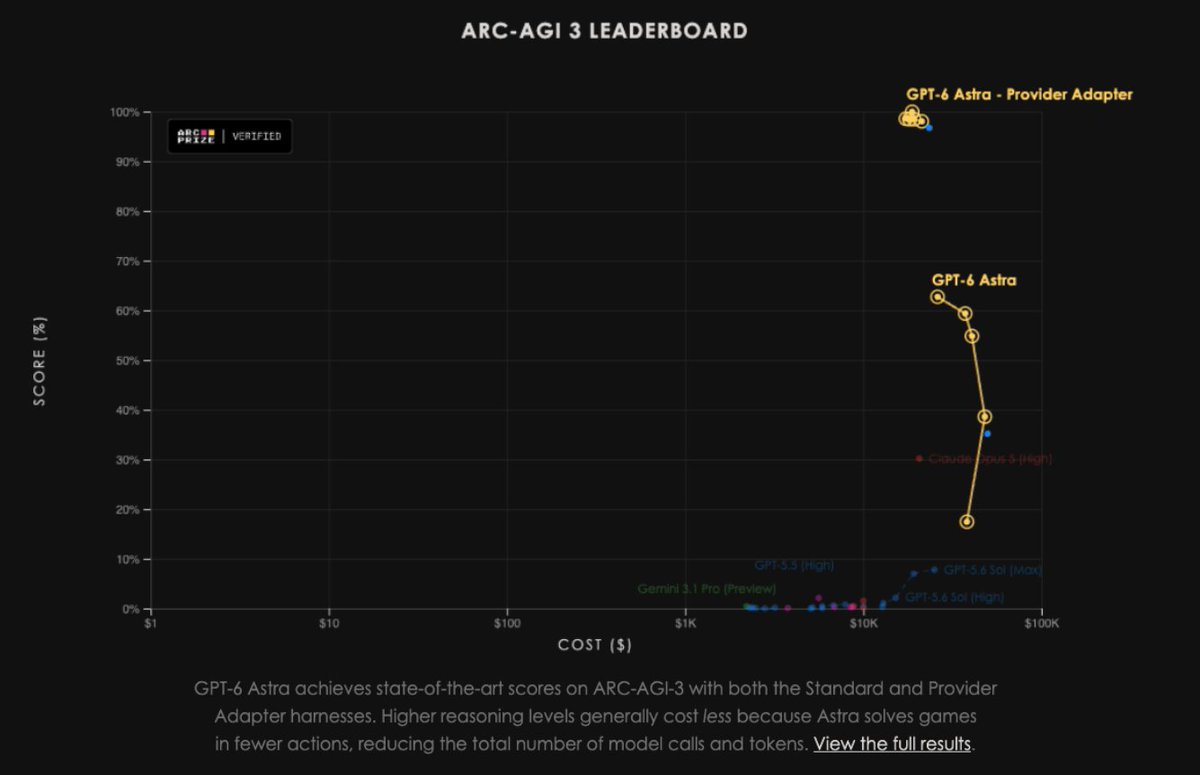
GPT-6 Astra represents a step-function change in model capability for interactive reasoning problems. It scores 66% on ARC-AGI-3 using our standard harness, and nearly 100% with a continuous conversation harness and custom compaction, at a cost of roughly $360 per game.
In fact, the continuous harness version significantly outperforms our human baseline in action efficiency across almost all levels. When we examined the reasoning chains to understand how the model operates, we found it performing highly efficient, on-the-fly symbolic world modeling for each game and level. It goes as far as developing its own shorthand DSL to represent in-game situations -- essentially a game-specific algebraic notation.
Overall, Astra exhibits symbolic modeling behaviors we had previously only seen with sophisticated harnesses -- so harness capabilities are increasingly shifting into the model itself.
We see Astra as a major breakthrough in model intelligence.
Read our post on Astra and what these results mean: https://t.co/wJnYxEqYNI
since you guys loved the exploding tesla..
I used GPT-6 Astra to create a 3D website that pulls apart the male anatomy into 2,234 modeled pieces!
we are in a renaissance of learning
I had early access to GPT-6. This model will completely shatter your understanding of what's possible, and it will start a new era of creativity.
It's hard to explain how big of a jump this is, so I'll share my tests.
1/6 Made this 3D model and animation in code from an image.
GPT-6 Astra by @OpenAI achieves SOTA on ARC-AGI:
- Astra scores 63% on ARC-AGI-3, 99% via a new provider adapter harness
- It surpasses human performance on 96% of ARC-AGI-3 levels
- It builds the most precise symbolic model of novel environments we've seen
Our analysis:
Anthropic’s Head of AI Lab:
"At Anthropic, 80% of our engineers are running self-improving agentic loops. Graphs next for agents.
in last 3 months, our team has started building Graphs for multi-agent orchestration. No more prompting."
in 1-hour podcast Head of Anthropic Lab reveal the latest internal setup for Claude code.
Worth more than $500 agentic course.
Watch it today, then read how to become a Graph Engineer in the article below.