if @elonmusk paid 100% of his net worth ($1.4 trillion) as a tax it would only cover federal government spending for 77 days. this isn’t a tax problem…
they’re not jobs if they’re not valued. they’re not valued if there aren’t customers out there willing to pay them for their great work. needing the government to “create” a job is tantamount to welfare and that level of welfare resolves these individuals to a dependency on the government and lack of economic mobility. and chains our people, collectively, to a more indentured future.
you may be well intentioned but you have, and always will, fail to see the destitute folly of government as a job creation engine.
i have tried to engage you on this topic, in good faith, with empiricism and reasoning, but you have only dodged my points and pivoted to some populist refrain about the importance of taxation and the evils of productivity-driven success.
i can only assume you’re dodging these truths because you and the rest of the politburo leadership have deemed the conversation unsafe speech and put your oligopoly at risk.
let’s leave it at that then.
perhaps if your ways get their day, we can all bask in the glories of the dark ages ahead.
Oh yes, I remember that Bond film where the villain decarbonized the auto industry, brought fast internet to everyone on the planet, and helped paralyzed people interact with the world again.
>Be Elon
>Get bullied so badly as a kid that you end up in the hospital
>Escape into books
>Read more than 8hrs a day
>Teach yourself programming
>Sell a video game at 12
>Leave South Africa
>Sleep on couches
>Work odd jobs
>Get into America
>Build a startup
>Get fired from your own company
>Start over
>Build another company
>Merge it into PayPal
>Get removed as CEO
>Your company gets acquired
>Walk away with nearly $180 million
>Instead of retiring at 31, put almost all of it into three impossible ideas: Electric cars, Solar energy, Rockets
>People tell you you're insane
>Start a rocket company with no aerospace degree
>Learn rocket science from textbooks
>First rocket fails
>Second rocket fails
>Third rocket fails
>Divorce
>Public humiliation
>Cash running out
>One launch away from bankruptcy
>Launch anyway
>The fourth rocket reaches orbit
>NASA signs a contract
>Survive
>Tesla is weeks from collapse
>Save it at the last minute
>Get mocked for wanting reusable rockets.
>Land one.
>Then another.
>Then dozens.
>Turn science fiction into engineering
>Get mocked for betting on EVs
>Turn electric cars into status symbols
>Force the entire auto industry to follow
>Build the most valuable car company in history
>Launch astronauts into orbit
>Create a global satellite internet network.
>Buy Twitter
>Fire most of the staff
>Rename it X
>Walk into politics
>Risk your reputation
>Risk your companies
>Risk your fortune
>Become one of the most polarising people on Earth.
>Get attacked by the media, politicians, competitors, and activists
>Keep building anyway
>Become a TRILLIONAIRE
men look at the accomplishments of great men in awe. they feel proud, inspired, and want to be great as well. parasites rub their greedy little insect hands together and say "that's mine." ro khanna is a parasite.
Abolishing private property in 2 easy steps
Step 1 - Rent control: Rent is lower than costs and taxes so you can't do maintenance.
Step 2 - Seizure: You don't have the money to do maintenance and the state uses it as an excuse to take your property.
As a young socialist, Hayek read Ludwig von Mises’ 1920 paper “Economic Calculation in the Socialist Commonwealth.”
Mises showed that socialist central planning isn’t merely inefficient, it’s impossible.
Without private property and genuine market prices, planners lack any rational way to allocate scarce resources or determine real costs and needs.
Even Oskar Lange, a leading socialist in the calculation debate, effectively conceded the point.
While he promoted “market socialism” with trial-and-error pricing by a central board, real-world socialist planners in Eastern Europe quietly relied on world capitalist market prices as a guide.
Without external free-market price signals, pure socialism would be economically blind and coordination would collapse.
Mises went further, arguing that interventionism, the “middle way” of government meddling, is inherently unstable.
Each intervention creates problems that invite more interventions, eventually leading to full socialization.
Price controls cause shortages, subsidies distort production, and the cycle continues until the economy is fully planned.
The lesson is clear.
Rational economics requires genuine market prices emerging from voluntary exchange and private property.
Half-measures don’t stabilize the system. They accelerate the drift into central planning.
The Austrian School understood this decades before the collapse of the Soviet bloc proved it in practice.
Dans le manifeste "techno-optimiste" de Marc Andreessen, il y a une phrase qui m'a marqué :
"Our enemies are not bad people – but rather bad ideas."
Nos ennemis ne sont pas des mauvaises personnes. Ce sont des mauvaises idées.
Prenons Jancovici. L'homme est brillant, sincère, travailleur. Il ne se lève pas le matin en se disant qu'il va nuire à l'humanité. Mais l'idée qu'il porte la décroissance, le rationnement, la frugalité érigée en horizon civilisationnel est une idée profondément destructrice. Elle prend des esprits brillants et les transforme en commissaires politiques d'un futur appauvri.
Et le plus fascinant, c'est ce que cette idée fait aux gens qui l'adoptent.
Dans mon entourage, une grosse partie de mes amis est sur cette ligne décroissantiste, avec tout le package qui va avec. L'argent c'est mal mais ils en veulent. Il faut moins prendre l'avion mais ils rêvent de voyager partout. Il faut consommer moins mais ils ne renoncent à rien de ce qu'ils aiment vraiment.
Et tous ont un point commun : ils sont déprimés. L'un d'eux m'a même confié qu'il était sous antidépresseurs.
Ce n'est pas un hasard. C'est mécanique.
Quand tu crois que ton désir de vivre, de créer, de t'élever est moralement suspect tu te détruis de l'intérieur. Tu passes ta vie à t'excuser d'exister. Tu vis dans la dissonance permanente entre ce que ton corps veut (plus, mieux, plus loin) et ce que ton idéologie t'ordonne (moins, sobre, immobile).
D'où ma théorie :
Quand on pense quelque chose de fondamentalement faux décroissance, communisme, extrémisme religieux (de tout ordre) ce n'est qu'une question de temps avant que ça devienne vraiment destructeur.
D'abord pour soi. Puis pour les autres.
Les mauvaises idées tuent. Lentement chez ceux qui y croient, brutalement chez ceux qui les subissent.
C'est pour ça que la bataille des idées n'est pas un luxe d'intellectuel. C'est la bataille la plus importante de notre époque.
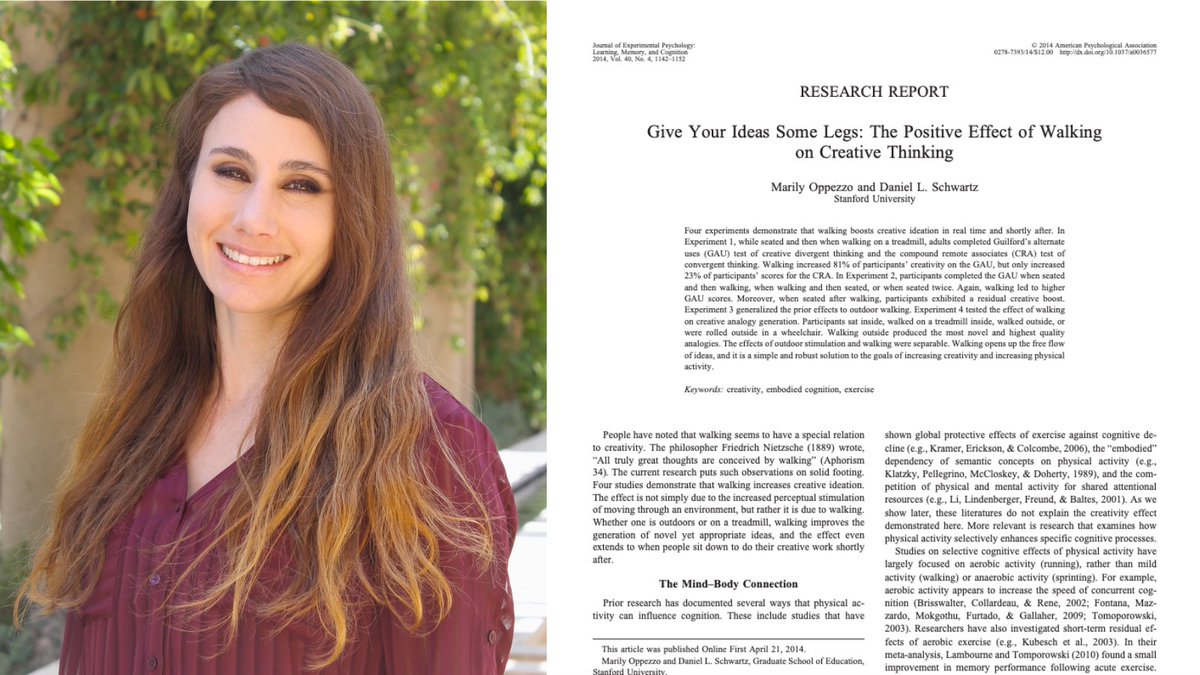
A Stanford psychologist spent 4 years proving that the simple act of walking generates 60% more creative ideas than sitting, and the experiment she designed to kill every alternative explanation is one of the most decisive findings in modern psychology.
Her name is Marily Oppezzo.
She got the idea for the study while walking with her advisor at Stanford to discuss her thesis topic, and the paper she eventually published in the Journal of Experimental Psychology in 2014 is sharp enough that it should have ended the seated meeting on the day it came out.
She ran 4 experiments on 176 people. Same person tested twice. Once sitting, once walking. The creativity tasks were the standard ones psychologists have used for decades to measure how good a brain is at generating novel useful ideas.
The result was almost too clean to publish.
81% of participants in the first experiment produced more creative ideas while walking than while sitting. In the second experiment, 88%. In the third, 100%. Every single person walked into a more creative version of themselves.
On average, people generated 60% more novel useful ideas the moment their legs started moving.
The skeptical question is the obvious one. Maybe it was the fresh air. Maybe it was the scenery passing by. Maybe it was the change of environment doing the work, not the walking itself.
Oppezzo killed every one of those explanations with one experimental decision.
She put people on a treadmill facing a blank wall. No scenery. No fresh air. No environmental change. Just legs moving in place while staring at white drywall. The 60% boost held.
Then she ran the experiment that closed the case completely. She took participants outside in two conditions. Half of them walked through a Stanford courtyard. The other half were pushed through the exact same courtyard in a wheelchair. Same outdoor stimulation. Same scenery passing at the same speed. The only difference was whether the legs were moving.
The walkers produced dramatically more novel high-quality ideas than the wheelchair group. The outdoors did almost nothing on its own. The walking did everything.
This is the part of the study that hit hardest when I read it the first time.
She also tested the opposite kind of thinking. Convergent thinking. The kind where there is one right answer and you have to narrow down to it.
Word puzzles where 3 words share a hidden fourth word that connects them. The seated participants did slightly better on these. Walkers got slightly worse.
Walking is not a general intelligence enhancer. It does one specific thing. It opens up the divergent search inside your brain. The part that generates options. The part that produces unexpected connections. The part that takes a problem and finds five ways into it instead of one.
When you need to converge on the single right answer, sit down. When you need to find the answer in the first place, get up.
The mechanism is now well understood. Walking selectively activates what neuroscientists call the default mode network, the system inside your brain that runs when you are not consciously focused on anything. The DMN is where mind-wandering happens. Where memories cross-reference each other. Where ideas that have been sitting in separate folders inside your head finally bump into each other.
When you sit at a desk and force yourself to concentrate, you suppress the DMN. When you walk at a natural pace, the executive part of your brain gets just busy enough handling the walking that the DMN comes online and starts doing the work that focus was blocking.
The most useful finding in the entire paper is the one almost nobody quotes.
The boost did not turn off the moment people stopped walking. Participants who walked first and then sat back down stayed elevated. Their next round of seated creativity work was still significantly better than people who had been sitting the whole time. The rest lingered for at least several minutes after the legs stopped moving.
You do not need to do creative work while walking. You need to walk before the creative work. The brain holds the state.
The history of this is the part that should haunt anyone who still does meetings in chairs.
Charles Darwin built a gravel loop behind his house in Kent called the Sandwalk and walked it 3 times a day for the rest of his life. The theory of evolution was developed one lap at a time on that path.
Nietzsche walked up to 10 hours a day during the years he wrote his most important books and openly said the work was conceived on his feet.
Beethoven composed for the morning and walked for 5 hours every afternoon with a pencil in his pocket for when something landed.
Kahneman said the best thinking of his Nobel Prize-winning career happened on leisurely walks with Amos Tversky. Steve Jobs refused to take important conversations sitting down. He held them on foot.
Every one of them was using the system Oppezzo would not measure until 2014. They just did not know what to call it.
The question worth sitting with is the one almost nobody asks.
Every meeting you have ever attended sitting around a table was a meeting held at a fraction of the brain power that was actually available to the people in the room. Every brainstorm that got stuck inside a conference room. Every problem you tried to solve at a desk and gave up on. Every idea you could not quite get to.
The intervention is the easiest one in modern science. No supplement. No app. No subscription. No training program. Just a pair of legs and 15 minutes.
The Stanford lab proved it. The philosophers knew it. The neuroscience explains it.
And almost everyone reading this is still trying to think their way out of problems sitting completely still.
Bezos went on CNBC yesterday and said "You could double the taxes I pay and it's not gonna help that teacher in Queens."
And all the bureaucrats and socialists lost their minds.
Promise the teacher a raise. Tax everyone. Launder the money through Washington. Then blame the billionaire. We aren't morons Ro, we've seen this before.
Bezos said the bottom half of earners should pay zero federal income tax.
A nurse in Queens making $75K hands the IRS $12K a year. He said cut it to zero. She keeps her full paycheck. No bs refund, paperwork or shady government program.
Simple.
They won't do it. And you should ask yourself why.
They don't ACTUALLY want to help anyone. They just want to pretend they tried and get your votes while making you hate the ppl they scammed.
They want the money to flow through Washington, the city, every ponzi department and consultant and charity so each one can wet their beak.
By the time it reaches the teacher it's maybe $100, if that...
And then they'll blame the billionaire who hasn't paid their "fair share." Right Warren???
Lets take a gander at Mamdani's education budget.
NYC spends $42K per student per year, 3x the national average ($15K). Highest in America. Florida pays $9K.
NYC spends more per pupil than most people pay for private school or college. Its frickn insane.
The budget has gone up every year, enrollment has gone down. With all that money only 3 out of 10 kids can read in the 8th grade. Cuba can read better english and they speak spanish lol.
So where is the money going? Def not to teachers. but shh, ro doesn't want you to know that.
A starting teacher in NYC makes $65K. Mamdani's city spends $42K per kid, runs a $40B budget. You could pay every teacher six figures with that money and have 12 kids per a classroom. But thats too logical.
It goes to administrators. Consultants. Overtime. Unions. Friends and family businesses. Pensions for people who left a decade ago. Studies about studies. Buildings that take ten years to renovate. Everyone else but the kids, teachers and actual schools
THERE IS ENOUGH MONEY.
Politicians decide where the money goes. Teachers are underpaid because of how government spends money. Not because Bezos doesn't pay enough.
Then they stand outside a billionaire's apartment with a camera and tell you he's the problem.
That's the SCAM.
Ro Khanna says tax billionaires to fund $60K teacher salaries. NYC already spends enough to fund $100K teacher salaries. The money's there, Ro. Your people are the ones who won't give it to her.
Federal level is the same story. DOE spending up 649% since 2000 and kids aren't any smarter. GAO found $186 billion in improper payments last year. $3 trillion in errors since 2003. It’s criminal.
Stop taxing the nurse. No bureaucracy. Just let the woman keep her full paycheck.
Outrage is deflection.
They'd rather she pay.
Because her keeping her own money doesn't fund the machine and they lose the one thing that keeps the whole racket going: a billionaire to blame.
Zero out taxes for the bottom half of earners. A nurse in Queens shouldn’t be sending money to Washington. Washington should be sending her an apology.
We could get rid of 2/3rds of violent crime - make our cities safe, and eliminate thousands of horrid crimes like this - if we locked up twice convicted violent criminals for decades.
Easy choice to make for me.
Does your own daughter need to suffer before you’ll defend others?
A few good books worth reading:
- Atlas Shrugged by Ayn Rand - a classic that celebrates builders. Once you read it, you’ll notice the same characters and events taking place today.
- The Changing World Order by Ray Dalio - great for understanding how civilizations rise and fall and how crypto can help create better countries.
- From Third World to First by Lee Kuan Yu (founder of Singapore) - talks about building a new country, worth reading for understanding nation-building.
Because we get asked a lot.
The Technological Republic, in brief.
1. Silicon Valley owes a moral debt to the country that made its rise possible. The engineering elite of Silicon Valley has an affirmative obligation to participate in the defense of the nation.
2. We must rebel against the tyranny of the apps. Is the iPhone our greatest creative if not crowning achievement as a civilization? The object has changed our lives, but it may also now be limiting and constraining our sense of the possible.
3. Free email is not enough. The decadence of a culture or civilization, and indeed its ruling class, will be forgiven only if that culture is capable of delivering economic growth and security for the public.
4. The limits of soft power, of soaring rhetoric alone, have been exposed. The ability of free and democratic societies to prevail requires something more than moral appeal. It requires hard power, and hard power in this century will be built on software.
5. The question is not whether A.I. weapons will be built; it is who will build them and for what purpose. Our adversaries will not pause to indulge in theatrical debates about the merits of developing technologies with critical military and national security applications. They will proceed.
6. National service should be a universal duty. We should, as a society, seriously consider moving away from an all-volunteer force and only fight the next war if everyone shares in the risk and the cost.
7. If a U.S. Marine asks for a better rifle, we should build it; and the same goes for software. We should as a country be capable of continuing a debate about the appropriateness of military action abroad while remaining unflinching in our commitment to those we have asked to step into harm’s way.
8. Public servants need not be our priests. Any business that compensated its employees in the way that the federal government compensates public servants would struggle to survive.
9. We should show far more grace towards those who have subjected themselves to public life. The eradication of any space for forgiveness—a jettisoning of any tolerance for the complexities and contradictions of the human psyche—may leave us with a cast of characters at the helm we will grow to regret.
10. The psychologization of modern politics is leading us astray. Those who look to the political arena to nourish their soul and sense of self, who rely too heavily on their internal life finding expression in people they may never meet, will be left disappointed.
11. Our society has grown too eager to hasten, and is often gleeful at, the demise of its enemies. The vanquishing of an opponent is a moment to pause, not rejoice.
12. The atomic age is ending. One age of deterrence, the atomic age, is ending, and a new era of deterrence built on A.I. is set to begin.
13. No other country in the history of the world has advanced progressive values more than this one. The United States is far from perfect. But it is easy to forget how much more opportunity exists in this country for those who are not hereditary elites than in any other nation on the planet.
14. American power has made possible an extraordinarily long peace. Too many have forgotten or perhaps take for granted that nearly a century of some version of peace has prevailed in the world without a great power military conflict. At least three generations — billions of people and their children and now grandchildren — have never known a world war.
15. The postwar neutering of Germany and Japan must be undone. The defanging of Germany was an overcorrection for which Europe is now paying a heavy price. A similar and highly theatrical commitment to Japanese pacifism will, if maintained, also threaten to shift the balance of power in Asia.
16. We should applaud those who attempt to build where the market has failed to act. The culture almost snickers at Musk’s interest in grand narrative, as if billionaires ought to simply stay in their lane of enriching themselves . . . . Any curiosity or genuine interest in the value of what he has created is essentially dismissed, or perhaps lurks from beneath a thinly veiled scorn.
17. Silicon Valley must play a role in addressing violent crime. Many politicians across the United States have essentially shrugged when it comes to violent crime, abandoning any serious efforts to address the problem or take on any risk with their constituencies or donors in coming up with solutions and experiments in what should be a desperate bid to save lives.
18. The ruthless exposure of the private lives of public figures drives far too much talent away from government service. The public arena—and the shallow and petty assaults against those who dare to do something other than enrich themselves—has become so unforgiving that the republic is left with a significant roster of ineffectual, empty vessels whose ambition one would forgive if there were any genuine belief structure lurking within.
19. The caution in public life that we unwittingly encourage is corrosive. Those who say nothing wrong often say nothing much at all.
20. The pervasive intolerance of religious belief in certain circles must be resisted. The elite’s intolerance of religious belief is perhaps one of the most telling signs that its political project constitutes a less open intellectual movement than many within it would claim.
21. Some cultures have produced vital advances; others remain dysfunctional and regressive. All cultures are now equal. Criticism and value judgments are forbidden. Yet this new dogma glosses over the fact that certain cultures and indeed subcultures . . . have produced wonders. Others have proven middling, and worse, regressive and harmful.
22. We must resist the shallow temptation of a vacant and hollow pluralism. We, in America and more broadly the West, have for the past half century resisted defining national cultures in the name of inclusivity. But inclusion into what?
Excerpts from the #1 New York Times Bestseller The Technological Republic: Hard Power, Soft Belief, and the Future of the West, by Alexander C. Karp & Nicholas W. Zamiska
https://t.co/8igjazz1On
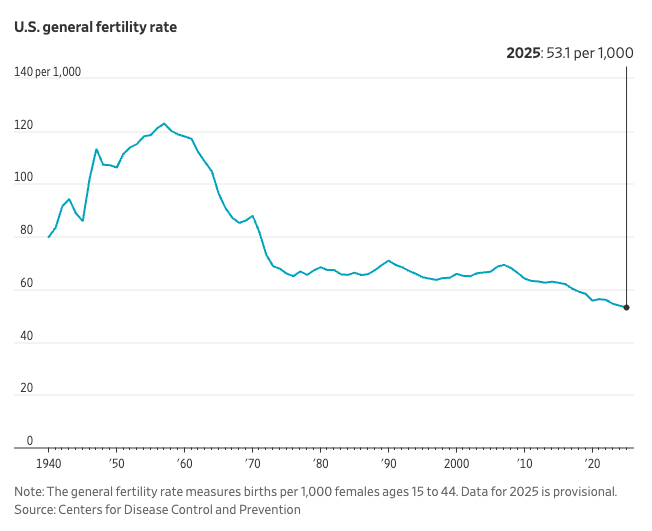
US fertility reached 1.57 last year, the lowest ever recorded, and the WSJ explanation is "uncertainty about finances, relationship stability, and the political climate"
my great grandma had eleven children during the second world war, in a country being bombed, in a house with no running water, on rations.
poor people have always had kids. the poorest people on earth right now still have kids and the financial excuse is a story we tell ourselves because it makes us feel good and the real one is unbearable
the real mechanism is that we got rich enough to redefine children as an expense instead of the point. somewhere in the last fifty years the cultural goal inverted and a child stopped being what life is for and became a line item competing with the lifestyle. once you frame it that way the math never works, because the math isnt supposed to work. that's the point
we are living in the richest moment in human history and we decided to use the surplus to buy ourselves out of the future. the most prosperous civilization that has ever existed is committing demographic suicide at the altar of personal optimization and comfort, and the official line is that we cant afford it
the birthrate is a lagging indicator of a civilization that forgot why it was alive