“reformed baptist” was once considered an utter oxymoron too. | No Lasting City podcast has 3 episodes about RD. Check them out! | Facilitated by @iMatthewJ.
A select handful of some core, basic tenets of Reformed Dispensationalism:
1) A commitment to a literal, grammatical, historical hermeneutic which leads us to gladly embrace;
a. The active obedience of Christ.
b. Particular redemption.
c. The future restoration of Israel.
“The righteousness of Christ (in his obedience and suffering for us) imputed unto believers, as they are united unto him by his Spirit, is that righteousness whereon they are justified before God.”
– John Owen
In a present and limited, but very real and miraculous way, God's kingdom is coming to earth each time a new soul is brought into the kingdom [by saving faith]."
— John MacArthur, 'The Gospel of Matthew', pg. 381.
We aren’t, today, “advancing the kingdom.”
We aren’t, today, “building the kingdom.”
We aren’t, today, “growing the kingdom.”
We aren’t, today, “expanding the kingdom."
We aren’t, today, “living in the kingdom.”
We aren’t, today, “inviting people into the kingdom.”
None of these ideas — so common in modern Christian jargon — is biblically supportable.
Instead, what the Scriptures teach is that the kingdom is a future reality — one which we are to anticipate (Revelation 20:1-6), seek (Matthew 6:33), and pray for (Matthew 6:10), knowing that what we will one day inherit (1 Corinthians 6:9) is so certain to come, that we can speak of it as though it’s already ours (Colossians 1:13).
#YourKingdomCome
“Our justification is due also to the active obedience of Christ, and not to passive obedience only…the ground of justification is the whole meritorious work of Christ.”
— James Boyce (1827–1888), founder of the Southern Baptist Theological Seminary.
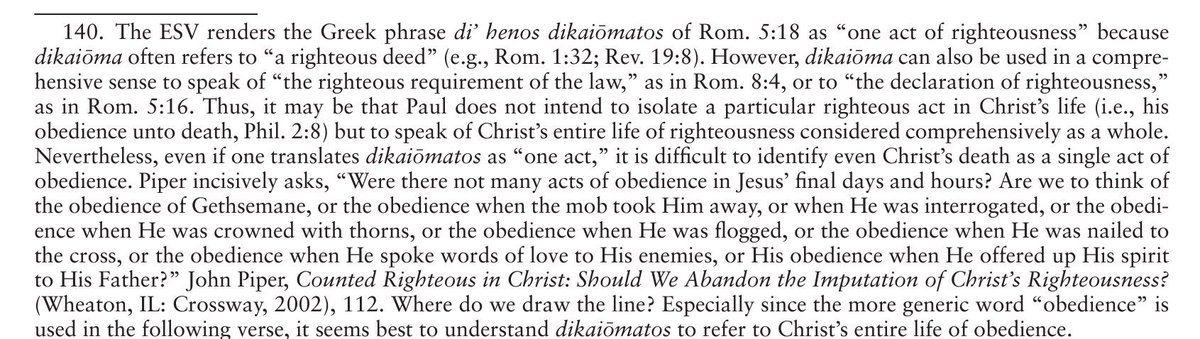
18 So then as through one transgression there resulted condemnation to all men, even so through one act of righteousness there resulted justification of life to all men.
19 For as through the one man’s disobedience the many were appointed sinners, even so through the obedience of the One the many will be appointed righteous. (Romans 5:18–19, LSB)
It was the singular act of righteous obedience of Jesus Christ, the act of suffering and dying, that secured the justification of the elect. And, it was not the obedience that secured our salvation per se, but the dying, the death (Hebrews 9:12). The pattern of obedience over Christ’s lifetime does not factor into the act of God’s justification of the sinners, but definitely gives Him glory as the Son of God (Matthew 17:5). This does not deny the excellence and righteousness of Jesus Christ since Pilate was never able to substantiate a sin on His behalf (Luke 23:4). Neither were the religious leaders able to substantiate guilt in Christ (Matthew 26:59-60). However, it does indicate that the obedience that the Father sees and by which He alone justifies is not His excellent life, but His death since that was the Father’s eternal purpose in eternity (Psalm 2:6), leading to His resurrection from the dead bodily (Psalm 2:7b).
The suffering and dying of the Messiah, being the eternal purpose of the Father, which He predestined by His own unilateral, sole authority and glory, without the counsel of the Son or the Spirit, (Ephesians 3:5,11), is of such eternal and infinite power and is of such an unfathomable plan, that to devalue it by adding anything to it, even the religious terms of obedience, although wrongly defined, is to cause tremendous injury to the act of death of the Messiah.
In my opinion, since God is impartial, those who do add such conditions to the efficacy of the death of the Messiah, add judgment upon themselves (James 3:1ff) by the God Who justifies by His own will, and based upon His own kind purpose in the Son to the praise of His great glory (Ephesians 1:5,6,9,11,12).