The only businesses left to build:
1. AI native service firms
2. Offline businesses
3. Distribution (media, community, audience)
4. Proprietary datasets
5. Domain specific harnesses (the agent that runs one industry's work)
6. Robotics and physical AI
7. Physical products with a fan following
8. Compute and energy
9. Health, longevity, and care
10. Marketplaces and social networks (for people and agents)
11. Real assets (property, equipment, land, infrastructure)
12. Vertical agents
13. Security
advice for men, ages 23-29
this is the stage where life stops responding to motivation and starts responding to structure. intelligence alone is no longer enough. passion without direction turns into frustration, and potential without execution becomes another form of wasted time. excuses begin to expire and responsibility quietly takes their place.
you will rarely feel ready. waiting until you feel ready is how years disappear. most of your growth in this phase will come from acting while uncertain, learning while uncomfortable and moving before you have everything figured out.
the people getting ahead are not necessarily smarter or braver. they are simply willing to move while confused.
money becomes louder at this age. not because money suddenly becomes the meaning of life, but because life becomes expensive. your ideas, opinions and ambitions mean very little if you cannot sustain yourself financially. learn skills that solve real problems, create value and generate income. your ability to make yourself useful will become one of your greatest assets.
your friendships will change. some bros will grow with you, some will grow away from you and some will stop growing altogether. do not interpret every distance as betrayal. sometimes people simply become strangers because their lives are heading in different directions. let people evolve without resentment and do not force old relationships to survive new versions of you.
romantic choices also begin to carry consequences. loneliness can make you tolerate people who cost you peace, focus and years. do not confuse chemistry with compatibility or excitement with love. choose someone who brings enough clarity, stability and peace into your life.
love should complement your direction, not constantly compete with it.
discipline will now matter more than motivation. motivation is emotional and unreliable but discipline is quiet and repetitive. it is what keeps you moving when nobody is watching, nothing feels exciting and the results are still invisible.
comparison will try to consume you. social media will make it look like everyone is ahead, richer, happier and more accomplished. remember that you are comparing your full reality to carefully edited pieces of someone else's. you do not see their debts, advantages, support systems, failures or private struggles. build your life instead of competing with an illusion or pixel.
this is also the age when habits begin to become infrastructure. what you repeatedly do now will become increasingly difficult to change later. the things you neglect do not simply disappear, they compound. so do the things you build. your health, skills, relationships, finances, reputation and discipline are all quietly becoming your future.
ages 23-29 are not supposed to look impressive, they are supposed to be intentional. this is the season to build quietly, make mistakes cheaply, learn aggressively, protect your peace and become useful.
you are not behind just because your life has not taken shape yet.
your 20s are laying the foundation.
your 30s will reveal how well you built it.
save, bookmark and share.
buena suerte.
Game theory explains why working harder inside a broken system is the worst response to that system. Because a system is never truly broken. It's just producing exactly the outcomes its own incentive structures were designed to produce, whether intentional or not. Working harder inside this system increases your output in the payoff matrix, but it simply won't change the actual structure of the system's matrix. Thus, the correct response is not more effort. Instead, you must aim to identify whose interests the current structure serves and position yourself in favor of those interests rather than against them. Change the game, or play the game that is actually being played. Either way, you must stop optimizing for the game you wish it to be and start acting realistically.
"AI will take your job."
But
These opportunities will rise:
- Inference Engineering for LLMs/VLMs
- Demand Forecasting with RL Agents
- Data Engineering at scale (evergreen)
- GTM Engineering & Strategist
- AI Product Managers
- DevRel for B2B AI
- Mathematician for AI Research
- Federated/Distributed Engineering
- Networking and Security for AI
- AGI R&D Engineering
- CUDA GPU kernels
- Technical Content Creation with human taste
- Sales & Marketing (evergreen)
- Teaching AI by Humans
- Observability in AI
- Solo founder with AI team
- Quant Finance with ML
- Multi-agent system engineering
- Cloud Deployment for AI services
- LLMs/SLMs in IoT
All technical skills require architecture design, business alignment, and distribution.
Coding will never be that tough, but understanding the basics is important. Why? So things won’t be a black box for you. Basics mean concepts, not syntax.
Learning these is mandatory to stay relevant:
1. Neural Networks
2. Transformers & LLMs
3. RL
4. Inference for LLMs
5. Linear Algebra
6. Distributed Systems
7. Ops
8. Content Creation (text or video)
9. Marketing and Sales
10. Public Speaking
Keep basics clean to stay relevant in next tech wave.
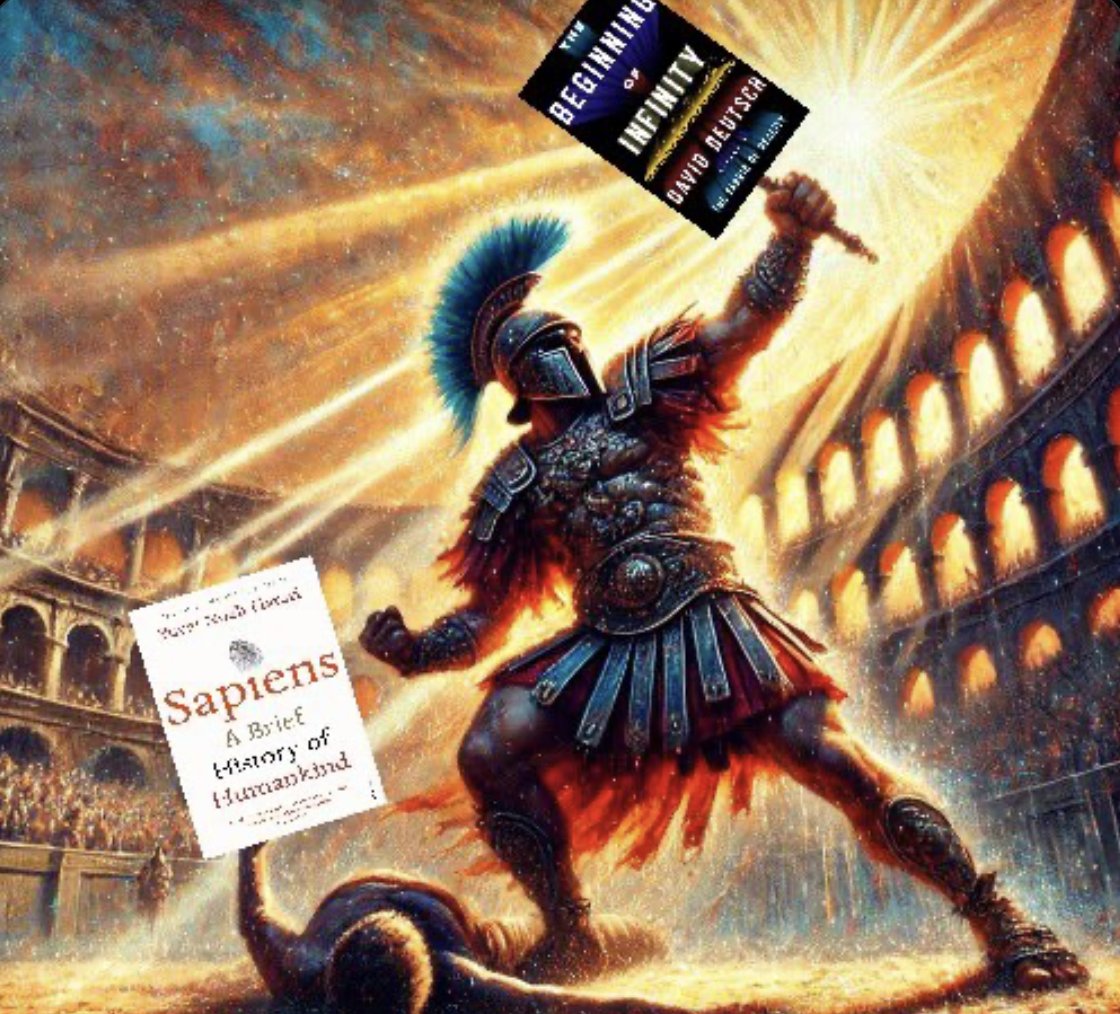
I used to think Sapiens was a great book. Sweeping, provocative, the kind of book that makes you feel like you finally understand the big picture of human history. It's on every CEO's bookshelf, assigned in universities, praised as a masterwork of synthesis. Yuval Noah Harari is treated as one of the serious thinkers of our time.
But something nagged at me. Some passages felt off. Claims that human rights are just figments of our collective imagination, not real things, just stories we tell ourselves. That nations, laws, money, justice, doesn't exist outside our heads. That meaning itself is a delusion we've invented to cope. That we're far more powerful than ever before but not happier. That hunter-gatherers had it better because they had no dishes to wash, no carpets to vacuum, no nappies to change, no bills to pay.
That sounded depressing to me, but was perhaps just the realistic scientific worldview? What it meant to see the world clearly, without comforting illusions.
Then I read The Beginning of Infinity by @DavidDeutschOxf. Deutsch has a concept he calls 'bad philosophy.' Not philosophy that's merely false, but philosophy that actively prevents the growth of knowledge. Ideas that close doors rather than open them. That makes problems seem unsolvable by design.
After soaking in Deutsch's framework (it's dense, a bit like digesting a delicious whale), it becomes clear: Harari's books are riddled with bad philosophy. They're smuggling nihilism in under the guise of scientific objectivity. Some examples:
On meaning: "Human life has absolutely no meaning. Humans are the outcome of blind evolutionary processes that operate without goal or purpose... any meaning that people inscribe to their lives is just a delusion."
On human rights: "There are no gods in the universe, no nations, no money, no human rights, no laws, and no justice outside the common imagination of human beings."
On free will: "Humans are now hackable animals. The idea that humans have this soul or spirit and they have free will, that's over."
On progress: "We thought we were saving time; instead we revved up the treadmill of life to ten times its former speed." The Agricultural Revolution? "History's biggest fraud." We didn't domesticate wheat, "it domesticated us."
On our cosmic significance: "If planet Earth were to blow up tomorrow morning, the universe would probably keep going about its business as usual. Human subjectivity would not be missed."
On the future: "Those who fail in the struggle against irrelevance would constitute a new 'useless class.'" Homo sapiens will likely "disappear in a century or two."
This is bad philosophy. It tells us our problems are cosmically insignificant, our solutions are illusions, and that progress is neither desirable nor within our control. It's also perfect nonsense. No one would ever go back to being hunter-gatherers. Would you rather worry about your kid spending too much time on Roblox, or face the 50% chance she won't reach puberty?
And our so-called "fictions"? They ended slavery. They gave women equal rights. They solved hunger. They eradicated smallpox. They turned sand into computer chips. They got us to the moon, and hopefully soon, to Mars and beyond. These "fictions" are already reshaping the universe, and over time they may become the most potent force in it.
Now compare Deutsch:
"Humans, people and knowledge are not only objectively significant: they are by far the most significant phenomena in nature."
"Feeling insignificant because the universe is large has exactly the same logic as feeling inadequate for not being a cow."
"Problems are soluble, and each particular evil is a problem that can be solved."
"We are only just scratching the surface, and shall never be doing anything else. If unlimited progress really is going to happen, not only are we now at almost the very beginning of it, we always shall be."
Where Harari sees a species of deluded apes stumbling toward obsolescence, Deutsch sees universal explainers, the only entities we know of capable of creating explanatory knowledge, solving problems, and potentially seeding the universe with intelligence.
The difference isn't academic. Ideas shape action. If you believe life is meaningless, progress is a trap, and humans are hackable animals with no free will, how does that affect what you build? What you fight for? What you teach your children?
Harari's books sell because they flatter a fashionable pessimism. They let readers feel sophisticated for seeing through the "delusions" everyone else lives by. That smug cynicism is corrosive. And it's everywhere: in schools, in media, in bestselling books. More than half of young adults now say they feel little to no purpose or meaning in life. This is what happens when you teach an entire generation bad philosophy. Less progress, less health, less wealth. Less flourishing. And ultimately, a higher chance that civilization and consciousness go extinct.
Fortunately, there's another equally well-written, but much truer, account of homo sapiens, appropriately titled 'The Beginning of Infinity'. And this one smuggles no despair in by the backdoor. But let's give Harari credit where it's due. He is right about one thing: if planet Earth blew up tomorrow, we wouldn't be missed. Because there'd be no one left to miss us, just a careless universe, blindly obeying physical laws. We are the only ones who can miss, but we're not going to. We're going to aim, hit, and keep going.
Full credit for the amazing meme to @Ben__Jeff