Starting to hire and retrain for new agent engineering roles for *internal* functions to help get more powerful agents working well on critical business processes. I expect this type of role to be a very big deal over time at Box and other companies.
It looks something like an internal FDE, whose job it is to wire up internal systems and get agents working with them effectively. The person will be extremely technical and capable of building secure, governed agents for internal workflows that connect to business systems (like Box, Salesforce, Workday, etc.), and codify workflows in skills.
In some cases this person may understand the business process well enough to do it fully, but in most cases I expect them to work with the business directly in an embedded fashion. Ironically, that may introduce another new role on the business side that is more akin to agent product management for internal processes. The key is that you need technical + process people that can span multiple teams or functions in an organization. It’s not about brining automation to a job, but bringing automation to a process.
This is going to be a very big trend in most companies going forward. Fun to watch the early innings of what this will look like.
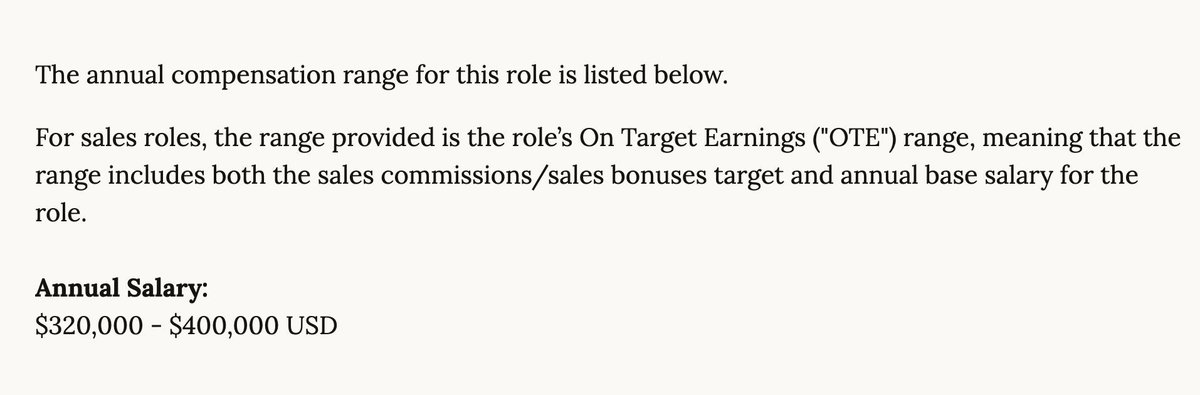
Anthropic is paying up to $400,000 a year for an events role.
They're looking for someone to own the execution of brand experiences that translate Anthropic's values into physical moments.
This person will produce everything from intimate thought-leadership gatherings to large-scale industry activations.
The top AI research lab in the world recognizes that to cross the chasm and reach everyday consumers, they need to lean into hospitality. They need to create visceral, unforgettable IRL experiences that make complex technology feel accessible and human.
They understand that digital channels are getting increasingly saturated. Every feed is flooded with AI content... every inbox is overflowing.
The massive opportunity now is offline, analog, in-person.
The companies that win in the next decade won't just have the best product but the most emotional in-person presence and the most compelling storytelling.
If you're in events, experiential marketing, or brand activations, this is your moment. The biggest tech companies in the world are betting on you.
The jump from working with a chatbot to having an agent that actually helps automate a process requires a real amount of work.
Most companies will need to have dedicated people that are responsible for bringing automation to their teams, instead of leaving this up to every individual employee. Partly because the work is more technical than we imagine today, and partly because it’s just hard to do this as a side project.
The job spec is to map out new workflows with agents, implement new systems to deploy agents, make sure the agent has all the right (up to date) context to work with, wiring up internal systems to connect to the agents, creating evals for the agents, figuring out where the human is in the loop, managing the system when there are new upgrades, helping with the change management of the existing business process, and so on.
These jobs may come from IT or engineering, or live directly in the business function itself. They’ll be called different things depending on the company, and in some sense it’s the future of software engineering that you’ll see a huge growth of in non-tech companies.
Most companies will have to be hiring for this now or in the future, and it’s another example of the kind of new jobs that will be created in AI.
ai is exposing everyone right now & making legacy entities vulnerable af. even labs are having a tough time shipping features that feel really good end to end.
most ppl fail to realize that the hard part of building ai stuff was never access to a good model, it's the orchestration layer, the data plumbing, the taste in knowing when ai should intervene vs shut up, how it should intervene, what it should say, how it should say it, how does human in the loop work.. among many other subtle things. copilot is a prime time example of this.
most legacy players have none of these instincts cuz they built their orgs around shipping deterministic software. we are firmly in the non deterministic era now & that requires a very different skillset to build great tools.
There is a huge opportunity for resourceful and entrepreneurial talent within organizations to go in and reimagine workflows for a world of agents.
The way you automate work with agents requires real work. It means setting up unstructured data in a way agents can easily access, learning the workflow and processes and creating skills or plans for agents to leverage, connecting disparate systems together, and likely changing the process itself to support getting the agents the need to do much of the work. Then you have to design where humans will play a role to oversee the workflows, how you validate the work, and so on.
Most of the gains you see from coding don’t take this level of effort because the agent knows more, it gets context more easily, and the users are technically. But for the rest of knowledge work there’s no way around this; there’s really no way to shortcut any of this work. It has to be done by a person or people on the team.
You will see a huge growth of roles within enterprises, and people that specialize in this will be hugely valuable in the economy. Great way for early career folks to make a huge dent quickly as well.
The big gap in most enterprises being able to automate work is being able to get right context to the agents.
We experience a huge benefit in coding in tech because the problem is generally far simpler than other areas of knowledge work. The codebase contains a bunch of necessary context, access controls and permissions are generally not a major concern, the users are technical enough to supply the context, and the final output is generally quickly verifiable.
Most knowledge work doesn’t look like this. The data is sitting in legacy silos that don’t easily connect to agents, the access controls are all out of whack (people have either too much or too little access), the information isn’t agent-ready, and more.
This is the big context gap for any type of agentic workflows in most organizations right. The platforms that make solving this easy, and the companies that retool their workflows to enable this, will be the winners in a world of agents.
We dramatically underestimate how much change management it is going to take to automate most knowledge worker tasks.
Between data being in legacy environments or systems or without good APIs, context missing for doing the task, teams that are less technical, and other factors, there’s still a lot of work to drive real AI transformation in an enterprise.
This is actually great news if you’re building right now because the opportunity is to build the software bridges to make this easier, or to build new services firms to help with this change management. Opportunity is all around for those looking.
seems obvious but:
things that are changing rapidly:
1. context windows
2. intelligence / ability to reason within context
3. performance on any given benchmark
4. cost per token
things that are not changing much:
1. humans
2. human behavior, preferences, affinities
3. tools, integrations, infrastructure
4. single core cpu performance
therefore,
ngmi:
1. "i found this method to cut 15% context"
2. "our method improves retrieval performance 10% by using hybrid search"
3. "our finetuned model is cheaper than opus at this benchmark"
4. "our harness does this better because we invented this multi agent system"
5. "we're building a memory system"
6. "context graphs"
7. "we trained an in house specialized rl model to improve task performance in X benchmark at Y% cost reduction"
wagmi:
1. product/ui
3. customer acquisition
4. integrations
5. fast linting, ci, skills, feedback for agents
6. background agent infra to parallelize more work
7. speed up your agent verification loops
8. training your users, connecting to their systems and working with their data, meeting them where they are
Since 2023, the top quartile of AI spenders on @tryramp have more than doubled their revenue. Bottom quartile? Flat
A roofing company in Texas. A window installer in Utah. A construction firm in Florida that grew 65%
The gap is accelerating and most companies don't feel it yet
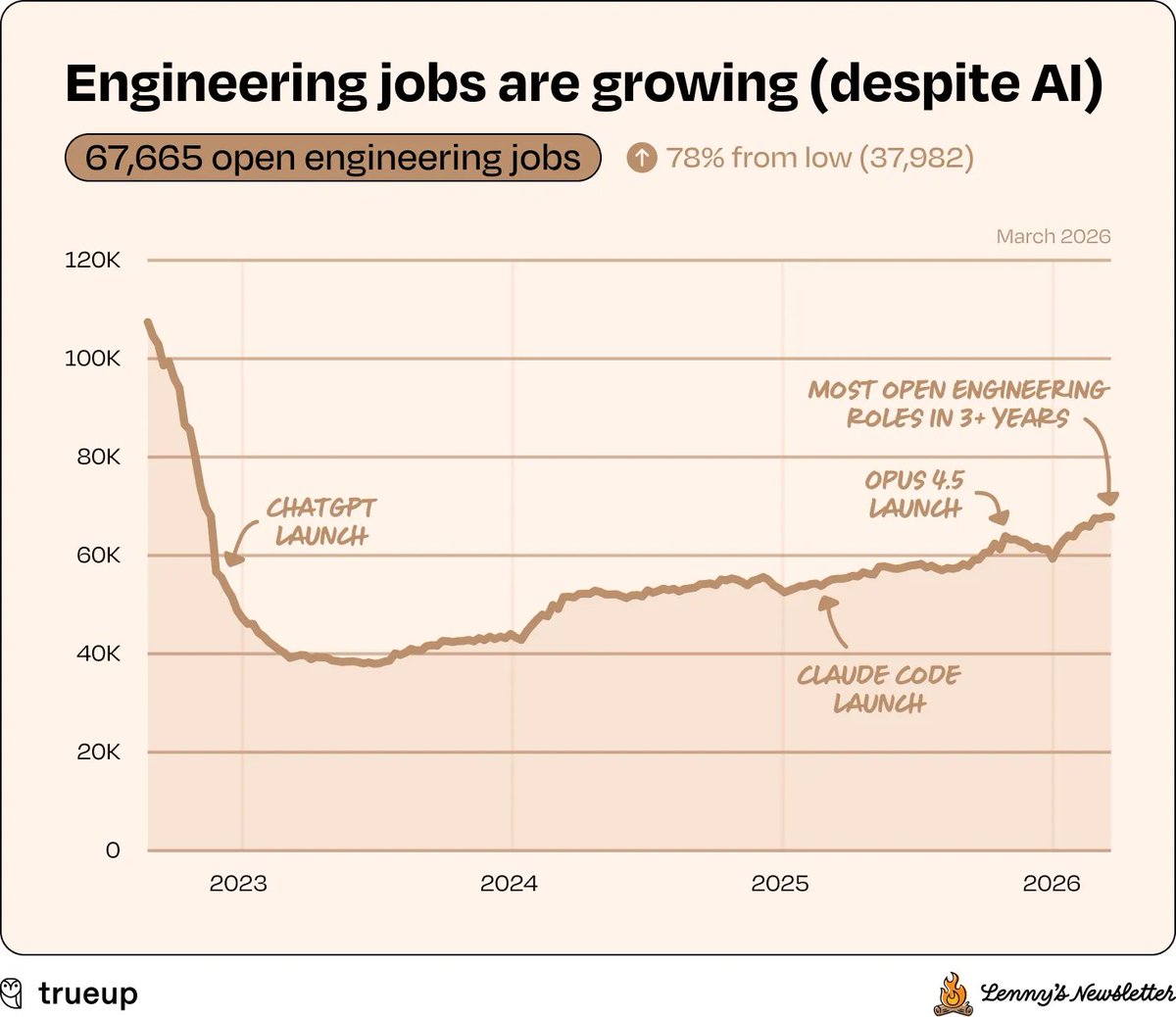
Engineering job openings are at the highest levels we’ve seen in over 3 years
There are over 67,000 (!!!) eng openings at tech companies globally right now, with 26,000 just in the U.S. We don’t know if there would have been more open roles if not for AI or if AI is actually leading to more open roles, but since the start of this year, the increase in open eng roles is accelerating even more.
Introducing TurboQuant: Our new compression algorithm that reduces LLM key-value cache memory by at least 6x and delivers up to 8x speedup, all with zero accuracy loss, redefining AI efficiency. Read the blog to learn how it achieves these results: https://t.co/CDSQ8HpZoc
Silicon Valley thinks AI agents are a $20/mo self-serve subscription.
Main Street is paying local agencies $10,000 just to turn them on.
Everyone assumes AI will be bought primarily online like Slack or Zoom. I think they are wrong.
Some of the biggest winners in the AI boom won't be the software vendors. It will be the humans installing it.
Here is the reality of SMBs right now:
• 54% lack internal AI expertise.
• 41% have data quality too poor for AI to even work.
• 41% already prefer buying AI through a local IT provider.
You cannot "1-click install" a genius AI into a messy CRM or a 15-year-old server. It will just execute the wrong tasks at the speed of light.
The AI software will be cheap and a lot will absolutely be bought online. Making it actually work for a messy, real-world business will be expensive.
Very bullish on the "Do It For Me" economy being back.
THIS IS COOL: Flea from the Red Hot Chili Peppers covers Frank Ocean’s ‘Thinkin Bout You’ on bass & trumpet with a live orchestra
Was not expecting that but it sounds 🔥
FWIW, accelerate or die applies to your career, too
I wouldn’t have said that a year ago. But I am watching people be 50-100-200% more productive than their peers by using AI
I’m not trying to be a doomer. Anyone can do it. But you have to start shipping. Now
Like recover all business controls ... tracking royalties ... locating money ... finding reg flags ... planning ... organizing years of information ... creating family office structure... business navigation ... I've been waiting my whole life for tools like this!
Jensen Huang just told every college student on Earth the one thing that determines whether they get hired.
It is not their GPA.
It is not their degree.
It is not their internship.
Huang: “If I have a choice between two, I would hire the one who’s expert in using AI.”
He did not say prefer. He said hire.
One gets the job. One does not. The only variable is whether you learned to use the machine.
Then he went down the list.
Accountant. Hire the one who uses AI.
Lawyer. Hire the one who uses AI.
Marketing. Supply chain. Sales. Customer service.
Every function. Same answer.
The person who can command the model does not have an edge. They are the only candidate in the room.
Everyone else is applying for a job that no longer exists.
Huang: “If you’re a carpenter, if you’re an electrician, go use AI. If I were a farmer, I would absolutely use AI.”
That line should demolish every assumption about who this technology is for.
This is not a Silicon Valley tool for software engineers.
This is infrastructure for anyone who builds anything with their hands or their head.
A farmer who uses AI to optimize soil, predict weather, and manage yields is not competing with other farmers.
They are operating at a level that used to take an entire department.
An electrician who uses AI to model loads, simulate wiring, and quote jobs in seconds does not compete with other electricians.
They compete with firms.
One person with the model replaces the output of a team without it.
That is not a prediction. That is Tuesday.
Huang: “Every college student should graduate and be an expert in AI.”
Not familiar with it. Not aware of it. Expert.
The university system is still training students to execute the work.
The market already moved. It wants the person who directs the machine that executes it.
Four years of tuition. Thousands of hours of lectures.
And if you walk out the door without mastering the one tool that redefines every industry you could enter, you burned all of it.
Huang: “I want to see what it could do to elevate my job, so that I could be the innovator to revolutionize this industry myself.”
That is the part most people miss.
AI does not replace ambition. It multiplies it.
The carpenter who learns the model does not lose their craft. They scale it.
The pharmacist who learns the model does not become redundant. They become dangerous.
One person. Deep skill. Full command of the machine. That used to be called a company.
The question is no longer what do you know.
It is what can you build with the machine that knows everything.
And the people who cannot answer that are not falling behind.
They already fell.
This is a much bigger deal than most people realize. If you don't know why, let me explain.
Agents perform "work" right now by calling "tools". These are just pieces of context shoved into the context window saying "if you think you the next thing you should do falls into one of these categories, then respond with this format" — that format is the "tool" a JSONSchema response which a harness then uses to call a function.
MCP, is best thought of as a way to shove more tools and context into your context window (it has a lot of shortcomings imo). The agent then has to pick which tool out of all the available tools it should call. So the more tools you have, the worse it selects the tools.
@threepointone and @KentonVarda have an excellent article (https://t.co/brec28Wsmm) where they introduced the idea of exposing the MCP tools as an SDK, so to call tools and compose them, the AI just does what it is ALREADY good at: write some code.
The question, as always, is where do you run that code safely. Many have proposed sandboxes and containers as a possible solution, but these are hella slow and make the experience untenable.
Thats what makes this announcement SO important, it allows you to run agent-written code in a matter of milliseconds with the explicit execution environment you specify pulled in (like a database, kv store, etc. Cloudflare calls these "bindings" btw).
In practice, this means people can start building MUCH more effective agents that can *do* a lot more, because they can be exposed to more tools.
Anyway, huge deal. Congrats to the CF team.