My first first-authored paper is now available @Dev_Cell. I deeply thank all collaborators, especially my co-first authors (Yuki Fujimoto and @HideMorishita), supervisors (Prof. Masaaki Komatsu and @HideMorishita), and members of Komatsu lab.
https://t.co/tH5M26JbH9
Engineered nanobodies selectively block opioid receptor signaling in living neurons and mice for precise control of receptor activity
https://t.co/2wEN6Lz1qF
Coordinated infraslow cortical oscillations of neuromodulators during NREM sleep. A study by @NedergaardLab, Celia Kjaerby & colleagues in @iScience_CP#SfN26 https://t.co/lXQebY3sw5
👀What if you could record calcium dynamics in as many cells as you want simultaneously, and read the temporal records in situ with a single endpoint imaging session?
🚀Introducing TCaMP, a genetically encoded calcium recorder.
🧬TCaMP is a new member of the CytoSense family, and writes Ca²⁺ dynamics along a protein tape (CytoTape) that elongates inside the living cell. Time becomes position along the tape. Like tree rings :deciduous_tree:, but for Ca²⁺ dynamics.
〽️The record is analog and continuous: Ca²⁺ levels on a single intensity scale along a continuous time axis, for scalable endpoint readout.
🔗TCaMP is built on split-1POK, a split tape monomer scaffold whose two halves reconstitute when the domains fused to them interact. Split-1POK is programmable: swap the interaction pair fused to it, and the same scaffold records that pair’s interaction dynamics across time instead.
🔬In human cells, TCaMP recorded Ca²⁺ from transmembrane entry, receptor activation, and intracellular store release, and detected stimulations as brief as 10 minutes.
⏱️At hour-scale kinetics over days, TCaMP complements fluorescent Ca²⁺ indicators, trading sub-second temporal resolution for scalability and recording duration. We envision TCaMP and the general split tape monomer strategy being useful for questions that span large cell populations across hours to days and beyond.
👏Work by Yixiao Yan, a PhD student in the lab.
📄 Preprint: https://t.co/ZWhnebfuAA
Our new preprint is out! We developed FluoCode, a combinatorial fluorescent barcoding system that can map projections from up to 21 brain regions within a single animal. We visualized cortico-subcortical projection maps in mice and marmosets. https://t.co/bNBvmNP64o
We wrote a biological light sheet into the brain🤯
SPress confines expression to a thin chosen plane for kilohertz, large-scale voltage imaging with a standard widefield microscope.
Optical sectioning, encoded through gene expression.
Preprint: https://t.co/hg4PcqvUR0
what if we could degrade gpcrs instead of simply inhibiting them?
a nature study describes a bifunctional antibody-based platform that rewires receptor trafficking to drive gpcr degradation and antagonism.
an interesting expansion of targeted protein degradation beyond intracellular proteins.
https://t.co/TvAjh93aeU
Our brilliant undergraduate student Kota Homma developed and carefully characterized uniSynK, a user-friendly, single-vector tool for dendritic spine enlargement based on SynK (Science, 2024): https://t.co/oDkAZAweRD
Give it a try! We'd love to hear your feedback!
1/ We discovered something totally unexpected about the neural structure of consciousness that overturns decades of thinking on its biological basis and brings us significantly closer to the recipe for generating conscious awareness.
New preprint: https://t.co/K8BwiHXvXg (led by @HesseJanis, with @FrankLanfranchi, @_conor_mcgrory, @Yuelin_Shi, and @EngelTatiana)
Our new preprint is now available!
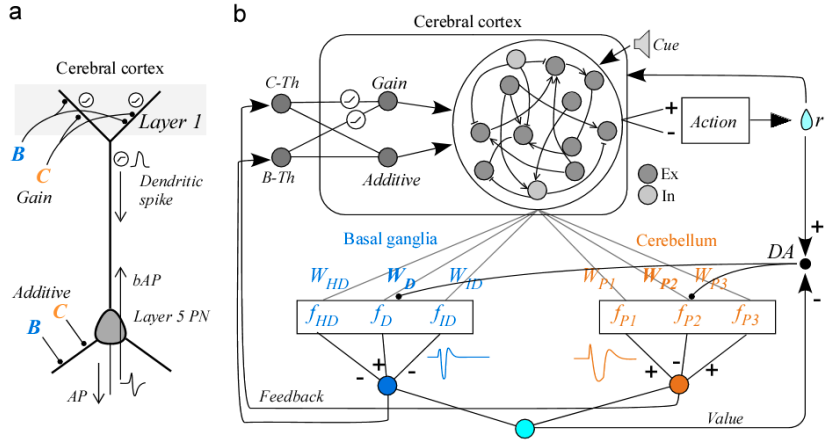
Thalamocortical credit routing from the basal ganglia and cerebellum: anatomical constraints and circuit principles https://t.co/V1U7i0VjHg