Harnessing the murine inner cell mass mechanical environment enhances derivation of in vitro nascent primitive endoderm precursor cells
Read this Research Article from our special issue #DevSIextracellular by Elena Corujo-Simon and colleagues.
https://t.co/WwdE54qyTp
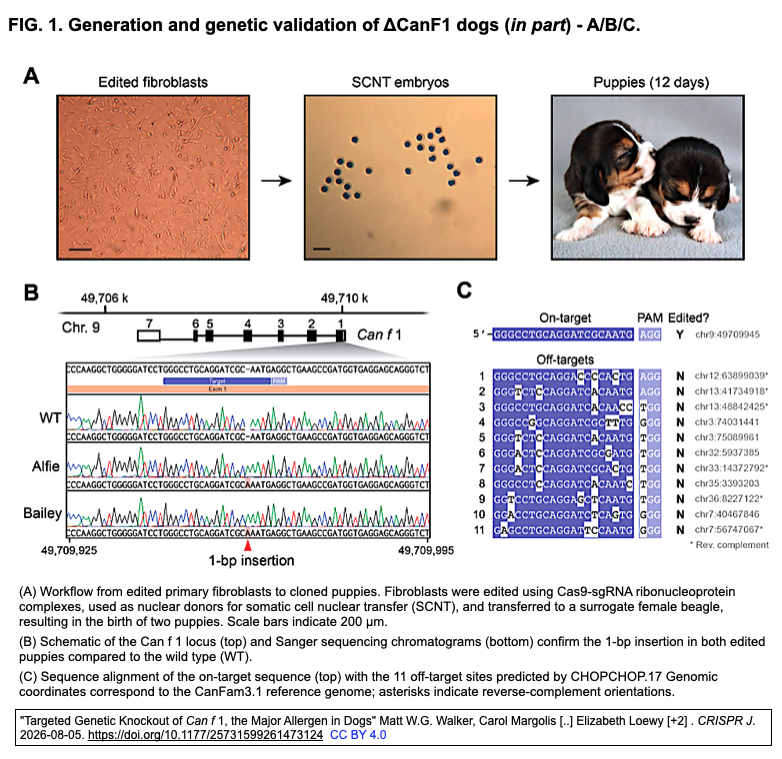
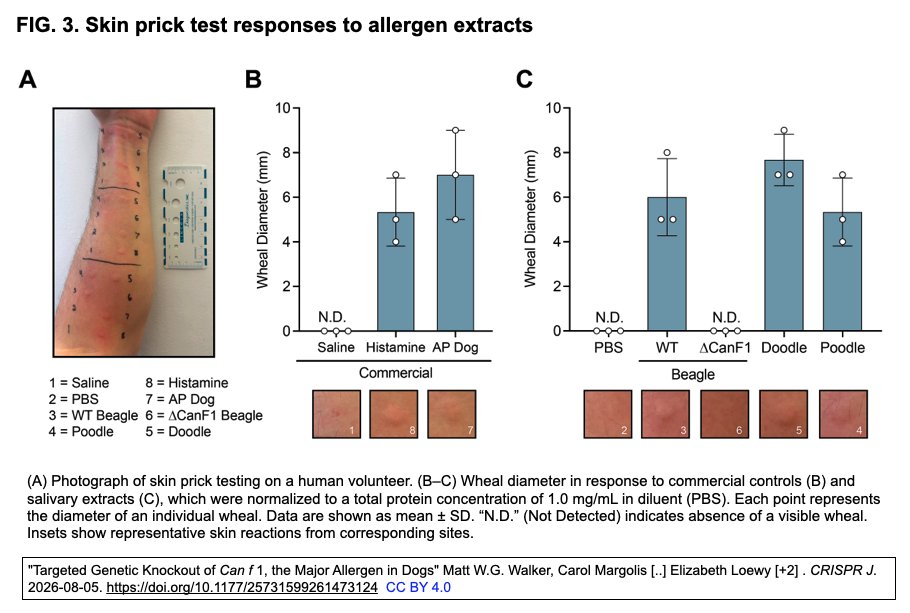
"Targeted Genetic Knockout of Can f 1, the Major Allergen in Dogs"
Walker MWG, Margolis C, Wiegand T, Gavin N, Loewy E.
CRISPR J. 2026-08-05. https://t.co/wqGQp7Kk6x
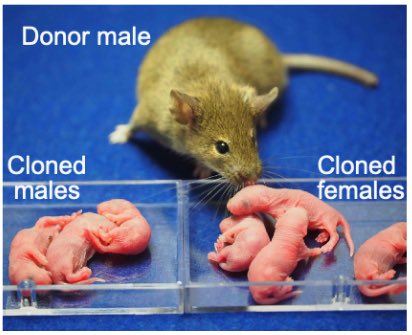
Our new preprint, in collaboration with Dr. Matoba @RBRC_iDED_jp , is now available! Initiating mammalian reproduction from a single male genome | bioRxiv
https://t.co/8AvCt1JSha
The image shows the birth of male and female cloned mice generated from a single adult male donor.
Engineered plasmids from thousands of labs share almost no consolidated design language — until now. PlasmidGPT is a generative language model pretrained on 153,208 engineered plasmid sequences from Addgene, learning embeddings rich enough to visualize research topics across labs and map plasmid diversity across vector types.
Those embeddings do real work: state-of-the-art lab-of-origin prediction for engineered plasmids, plus generalization to natural plasmids for host taxonomy prediction at both phylum and genus level. On the generative side, PlasmidGPT can be steered by a seed sequence or explicit design constraints to produce new functional plasmid sequences that recapitulate the part co-occurrence and synteny patterns seen in real plasmids — not just plausible-looking DNA, but structurally coherent designs.
https://t.co/NsP6VNIYE2
Institute member Hiro Nakauchi and his collaborators have made siginificant progress on a new organ transplantation method. Read on for more: https://t.co/mZbEmqC898
Elephant iPSC !!!
And of course they had to suppress p53 since elephants have a lot more of this tumor suppressor than other species.
https://t.co/ia15gLtxGt
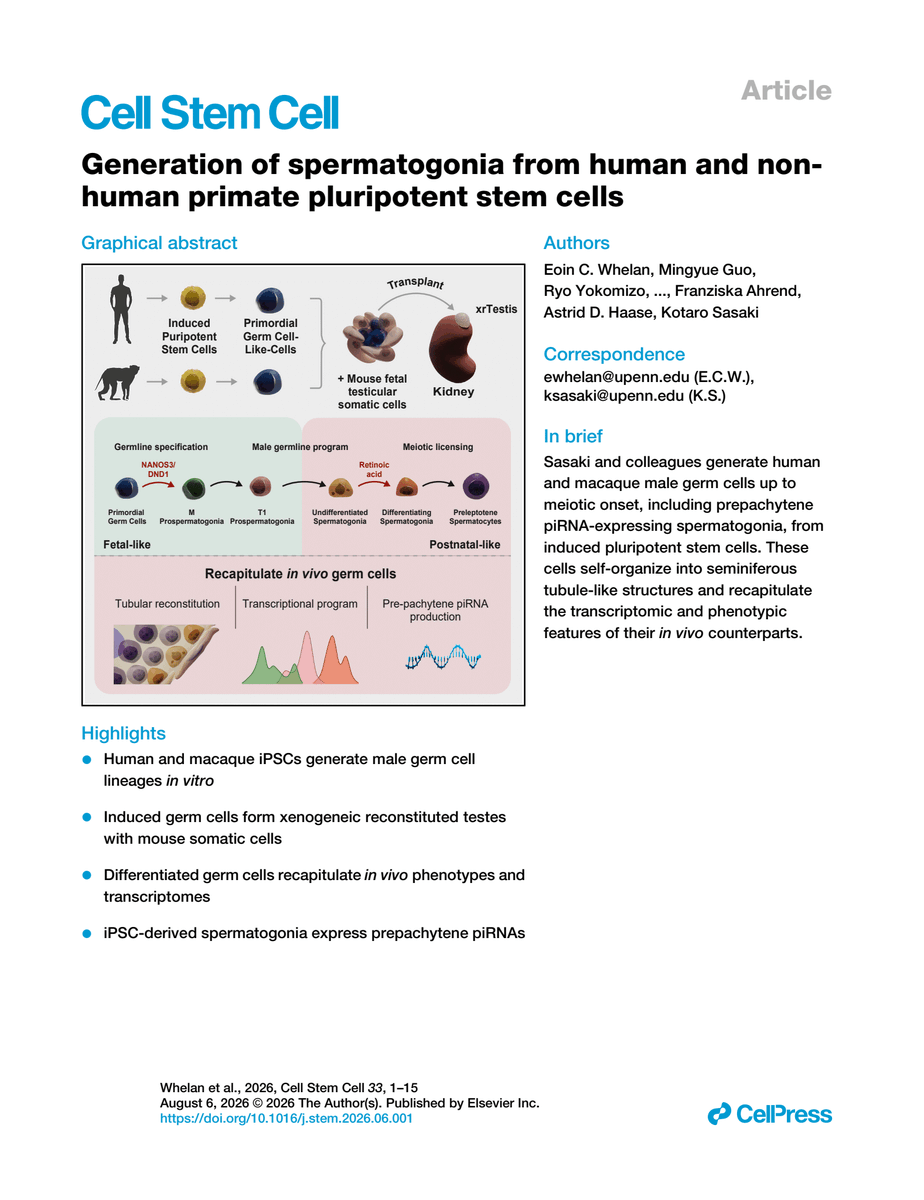
"Generation of spermatogonia from human and non-human primate pluripotent stem cells"
Learn more in Cell Stem Cell: https://t.co/jgJUuwgr3U
Eoin C.Whelan, Kotaro Sasaki & colleagues
@cellstemcell
Why 50% of human fertilized eggs fail to complete pre-implantation development?
Latest work from my lab in @CellCellPress now clarifies the two causes that contribute to the low efficiency of early human embryos and provides one of the solutions. (1/7)
https://t.co/NyKUdWQBv0
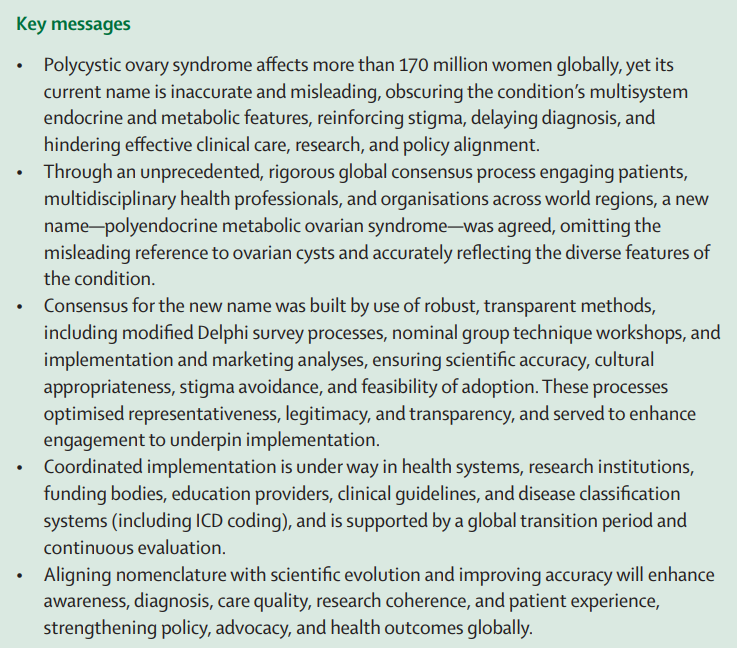
Experts reach consensus to rename polycystic ovary syndrome (PCOS), better reflecting the condition’s full health impacts.
Find out more 👉 https://t.co/Azue7YDFcn @ESEndocrinology#ECE2026
Reverse transcriptase inhibitors enable the generation of fertile spermatids from fetal mouse testes in vitro: Communications Biology, Published online: 27 January 2026; doi:10.1038/s42003-026-09613-yReverse transcriptase inhibitors combined with hypoxia… https://t.co/RlRtnCGOO2