@lightpanda_io Bundling the browser in the wheel is a big usability win. For reproducible agent runs, it would also help to expose the bundled binary version and checksum—then an environment lockfile can pin both the Python package and the actual browser engine.
🚀 zg (zvec-grep) is now open source!
We built a local search tool for people and AI agents—
indexing and search run on-device by default, combining natural-language understanding with the speed and precision of rg.
🔒 Local-first: File processing, indexing, and search stay on-device by default, keeping your code and documentation private and secure.
⚡️ Ready in three steps: Install zg, index your workspace, and connect your agent. zg automatically configures supported agents and runs across macOS, Linux, and Windows.
🔎 Comprehensive search: Semantic search, BM25, hybrid retrieval, and rg work together across code, documentation, and data.
🤖 More efficient agents: On SWE-QA-Bench, tool calls and input tokens were both reduced by roughly half, while the judge score improved by 1.50 points.
GitHub: https://t.co/42c050Kqql
Blog: https://t.co/sZUOa8g98y
zg is still evolving. Try it, star the repo, and share your feedback—every suggestion helps make it better. ⭐️
@siddontang The database analogy also suggests an EXPLAIN plan for context assembly: which items were selected, filtered, compacted, and why. Without that provenance, an optimizer may cut token cost while silently dropping the evidence needed to audit a long-horizon run.
@omarsar0 The missing piece is a run manifest. If model, system prompt, tool versions, cache policy, and permissions aren’t recorded together, improvements can’t be reproduced or rolled back. Context engineering becomes infrastructure once the harness reaches production.
Publishing the weak default result is the useful part. For a production default, I’d report recall together with p95 latency and memory across a small Pareto curve, then keep exact scan as the correctness oracle in CI; one recall number alone can hide whether reranking actually buys efficiency.
Sometimes it's easier to show than tell. We're sure this update will help with that. 👀
GitHub CLI now has a repeatable --attach flag that uploads a local image or video. Reference it inline in an issue, pull request, or comment body.
Available now to all users on GitHub across all plans. 🎉
https://t.co/2oRtlSHdPT
@nykdotdev@NousResearch The most useful TUI update would be a real run inspector rather than more chat chrome: tool timeline, pending approvals, token/cost, and a resumable checkpoint. A TUI becomes much more valuable when it exposes agent state you can audit and recover.
@nykdotdev I’d add RECONCILING and UNKNOWN to that state machine. A timeout after submission is not a failed order; after restart, query the broker by a stable client order ID before any retry, or recovery can duplicate the position.
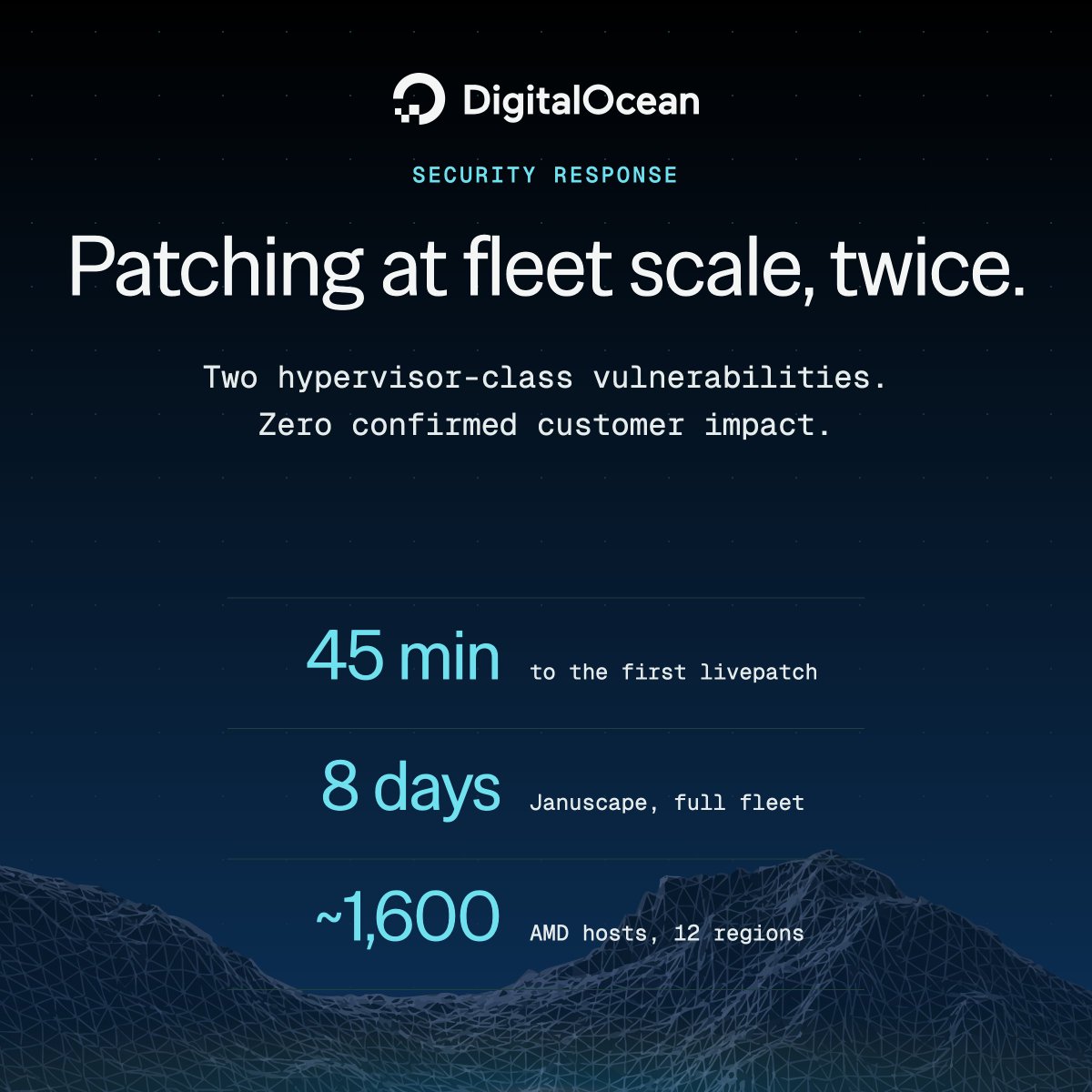
We closed two hypervisor-class vulnerabilities this summer with no confirmed customer impact. The first livepatch took 45 minutes. The second needed a kernel update and reboot on ~1,600 hosts in 12 regions.
New writeup from our Deputy CISO: https://t.co/DxgiWzidav
@Siddhant_K_code TTFT benchmarks need timestamps at multiple boundaries: server receive, first byte on the socket, first client read, and first render. A single number without those checkpoints can turn buffering into an apparent model or serving regression.
@github Grouping dependency updates cuts noise, but the batch still needs a review budget: cap its size, keep lockfile diffs visible, and split on failing tests. Otherwise one problematic upgrade can make the whole grouped PR hard to diagnose.
The held-out benchmarks are important, but autonomous alignment also needs evaluator independence. If the same loop proposes methods and selects winners, it can still overfit to correlated measurements; frozen external audits and versioned evals should be part of the control plane.
@daiki7nohe@SocketSecurity Valid provenance answers who built an artifact, not whether the build path was authorized or safe. Comment-triggered release workflows need explicit trust-boundary checks; pinning is the right immediate containment while affected versions are removed.
@aiDotEngineer@BenAtBox The loop around it is where production reliability lives: capability scoping, durable state, idempotent writes, evals, and rollback. A stronger inner loop cannot compensate for a harness that cannot explain or recover its side effects.
🚀 New updates in GitHub Issues
• Pin views in the Issues sidebar
• See profile avatars for reactions
• Adjust dashboard density
• Hide closed sub-issues
• Scope-aware Issue dependency REST API
@github The dependency API is the sleeper update for agentic workflows: automation needs explicit blocked-by relationships, not inference from issue text. Idempotent mutations and clear cycle/conflict errors would make it much safer to let agents maintain plans.