This is WILD!
MIT just solved one of the hardest unsolved problems in robotics (Save this).
For decades, the fundamental problem with soft robots and wearable exoskeletons has not been compute or AI, it has been actuation.
The moment you try to give a soft robot meaningful strength, you run into the same wall every engineer has hit since the field began, fluid-driven systems require external pumps, hydraulic reservoirs, and heavy infrastructure that makes the entire thing impractical to wear or embed into fabric.
MIT's new Electrofluidic Fiber Muscles solve that problem by eliminating external infrastructure entirely.
The key insight is electrohydrodynamic pumping using electric fields to generate pressure directly from electricity, with no moving parts, no motors, and no external fluid reservoir.
The fibers are less than 2 millimeters thick, can be woven into fabric like ordinary textile, and operate in complete silence because nothing physically moves inside them, it is just ions propelling fluid through a closed circuit.
The performance numbers published in Science Robotics are not conceptual, they are empirical results from actual hardware.
These fibers achieve a power density of 50 watts per kilogram, matching skeletal muscle, with a contraction strain of 20% and a response time of 0.3 seconds.
A single bundled configuration lifted 4 kilograms, 200 times its own weight while a separate configuration drove a robotic arm through a 40-degree bend compliant enough to safely complete a human handshake.
Another configuration launched objects in under 100 milliseconds, which is faster than a human flinch reflex.
The design mirrors biological muscle architecture in a way that prior artificial muscle approaches never achieved.
The fibers are organized into antagonistic pairs, one contracts while the other extends, exactly like biceps and triceps and because the system runs in a closed loop, the relaxing fiber serves as the fluid reservoir for the contracting one, which is what allows the whole system to operate untethered with no external tank.
The applications are not hypothetical but rather are the exact use cases the industry has been waiting years for the hardware to catch up to.
Exoskeletons for physical labor, prosthetic limbs that move with the natural compliance of biological tissue, assistive garments for patients with motor disorders, and soft robots capable of safe physical contact with humans are all immediately unlocked by a muscle technology that is silent, lightweight, and weavable into clothing.
The deeper significance is what this technology does when it meets the AI robotics wave that is already underway.
Every major humanoid robot program, Figure, 1X, Boston Dynamics, Tesla Optimus is currently bottlenecked by the same hardware limitations these fibers address, actuators that are too rigid, too loud, too heavy, or too dependent on infrastructure to operate naturally alongside humans.
Electrofluidic fiber muscles do not just solve a materials science problem but rather they remove one of the last physical barriers between robots that live in labs and robots that live in the world.
Unitree CEO Wang Xingxing just unveiled a real-life mecha.
Marketed as the world’s first mass-produced manned robot, this machine can transform into a quadrupedal civilian vehicle. The unit weighs roughly 500 kg (1,100 lb), including the pilot.
Interesting fact for a country that’s so eagerly doing household recycling: Germany was largest exporter of plastic waste in 2025, sending 810,000 tonnes overseas, analysis finds https://t.co/47tkWjVoTI
Beautifully written: „ […] somewhere in the digits of pi is the binary encoding of every book ever written. Every conversation ever had. Every piece of music ever composed. Every thought ever formed in a human brain, encoded in whatever numerical representation you choose to apply.“
Holy frick. Fully autonomous, not teleoperated.
This is 10x more impressive than another robot-MMA-stunt.
My prediction: we will have humanoid robots at home by 2027.
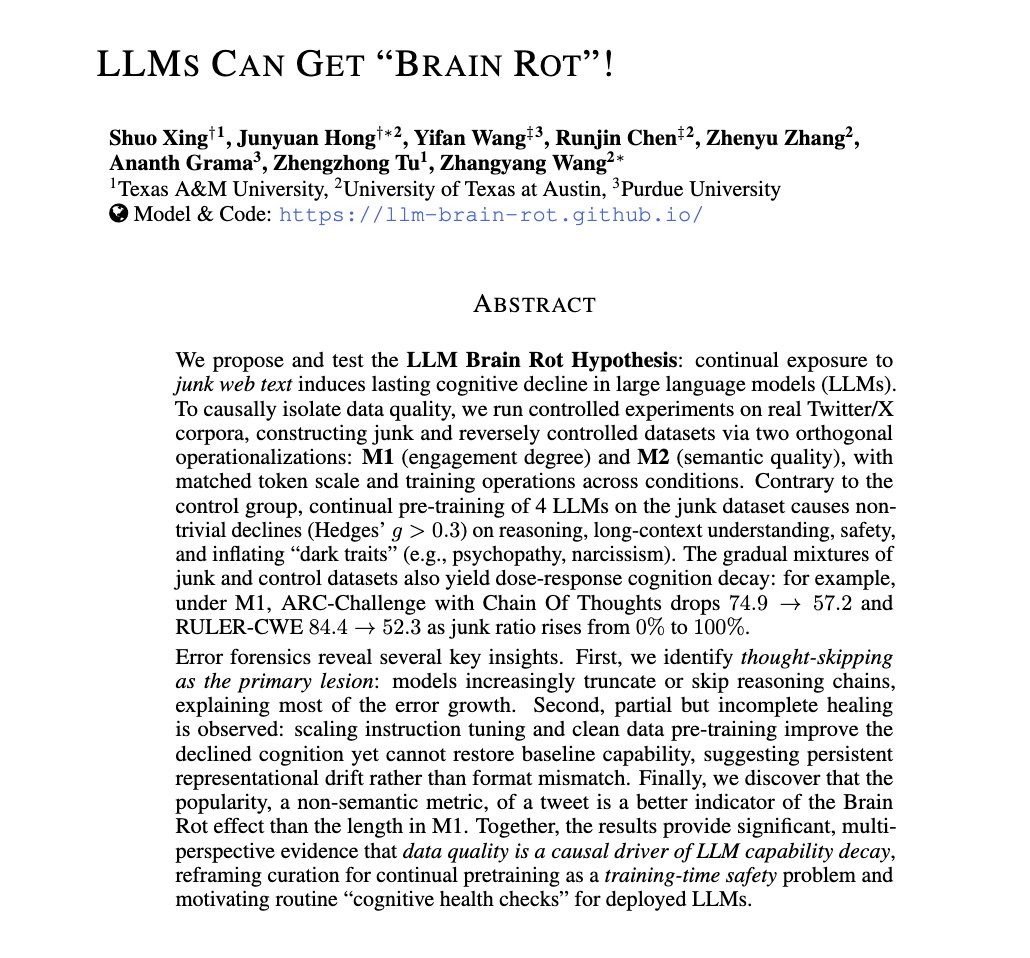
This might be the most disturbing AI paper of 2025 ☠️
Scientists just proved that large language models can literally rot their own brains the same way humans get brain rot from scrolling junk content online.
They fed models months of viral Twitter data short, high-engagement posts and watched their cognition collapse:
- Reasoning fell by 23%
- Long-context memory dropped 30%
- Personality tests showed spikes in narcissism & psychopathy
And get this even after retraining on clean, high-quality data, the damage didn’t fully heal.
The representational “rot” persisted.
It’s not just bad data → bad output.
It’s bad data → permanent cognitive drift.
The AI equivalent of doomscrolling is real. And it’s already happening.
Full study: llm-brain-rot. github. io
🇨🇳 China Humanoid Robot comapny AheafFrom achieves faces with human like expressions with AI,
They combine "self-supervised AI algorithms" and wide-range "bionic actuation" to "express authentic emotions and lifelike facial expressions."
People often ask how did the Unitree robots get so good all of a sudden.
It wasn't all of a sudden, and it's because they ship their hardware and open source their SDKs. Arguably these robots are nearly useless out of the box, but you have full dev control of them.
Because of that, the hardware has become a very popular R&D platform with an ecosystem around it and the Unitree G1 is undoubtedly an order of magnitude better than it could ever be at this point if Unitree was instead just doing quiet internal dev of both the hardware and software.
Too many hardware companies for really cool products that seek to be community-driven (robots, AR glasses...etc) desire to make a profitable walled garden and their greed just ends up walling out developers and their product gets outpaced by the G1s of the world.
for anyone skeptical how amazing humanoid robot fights will get, watch this.
ya'll about to be super surprised how fast this gets into holy sh!t territory.
South Korean company WIRobotics unveiled ALLEX, a general-purpose humanoid robot with low-friction backdrivable arms and human-like hands.
Each hand features 15 DOF, supports lifting over 30 kg, and delivers more than 40 N at the fingertips.