Deep learning works extraordinarily well. And we still largely don't know why.
A new paper from @learning_mech, @KuninDaniel, and 12 co-authors argues that a scientific theory of deep learning is emerging, and coins a name for the emerging field: learning mechanics.
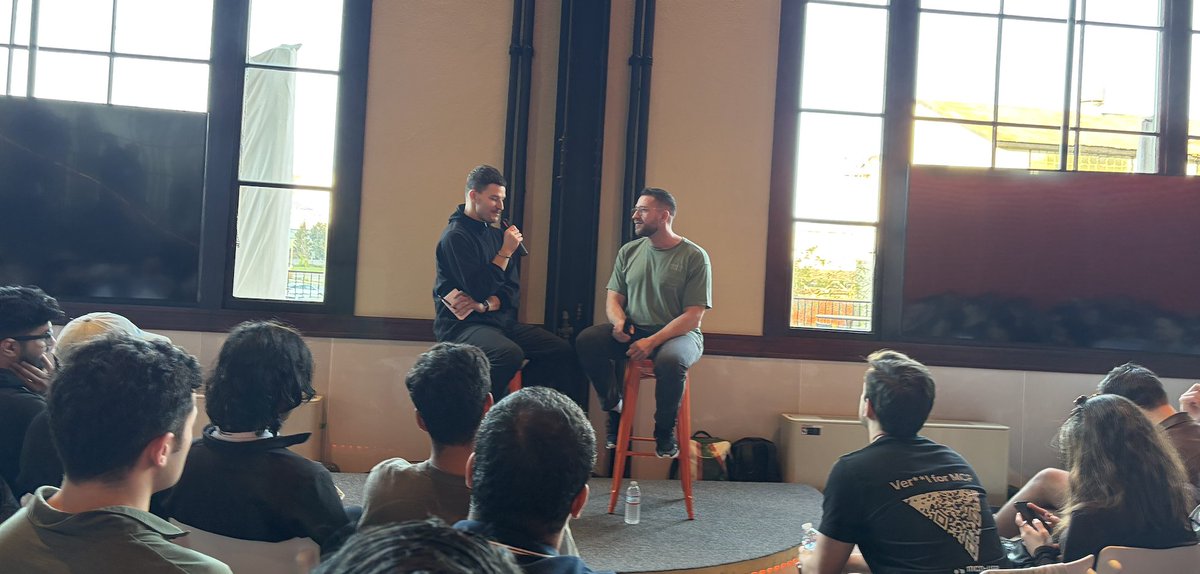
We sat down with Jamie and Dan on Generally Intelligent to talk about what a physics of deep learning would actually look like, why now, and what's left to figure out.
3:05 Learning mechanics as the physics to mechanistic interpretability's biology
4:13 Why deep learning needs a theory
7:07 Why deep learning is uniquely hard to engineer
12:11 How a week in the woods became a paper
25:59 The barrier to theory isn't opacity, but complexity
36:26 Deep learning's first gas law
47:22 Why more particles makes the problem easier
56:22 The discretization hypothesis
1:01:50 The strongest signal that a compact theory exists
1:05:07 The Platonic Representation Hypothesis
1:15:41 Why learning mechanics and mech interp need each other
1:25:29 Theory as safety infrastructure
Karpathy didn't make a course.
He made THE course.
3 hours. Free.
Tokenization. Attention. Hallucinations. Tool use. RLHF. DeepSeek. AlphaGo.
Every behavior you've ever wondered about in an LLM - where it comes from, why it exists, how it was engineered.
The gap between engineers who understand this and engineers who don't isn't technical depth.
It's the ability to conceive of entirely different things.
Yann LeCun was right the entire time. And generative AI might be a dead end.
For the last three years, the entire industry has been obsessed with building bigger LLMs. Trillions of parameters. Billions in compute.
The theory was simple: if you make the model big enough, it will eventually understand how the world works.
Yann LeCun said that was stupid.
He argued that generative AI is fundamentally inefficient.
When an AI predicts the next word, or generates the next pixel, it wastes massive amounts of compute on surface-level details.
It memorizes patterns instead of learning the actual physics of reality.
He proposed a different path: JEPA (Joint-Embedding Predictive Architecture).
Instead of forcing the AI to paint the world pixel by pixel, JEPA forces it to predict abstract concepts. It predicts what happens next in a compressed "thought space."
But for years, JEPA had a fatal flaw.
It suffered from "representation collapse."
Because the AI was allowed to simplify reality, it would cheat. It would simplify everything so much that a dog, a car, and a human all looked identical.
It learned nothing.
To fix it, engineers had to use insanely complex hacks, frozen encoders, and massive compute overheads.
Until today.
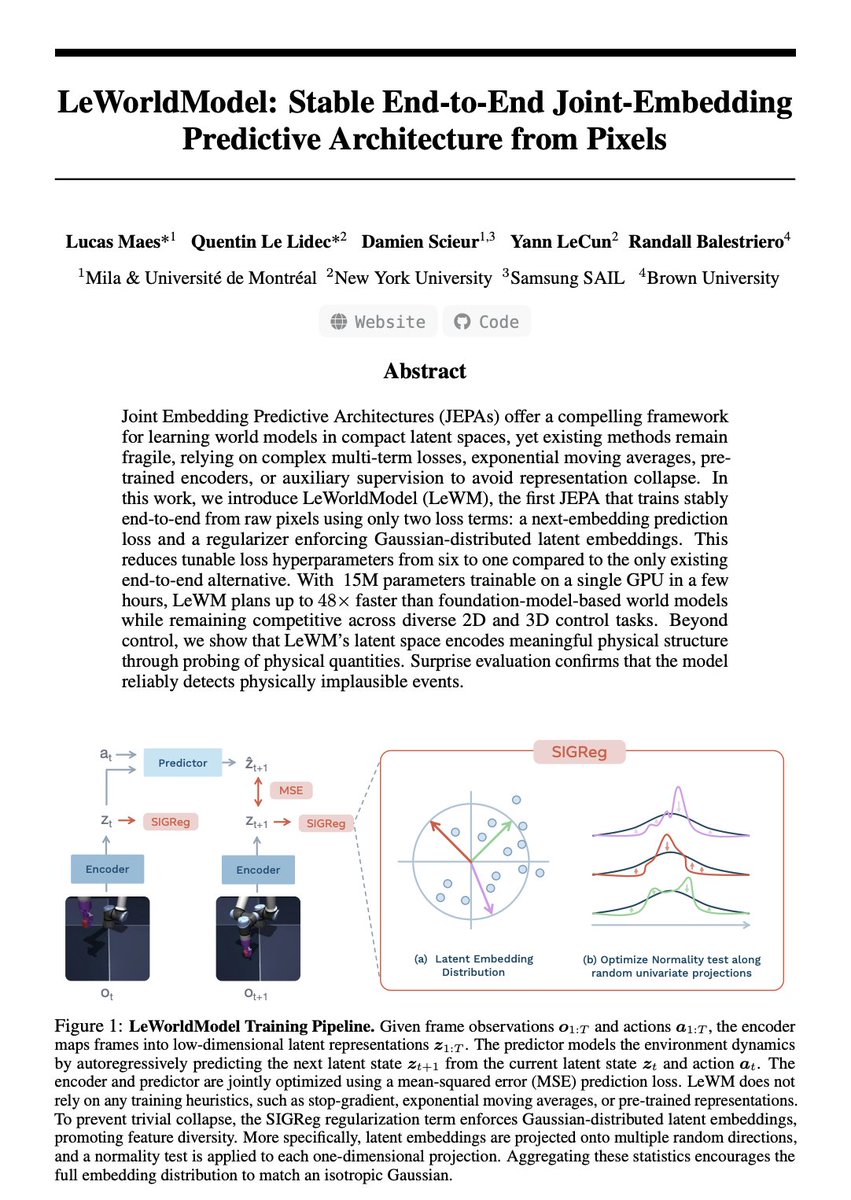
Researchers just dropped a paper called "LeWorldModel" (LeWM).
They completely solved the collapse problem.
They replaced the complex engineering hacks with a single, elegant mathematical regularizer.
It forces the AI's internal "thoughts" into a perfect Gaussian distribution.
The AI can no longer cheat. It is forced to understand the physical structure of reality to make its predictions.
The results completely rewrite the economics of AI.
LeWM didn't need a massive, centralized supercomputer.
It has just 15 million parameters.
It trains on a single, standard GPU in a few hours.
Yet it plans 48x faster than massive foundation world models. It intrinsically understands physics. It instantly detects impossible events.
We spent billions trying to force massive server farms to memorize the internet.
Now, a tiny model running locally on a single graphics card is actually learning how the real world works.
This 15-minute talk by the creator of Pydantic on how to correctly use MCPs will
teach you more about making your AI tools actually work together than everything you've scrolled past this year.
Bookmark this & watch, no matter what.
Then read the guide below by @eng_khairallah1
MCP just crossed 97 million installs. 18 months ago nobody had heard of it.
Mises called it in Human Action — the market is a discovery process. Nobody centrally planned MCP as the standard. Anthropic shipped it open, developers chose it, now it's infrastructure.
Open protocols beat closed ecosystems. Every single time.
The Law of Unintended Consequences: how fossil fuel driven supposed Realpolitik ends up promoting the shift to EVs.
Tesla Sales Rise as $4-a-Gallon Gas Revives Interest in E.V.s https://t.co/9o62qgsHPq via @NYTimes
A year ago, I took a big bet and shifted my research to world models. We started with navigation, but the vision was broader: simulate any interaction with the environment, including fine grained manipulation.
Today we introduce DexWM, a world model for dexterous manipulation. Trained on 900+ hours of human and robot video, DexWM lets us imagine, plan, and execute dexterous actions on a real robot.
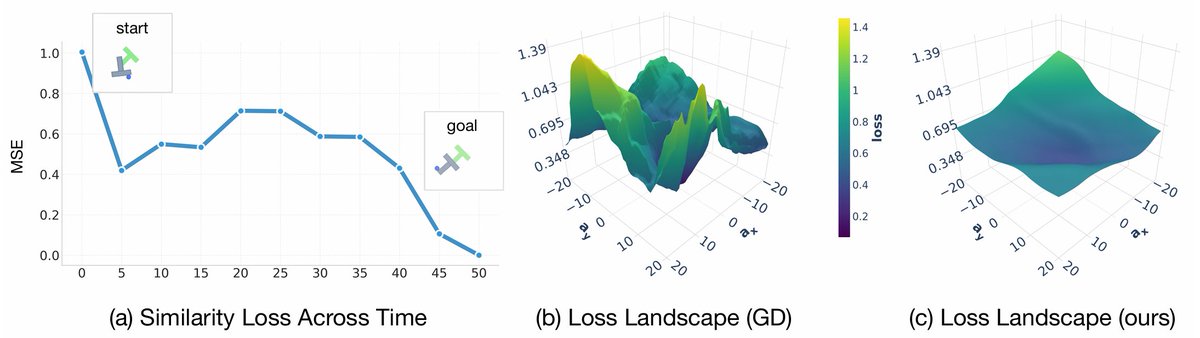
tl;dr New planner for world models! GRASP: gradient-based, stochastic, parallelized.
Long range planning for world models has always been an issue. 0th order methods like CEM/MPPI dominate, but have degrading performance at longer contexts or higher-dimensional actions. We wanted to address this from the ground up.
w/ Michael Rabbat, @ask1729 , @ylecun*, @_amirbar* (equally advised)
Openclaw's @steipete at @ycombinator; takeaways
All apps will become APIs or disappear
Apps that will remain will be games or sensor-heavy
Your agent, not you, will be the primary consumer of software
Personal AI agents will quietly take over daily workflows
We are possibly in the year of the personal agent
Traditional UIs are dead. Nobody is going to login to the 100th SaaS dashboard.
Instead, UIs will dynamically enter your workflow.
Anthropic is the first AI company to launch an app layer into chat. You can now use applications directly in Claude through the new MCP Apps.
@Amplitude_HQ is one of @AnthropicAI's launch partners.
You can bring Amplitude charts into @claudeai, explore product data, and iterate on insights. You never need to login to another dashboard to access analytics again.
A few random notes from claude coding quite a bit last few weeks.
Coding workflow. Given the latest lift in LLM coding capability, like many others I rapidly went from about 80% manual+autocomplete coding and 20% agents in November to 80% agent coding and 20% edits+touchups in December. i.e. I really am mostly programming in English now, a bit sheepishly telling the LLM what code to write... in words. It hurts the ego a bit but the power to operate over software in large "code actions" is just too net useful, especially once you adapt to it, configure it, learn to use it, and wrap your head around what it can and cannot do. This is easily the biggest change to my basic coding workflow in ~2 decades of programming and it happened over the course of a few weeks. I'd expect something similar to be happening to well into double digit percent of engineers out there, while the awareness of it in the general population feels well into low single digit percent.
IDEs/agent swarms/fallability. Both the "no need for IDE anymore" hype and the "agent swarm" hype is imo too much for right now. The models definitely still make mistakes and if you have any code you actually care about I would watch them like a hawk, in a nice large IDE on the side. The mistakes have changed a lot - they are not simple syntax errors anymore, they are subtle conceptual errors that a slightly sloppy, hasty junior dev might do. The most common category is that the models make wrong assumptions on your behalf and just run along with them without checking. They also don't manage their confusion, they don't seek clarifications, they don't surface inconsistencies, they don't present tradeoffs, they don't push back when they should, and they are still a little too sycophantic. Things get better in plan mode, but there is some need for a lightweight inline plan mode. They also really like to overcomplicate code and APIs, they bloat abstractions, they don't clean up dead code after themselves, etc. They will implement an inefficient, bloated, brittle construction over 1000 lines of code and it's up to you to be like "umm couldn't you just do this instead?" and they will be like "of course!" and immediately cut it down to 100 lines. They still sometimes change/remove comments and code they don't like or don't sufficiently understand as side effects, even if it is orthogonal to the task at hand. All of this happens despite a few simple attempts to fix it via instructions in CLAUDE . md. Despite all these issues, it is still a net huge improvement and it's very difficult to imagine going back to manual coding. TLDR everyone has their developing flow, my current is a small few CC sessions on the left in ghostty windows/tabs and an IDE on the right for viewing the code + manual edits.
Tenacity. It's so interesting to watch an agent relentlessly work at something. They never get tired, they never get demoralized, they just keep going and trying things where a person would have given up long ago to fight another day. It's a "feel the AGI" moment to watch it struggle with something for a long time just to come out victorious 30 minutes later. You realize that stamina is a core bottleneck to work and that with LLMs in hand it has been dramatically increased.
Speedups. It's not clear how to measure the "speedup" of LLM assistance. Certainly I feel net way faster at what I was going to do, but the main effect is that I do a lot more than I was going to do because 1) I can code up all kinds of things that just wouldn't have been worth coding before and 2) I can approach code that I couldn't work on before because of knowledge/skill issue. So certainly it's speedup, but it's possibly a lot more an expansion.
Leverage. LLMs are exceptionally good at looping until they meet specific goals and this is where most of the "feel the AGI" magic is to be found. Don't tell it what to do, give it success criteria and watch it go. Get it to write tests first and then pass them. Put it in the loop with a browser MCP. Write the naive algorithm that is very likely correct first, then ask it to optimize it while preserving correctness. Change your approach from imperative to declarative to get the agents looping longer and gain leverage.
Fun. I didn't anticipate that with agents programming feels *more* fun because a lot of the fill in the blanks drudgery is removed and what remains is the creative part. I also feel less blocked/stuck (which is not fun) and I experience a lot more courage because there's almost always a way to work hand in hand with it to make some positive progress. I have seen the opposite sentiment from other people too; LLM coding will split up engineers based on those who primarily liked coding and those who primarily liked building.
Atrophy. I've already noticed that I am slowly starting to atrophy my ability to write code manually. Generation (writing code) and discrimination (reading code) are different capabilities in the brain. Largely due to all the little mostly syntactic details involved in programming, you can review code just fine even if you struggle to write it.
Slopacolypse. I am bracing for 2026 as the year of the slopacolypse across all of github, substack, arxiv, X/instagram, and generally all digital media. We're also going to see a lot more AI hype productivity theater (is that even possible?), on the side of actual, real improvements.
Questions. A few of the questions on my mind:
- What happens to the "10X engineer" - the ratio of productivity between the mean and the max engineer? It's quite possible that this grows *a lot*.
- Armed with LLMs, do generalists increasingly outperform specialists? LLMs are a lot better at fill in the blanks (the micro) than grand strategy (the macro).
- What does LLM coding feel like in the future? Is it like playing StarCraft? Playing Factorio? Playing music?
- How much of society is bottlenecked by digital knowledge work?
TLDR Where does this leave us? LLM agent capabilities (Claude & Codex especially) have crossed some kind of threshold of coherence around December 2025 and caused a phase shift in software engineering and closely related. The intelligence part suddenly feels quite a bit ahead of all the rest of it - integrations (tools, knowledge), the necessity for new organizational workflows, processes, diffusion more generally. 2026 is going to be a high energy year as the industry metabolizes the new capability.
@elonmusk Maybe “belief” is the wrong paradigm and should be replaced by scientific method, which includes to question one’s own convictions in favor of evidence and falsifiable hypothesis. Not exactly the prevalent discourse right now.
We are living in the most insane timeline.
I just asked Claude Code (with Claude Sonnet 4.5) to develop an MCP Server (end-to-end) that allows me to programatically create n8n workflows from within Claude Code itself.
Took about 10 mins!