How cost-effective are NIH Extramural vs Intramural mechanisms? We did internal analysis at NIH but never published. Happy to share some answers: Extramural is better for publications and citations; Intramural is better at basic -> clinical translation https://t.co/S76uJoO4sR
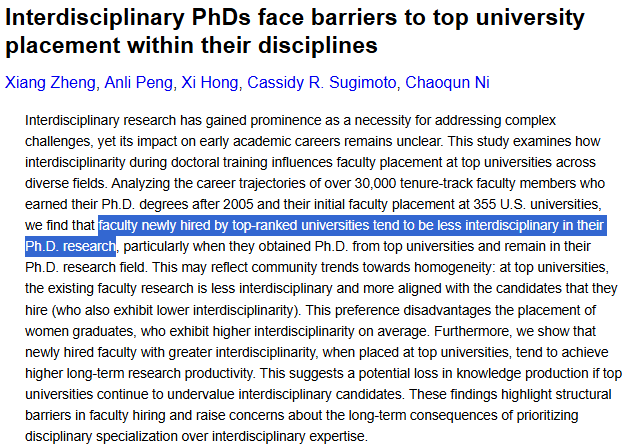
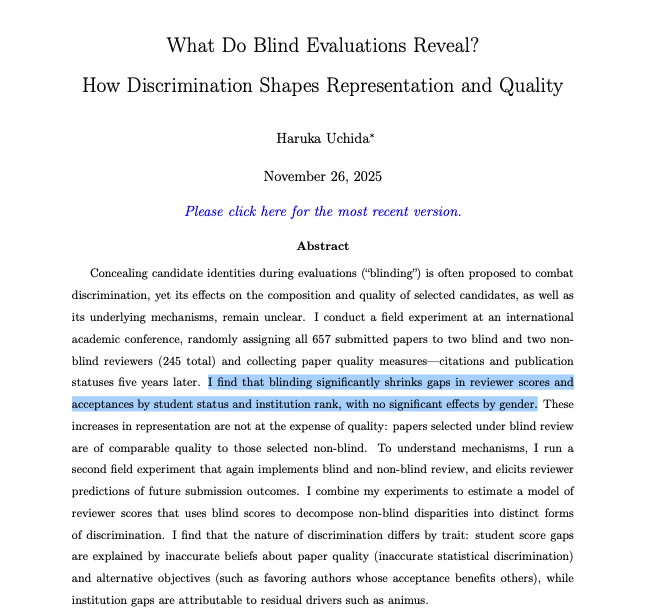
Prestige bias in academic research:
Paper submissions from authors affiliated with top-20 ranked institutions receive higher reviewer scores, an effect that vanishes when reviews are blinded. Blinded reviewing narrows disparities in reviewer evaluations and acceptance rates.
Journal prestige overlooks most influential papers. Our analysis shows that top impact factor journals only catch a small fraction of equally influential articles. There's a lot more science deserving of recognition! #AcademicTwitter#AcademicChatter https://t.co/X5D7TclNi5
Gender inequality is real in the scientific community, and iSchool Assistant Professor Chaoqun Ni (@ChaoqunNi) has illustrated this in her research on the "science of science." Read more about Ni's work: https://t.co/IKmJyMw0xO
#ischool#genderinequality
Many scientists suspect that they do not receive enough recognition for their influential studies, and now we have data to back this up #AcademicTwitter#AcademicScience#ScienceOfScience https://t.co/eraizXf4dA
“approximately half of researchers never publish in a venue with an impact factor above 15, which may exclude them from opportunities. Many of them publish equally influential work; so journal-level measures may recognize as little as 10-20% of work that warrants recognition”
"Chosen journal-level measures (IF) that are routinely considered under decision-making norms may recognize as little as 10-20% of the work that warrants recognition".
https://t.co/SFt5kIYRqC
This work by @ChaoqunNi, @lariviev, @csugimoto and others has just been published as a #ReviewedPreprint in @eLife
https://t.co/pw3uYl1jXv, along with public peer reviews:
https://t.co/BMzZo65REc
"During career advancement and funding allocation decisions in biomedicine, reviewers have traditionally depended on journal-level measures of scientific influence like the impact factor."
It's not that they have "depened" on it. Funding agencies and hiring and P&T committees have actively (and repeatedly) chosen to use that atrocious metric to evaluate individual researchers
https://t.co/BYvE5Y1ExK