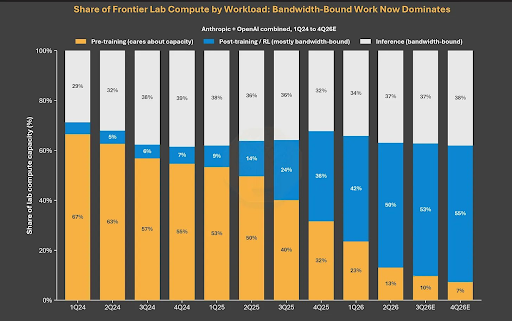
This SemiAnalysis chart is going viral, and it exposes the biggest crack in the entire AI infrastructure boom.
Most market forecasts assume that everyday commercial use of AI would quickly explode to 80%+ of all datacenter activity, easily paying for all the expensive chips and power.
The actual data shows the exact opposite.
Between teaching base models and running reasoning experiments, over 60% of all datacenter compute is burned on training through 2026.
Inference (everyday people and businesses actually using and paying for AI) stays trapped at just 35% to 38%.
Think of it like a factory: if 65% of your power bill goes toward building experimental machines, and only 35% goes toward making products customers actually buy off the shelf, your business model is walking on a tightrope.
Here is why that dynamic breaks the math:
1. AI Startups Are Bankrolling the Construction Boom
Most of this massive datacenter buildout is not backed by consumer subscriptions. It is backed by signed commitments from frontier AI labs (OpenAI, Anthropic). They are spending down tens of billions in venture funding to secure guaranteed hardware contracts on the books of cloud providers.
2. Training Is Pure R&D Expense, Not Revenue
Training an AI does not generate cash. It is pure research spending. When over 60% of your multi-billion-dollar compute cluster is locked in training, you need massive profit margins on that remaining 37% of customer usage just to keep the lights on.
3. The Price War Is Crushing Those Margins
Open-weight models from DeepSeek, https://t.co/AfQvDQCz3I (GLM), and Moonshot (Kimi) are rapidly closing the capability gap. At the same time, closed alternatives like Gemini 3.8 Flash, Meta's Muse, and Grok from xAI are aggressively targeting price-performance. This relentless push toward cost efficiency is forcing OpenAI and Anthropic to roll out cheaper model tiers and slash API rates, gutting the Inference margins labs need to fund their compute bills.
4. The Domino Effect on Power and Land
If AI labs cannot fund their massive training bills with profits from paying users, who pays for the next wave of multi-billion-dollar datacenter campuses?
If venture capital checks or tech giant subsidies slow down, the 60%+ of datacenter capacity allocated to experimental training suddenly hits a brick wall.
The entire AI trade relies on the belief that everyday Inference use will magically grow fast enough to bail out these massive training bills.
That is the bear case.
I am hearing two different narratives
@chamath: 70-75% of revenue is from VC backed companies
WSJ: Around one-fifth of Anthropic's revenue in the first half of 2026 came from just two unnamed customers (rumored to be META, MSFT OR Cursor)
One of these narratives is likely to be true
1% of companies represent 90% of AI spending.
Of that 90%, 80% of this spend are from unprofitable VC backed companies.
So, roughly, $0.70-75 of every dollar of AI spending right now comes from AI companies spending VC investment dollars.
As a result, the revenue quality in AI is currently poor. This happened in previous cycles as well, like cloud when early users of AWS were mostly venture backed startups.
The thing, though, is that before AWS could scale and pull thru GCP and others as legitimate cash machines, there were a few clearing events to sort out these brittle revenues.
This is the extrapolation of Ken’s point. We will need to transition from speculative AI spending to consistent, reliable spend that shows up in public market earnings reports.
This hasn’t happened yet because most of the breathtaking revenue growth comes from LPs investing in VC funds who then send it to startups.
CATL's slower than expected third quarter profit growth triggered an 11% single-day equity drop in Shenzhen and Hong Kong, erasing approximately $20 billion in market value and pulling down Chinese peer battery stocks.
Earnings and Valuation Headwinds:
Q3 earnings missed consensus across operating units due to compressed gross margins, prompting downward revisions from Citigroup, Jefferies, and Morgan Stanley.
CATL's market capitalization has nearly halved since its May peak, compounded by automakers pursuing "de-CATLization" by shifting procurement toward lower-cost rivals.
Total Q3 sales volume surpassed 260 GWh, with energy storage systems accounting for roughly 25% of total volume.
Policy and Fiscal Margin Pressures:
Domestic Consumption Tax: Beijing terminated the 10-year lithium-ion battery consumption tax exemption in July, enforcing a 2% tax effective September 2026.
Export Rebate Rollback: The Chinese government trimmed value-added tax (VAT) export rebates for batteries and set a complete phase-out by 2027, forcing suppliers to renegotiate cost splits with global off-takers.
Pass-Through Limits: CATL indicated it is actively negotiating cost-sharing with customers, but Gavekal Capital noted margin clarity will take at least a full quarter to demonstrate.
Energy Storage and Market Competition
Accelerating grid-scale storage demand from data centers and renewables is being offset by severe industry-wide price discounting.
Morgan Stanley noted that while CATL maintains a quality premium, price wars in storage cells are eroding unit margins amid cooling global EV expansion.
Early Stages of Turnaround……
1. Financial Attrition and Capex Starvation (Tier-2/3 Shakeout)
Divergent cash cushions: While CATL maintains a massive net cash reserve and operating margins above 20%, tier-2 and tier-3 players (such as CALB, EVE Energy, Gotion High-Tech, Sunwoda, and SVOLT) operate at gross margins between 10%–15% and frequently face negative net operating cash flows.
Tighter capital markets: The China Securities Regulatory Commission (CSRC) and state-backed lenders have sharply curtailed equity refinancing, domestic IPOs, and easy debt for industries suffering from structural overcapacity.
The resolution: Without external capital to fund working capital deficits, smaller manufacturers cannot afford the routine equipment overhauls and R&D cycles required to stay competitive. Marginal players will idle lines, scrap planned gigafactories (as already seen with retrenched overseas projects), and quietly exit the market or enter debt restructuring.
2. State-Led Supply Discipline and "Anti-Involution" (反内卷) Policy
Curbs on predatory pricing: China’s central authorities, including the Ministry of Industry and Information Technology (MIIT) and the NDRC, have explicitly targeted "irrational involution" (内卷式恶性竞争). In utility-scale energy storage (ESS) tenders—a major theater of the price war—regulators and state grid operators are phasing out "lowest-price-wins" bidding mechanisms that forced cell makers to sell below cost.
Higher technical and safety barriers: The MIIT has raised technical thresholds for battery expansion projects, enforcing stricter minimum energy density, cycle life, and carbon footprint standards under updated national standards (GB specs).
Restricting local government subsidies: Beijing is curbing provincial and municipal governments from providing cheap land, subsidized electricity, and local guarantees to build redundant battery plants purely for local GDP metrics.
…..but Hurdles Remain
Even though financial attrition and anti-involution policy directives have been active talking points for months, CATL’s stock has suffered a severe valuation de-rating—falling from a peak multiple of 40x–50x forward earnings down to around 16x–20x.
1. "Zombie Capacity" and Municipal Protectionism
In textbook economics, cash-bleeding Tier-2 and Tier-3 manufacturers shut down quickly. In China's regional economic model, they do not:
Conflicting government incentives: While Beijing’s central ministries (MIIT, NDRC) preach "anti-involution" (反内卷), municipal and provincial officials face opposing pressures. Closing a local battery plant means immediate debt defaults for local government financing vehicles (LGFVs), lost tax revenues, and manufacturing layoffs.
Artificial life support: Local state-owned banks and regional governments continue to roll over short-term loans, provide subsidized power tariffs, and arrange captive local procurement for struggling producers (such as SVOLT or regional Tier-3s). As long as plants can cover their variable costs, they keep running, dragging out the supply cleanup from months into years.
2. Carmaker In-Sourcing and Aggressive "De-CATLisation"
The threat to CATL is no longer just rival merchant suppliers like CALB or EVE Energy; it is the automakers themselves:
OEM survival mode: In China’s brutal retail EV price war, automakers are operating near zero margin or taking steep cash losses. They cannot tolerate a component supplier extracting 20%+ operating margins while they bleed.
Captive battery manufacturing: Automakers have aggressively in-sourced packs and cells (e.g., Geely’s Golden Brick battery, GAC’s in-house cell lines, and BYD’s fully integrated Blade ecosystem).
Split procurement tactics: Automakers deliberately award low-margin, high-volume mass-market vehicle orders to Tier-2 suppliers purely to prevent CATL from regaining absolute pricing power, reserving CATL only for premium or flagship configurations.
What Actually Turns the Stock
The inflection point for CATL's share price will not come from policy announcements or reports that competitors are losing money. It will require two concrete operational signals:
Physical line closures: Seeing visible capacity liquidations and failed restructurings among named Tier-2/3 players, rather than temporary production cuts.
Gross margin floor: CATL demonstrating in consecutive quarterly prints that cell gross margins have stabilized around 20%–22% without requiring further price concessions to retain its 40%+ domestic volume share.
The premise that automakers can indefinitely build in-house batteries and prop up Tier-2 suppliers assumes that automakers have infinite capital and that in-house battery plants are economically viable.
In reality, automakers are running into a structural wall on both fronts. The strategy of using captive plants and bleeding Tier-2 players to suppress CATL is already showing cracks for four specific reasons:
1. The "Utilization Curse" of In-House Battery Fabs
Battery manufacturing is an electrochemistry and process-engineering business, not a metal-stamping car assembly line.
The scale threshold: A modern battery cell plant requires at least 30–50 GWh of standardized scale and 75%+ continuous capacity utilization to match CATL’s unit production costs.
The depreciation penalty: If an automaker builds a 20 GWh plant for its proprietary battery (like Geely's Golden Brick or GAC's in-house cell lines) but vehicle sales fall short of optimistic delivery targets, the plant runs at 35%–45% utilization. At that level, fixed-asset depreciation per kilowatt-hour skyrockets. The automaker ends up producing an in-house cell that costs 0.50–0.60 RMB/Wh, while CATL can sell them an equivalent or superior cell off the open market for 0.38 RMB/Wh.
The retrenchment is already underway: Automotive history is littered with carmakers abandoning cell production once cash burn spikes. Nio cancelled its multi-billion-yuan self-developed battery cell manufacturing plant when vehicle losses mounted. Great Wall Motor’s battery spinoff, SVOLT, burned billions in losses, terminated its Shanghai IPO, and shuttered its European gigafactory operations. Outside of BYD (which was a battery maker before it was a car company), full vertical cell integration is a balance-sheet destroyer for automakers.
2. OEMs Are Bleeding Tier-2 Players, Not Nurturing Them
Automakers are not paying Tier-2 suppliers a sustainable margin out of goodwill; they are squeezing them aggressively for maximum price concessions to survive their own retail price war:
Operating on negative cash flow: Tier-2 suppliers (CALB, Sunwoda, EVE Energy) are accepting sub-cost contracts to maintain factory utilization and keep local bank credit lines active.
The warranty and yield risk: When a battery maker burns cash for too long, it cuts maintenance capex, tolerates lower cell yields, and reduces QA testing. In the EV sector, a high battery defect rate triggers catastrophic vehicle recalls and warranty liabilities that can bankrupt an auto brand.
The limit of leverage: An automaker cannot build an 8-year vehicle warranty on an insolvent supplier. Once a Tier-2 supplier’s working capital runs dry or banks refuse debt rollovers, the automaker must either acquire the insolvent supplier (absorbing its losses onto the carmaker's own balance sheet) or return to CATL.
3. Automaker Consolidation Will Precede Battery Consolidation
The fragmented automaker landscape that currently enables Tier-2 battery makers will not survive:
The coming auto brand shakeout: China still has dozens of competing EV brands, many of which survive on local subsidies and venture capital while losing money on every car sold.
Re-aggregation of purchasing power: Over the next 24 to 36 months, the retail EV price war will force a wave of bankruptcies and mergers among weaker automakers. The surviving 5 to 7 dominant auto groups (BYD, Geely, Changan, Seres/Huawei, Li Auto, Xiaomi) will prioritize supply chain security, brand equity, and premium fast-charging capabilities over fractional cell savings on speculative suppliers.
4. The Endgame: The "Semiconductor Foundry" Model
This conflict will resolve the same way the technology sector resolved the microchip fabrication dilemma in the 1990s, when computer makers realized that building their own silicon fabs destroyed capital:
Pack and software stay in-house: Automakers will retain battery pack design, cell-to-chassis (CTC) structural integration, thermal layout, and battery management system (BMS) software. This gives them differentiated vehicle dynamics and safety branding without the burden of cell chemical manufacturing.
Cell manufacturing shifts to joint ventures and foundries: Carmakers will surrender 100% captive manufacturing and instead sign 50/50 joint ventures with CATL (the model CATL already operates with FAW, SAIC, GAC, and Geely) or deploy CATL’s technology-licensing (LRS) framework.
Thanks for reading.
$GOOGL down on news of OpenAI’s frontier models becoming available to buy on the Google Cloud Marketplace.
Why the Market is Treating It with Skepticism (The "Bear" View):
1. Perceived Concession on Gemini’s Standalone Primacy:
Distributing OpenAI’s flagship models (including GPT-6 Astra) and Codex inside Google Cloud's Model Garden is interpreted by some traders as a tacit admission that Gemini cannot win every enterprise AI workload alone.
If large enterprise customers demand OpenAI, Google was forced to carry its arch-rival's software to prevent customers from defecting to Microsoft Azure.
2. The "Agentic Coding" Vulnerability:
Specifically, bringing OpenAI's Codex to Google Cloud strikes a sensitive nerve. On Alphabet's Q2 2026 earnings call, management openly conceded that agentic coding was an area where Google needed to catch up ("There are areas where we have acknowledged we need to improve. Coding and agentic coding is an example of that..."). Hosting Codex on Google Cloud highlights that Google's internal coding agents (like CodeMender/Gemini) still face formidable competition from OpenAI.
3. Margin Dilution on Reselling vs. First-Party Models:
When an enterprise consumes Google’s own Gemini models, Google captures high-margin (65%–75%), 100% first-party software revenue. When an enterprise consumes OpenAI models via Google Cloud Marketplace, OpenAI takes the vast majority of the model fee, leaving Google with only a marketplace take-rate (typically 3%–15%) plus underlying data storage and networking fees.
Why I believe this news Is Structurally Net-Positive for Google Cloud
1. This expands Google Cloud's addressable market:
Some buyers are only interested in OpenAI models and tools (Codex). Previously, Google could not have that business, now it can
2. The "Switzerland of AI" Advantage:
Google Cloud is now the only hyperscaler that offers all three frontier AI families under a single enterprise invoice:
Google Gemini (Proprietary first-party)
Anthropic Claude (Strategic cloud partner)
OpenAI GPT / Codex (Marketplace partner)
@AllVentured Respectfully disagree. Current compute shortage is well documented and corroborated by every single piece of data and qualitative narrative from authoritative sources. It is a real shortage today, no illusions.
Flagged this exact compute-split concern a week ago under @GavinSBaker's thread before the chart started circulating. The AI trade has suffered a major drawdown since then:
https://t.co/skHaVOmAey
This SemiAnalysis chart is going viral, and it exposes the biggest crack in the entire AI infrastructure boom.
Most market forecasts assume that everyday commercial use of AI would quickly explode to 80%+ of all datacenter activity, easily paying for all the expensive chips and power.
The actual data shows the exact opposite.
Between teaching base models and running reasoning experiments, over 60% of all datacenter compute is burned on training through 2026.
Inference (everyday people and businesses actually using and paying for AI) stays trapped at just 35% to 38%.
Think of it like a factory: if 65% of your power bill goes toward building experimental machines, and only 35% goes toward making products customers actually buy off the shelf, your business model is walking on a tightrope.
Here is why that dynamic breaks the math:
1. AI Startups Are Bankrolling the Construction Boom
Most of this massive datacenter buildout is not backed by consumer subscriptions. It is backed by signed commitments from frontier AI labs (OpenAI, Anthropic). They are spending down tens of billions in venture funding to secure guaranteed hardware contracts on the books of cloud providers.
2. Training Is Pure R&D Expense, Not Revenue
Training an AI does not generate cash. It is pure research spending. When over 60% of your multi-billion-dollar compute cluster is locked in training, you need massive profit margins on that remaining 37% of customer usage just to keep the lights on.
3. The Price War Is Crushing Those Margins
Open-weight models from DeepSeek, https://t.co/AfQvDQCz3I (GLM), and Moonshot (Kimi) are rapidly closing the capability gap. At the same time, closed alternatives like Gemini 3.8 Flash, Meta's Muse, and Grok from xAI are aggressively targeting price-performance. This relentless push toward cost efficiency is forcing OpenAI and Anthropic to roll out cheaper model tiers and slash API rates, gutting the Inference margins labs need to fund their compute bills.
4. The Domino Effect on Power and Land
If AI labs cannot fund their massive training bills with profits from paying users, who pays for the next wave of multi-billion-dollar datacenter campuses?
If venture capital checks or tech giant subsidies slow down, the 60%+ of datacenter capacity allocated to experimental training suddenly hits a brick wall.
The entire AI trade relies on the belief that everyday Inference use will magically grow fast enough to bail out these massive training bills.
That is the bear case.
Been pounding the table on this dynamic all week.
If 60%+ of compute is locked in pre and post-training, while open models aggressively compress closed-lab margins, the math breaks. Closed labs lose the cash flow required to fund the next wave of massive training clusters.
Because training eats the lion's share of current datacenter capacity, that puts the entire infrastructure trade in serious jeopardy.
Glad to see this chart finally getting the airtime it deserves.
@KairosPraxis IMO Zuck was including depreciation when he said operating cost. Imagine him looking at an income statement equivalent analysis of 1GW data center, and how it impacts operating income/ eps
Everyone assumes AI agents will destroy retail advertising because algorithms do not click on banner ads.
The actual unit economics tell a completely different story.
When an AI agent buys groceries on your behalf, it does not care about packaging or slogans. It optimizes for three variables: price, ratings, and delivery speed.
That does not kill advertising. It just turns marketing budgets into direct math:
1. Algorithmic Price Subsidies
If a consumer brand wants an agent to pick their product over a rival, buying a sponsored banner is useless.
Instead, the brand bids on DoorDash, Instacart, or Amazon to fund an instant $0.50 discount at checkout. When the agent calculates the total cart cost, that brand becomes the objectively cheaper choice.
The brand secures the volume, the shopper saves cash, and the platform collects an ad fee. The ad dollar simply moved directly into the algorithm's objective function.
2. The Context Window Tollbooth
An AI assistant running via API cannot ingest 5,000 grocery SKUs every time someone orders paper towels. Latency budgets and token limits force the API to return a short list of 5 to 10 items.
Whoever controls that API endpoint decides which three products occupy the top spots of the JSON payload. Brands will pay retail platforms heavily for priority API placement, because if an item is not in those top slots, the model never even knows it exists.
Ad spend is not disappearing. It is shifting from human eyeball capture to API ranking and dynamic price cuts. The aggregators that own the delivery rails and the merchant APIs will capture just as much margin as they always did.
Did China just come to rescue the AI trade?
China Plans AI Export Curbs to Exert Control Over Key Tech, outlines Beijing's draft proposal to place export controls on homegrown advanced artificial intelligence, chip designs, and computing clusters:
Scope of the Curbs: The draft covers 23 AI technologies, restricting overseas transfers of model weights and source code. It applies to models trained on "important data" with at least 2 trillion parameters (such as Moonshot AI’s @Kimi_Moonshot K3 or @Alibaba_Qwen 3.8-Max) or those ranking among the global top 10 in performance, safety, and usage.
Overseas end-users accessing models via apps, websites, or APIs/cloud services are not restricted, and deployments on foreign infrastructure owned by the Chinese provider can receive automatic approvals.
China enacted a temporary registration requirement effective immediately on Friday. This freeze impacts transactions currently in progress, including ongoing intellectual property licensing, overseas transfers, and ownership changes placing domestic technology under foreign control.
$NVDA $AMD $AVGO $MU $NBIS $CRWV
@TMTLongShort If there was much higher demand for “smarter models” the already smart models would not be losing token share to open source.
The pricing power of intelligent models is also questionable given recent price deflation at the frontier.
@GavinSBaker@masayoshisson@3F_Research These are unusual times, where sudden surge in demand and physical constraints in supply are creating increases in spot prices and extending useful life of equipment. Applying this as a base case scenario in your model is a mistake IMHO
Applied Materials' comments during the SEMICON West presentation hit $AMAT, $MU, $KLAC.
1. Refusal to Provide a 2030 Top-Line Revenue or WFE Target
Investors came into the event expecting a comprehensive 2030 financial model (especially after IR promised "new financial targets" in the opening remarks). Instead, both Gary Dickerson and Brice Hill explicitly refused to provide a 2030 WFE forecast or a total company revenue target
2. Underwhelming 2030 Gross Margin Target (54%) and Cost Headwinds
AMAT is already generating 50% company-wide non-GAAP gross margins today, with Semiconductor Systems exceeding 55%. Management's 2030 company-wide gross margin target of 54% implies only ~100 bps of annual expansion over the next four years. During Q&A, C.J. Muse immediately pushed back, noting that silicon mix alone should drive 100 to 200 bps of upside and asking if the 54% target was overly conservative. Brice Hill pushed back on the upside narrative, warning that margins face offsetting headwinds from building new factories, expanding logistics infrastructure, fuel costs, and rare earths.
3. Confirmation of "Memory De-Spec'ing" in Inference and Agentic AI ($MU)
In the very first Q&A question, Vivek Arya asked about industry chatter regarding "memory de-spec'ing" in new AI server architectures. Rather than debunking it, Brice Hill and Mike Sullivan confirmed it is happening: Hill acknowledged that system architects have determined "you need less DRAM for some of the different AI workloads" (specifically inference and agentic AI compared to heavy training workloads) and are tuning systems to optimize memory usage. Sullivan added that some new workloads "can't drive utilization all the way up to the top of the HBM stack" and are re-partitioning storage elsewhere in the system. Even though management argued these workloads are additive overall, validating that architects are actively designing down HBM/DRAM intensity per system is a direct hit to the memory WFE bull case.
4. Warning of a "Non-Linear, Bumpy Ride" From Physical Bottlenecks ($SOX)
Both Gary Dickerson and Brice Hill repeatedly cautioned that WFE growth "won't probably be a smooth curve of growth": Cleanroom Caps: Hill stated that customer cleanroom availability is the primary bottleneck metering how much equipment can actually be consumed in any given quarter over the medium term. Supply Chain Pinch Points: Management noted they have forced suppliers to raise output forecasts every single quarter this year, creating ongoing "pinch points" across manufacturing fixtures, hiring lead times, and test capabilities. Data Center Energy: Management also flagged data center power grid availability and financing as macro pacing factors that will make the trajectory uneven.
5. Direct Attack on $KLA, Onto, and Nova (Spillover to Semicap Peers): Keith Wells announced that AMAT is launching a new line of optical inspection tools in 1H 2027 to aggressively go after the $7 billion optical inspection TAM currently held "monopolistically" by competitors, plus a new "cost-effective" optical inspection platform for advanced packaging to undercut existing tools priced in the tens of millions of dollars. A price and share war in optical inspection and packaging metrology is a direct negative catalyst for process control peers like KLA, Onto Innovation, and Nova.