Beginning July 20, Claude Fable 5 will be included in all Max and Team Premium plans, at 50% of limits.
Pro and Team Standard users will continue to have access to Fable via usage credits, and will receive a one-time $100 credit.
Demand for Fable has been challenging to predict, which is why we rolled it out to subscription plans in stages, extending access several times as we secured additional capacity.
My 24 GB Mac just survived ChatGPT/Codex reaching 106.92 GB of reported memory, with another ~15 GB used by other apps. macOS fought heroically with compression and swap until I could force-quit it.
The likely trigger: several huge full-history Codex subagents restored concurrently, followed by a Git/process storm. I added detailed forensic evidence to the existing @OpenAI Codex issue.
I genuinely love this product — sharing this because I hope the evidence helps the team make multi-agent workflows even stronger ❤️
https://t.co/WO55I6XWwV
Subject: Codex Desktop spawned thousands of child processes and reached 106.92 GB memory usage
Hi OpenAI Support,
I encountered a severe memory issue in the ChatGPT/Codex macOS desktop app.
Environment:
macOS 26.5, build 25F5053d
24 GB physical RAM
ChatGPT/Codex desktop app
Codex Framework version: 150.0.7871.124
What happened:
The macOS “Force Quit Applications” window reported that ChatGPT was using 106.92 GB of memory. The system displayed the “Your system has run out of application memory” warning, and I had to force-quit ChatGPT.
I investigated the macOS unified logs afterward. The evidence suggests this was not a normal renderer memory leak. The ChatGPT/Codex process tree was spawning an abnormally large number of short-lived child processes, including repeated git, bash, node, and related commands.
Observed behavior included:
Groups of Git processes repeatedly starting at intervals of approximately 10 seconds.
Commands such as git add -u and git status being launched by the ChatGPT/Codex process tree.
At one point, process IDs increased by roughly 1,800 within approximately 20–25 seconds, indicating a process-spawning storm.
macOS repeatedly logged messages like:
triggered unnest of range ... of DYLD shared region in VM map ...
While not abnormal for debuggers, this increases system memory footprint
almost permanently (until the shared region is re-slid).
The memory consumed by these child processes and their VM mappings appears to have been attributed to the ChatGPT application coalition, which likely explains why Force Quit showed 106.92 GB for ChatGPT despite the machine having only 24 GB of physical RAM.
The likely sequence was:
A Codex Git/worktree watcher, repository checkpoint mechanism, or similar background component entered a loop.
It spawned thousands of short-lived Git and shell processes.
macOS repeatedly created or unnested DYLD shared-region mappings for those processes.
The accumulated VM footprint was attributed to ChatGPT.
The system exhausted available memory/compressed memory/swap and displayed the out-of-memory warning.
After I force-quit the affected process, a new ChatGPT process started at approximately 03:43:47 local system-log time and memory usage returned to normal.
I cannot identify the exact internal Codex component with complete certainty because the original process tree was already gone by the time I investigated it. However, the process-spawning storm and repeated DYLD shared-region warnings are clearly present in the system logs.
Expected behavior:
Codex background Git monitoring should have bounded concurrency and should not continuously spawn thousands of Git or shell processes.
Actual behavior:
The ChatGPT/Codex process tree spawned an extreme number of short-lived processes, and its reported memory footprint grew to 106.92 GB, making the system unusable.
I can provide the screenshot and relevant sanitized macOS unified-log excerpts if needed.
@thsottiaux
I talk to engineers at other companies every day and hear the same thing: one person is 10x'ing their output with Claude but the rest of the org hasn't caught up.
Watching teams adopt AI, I keep seeing the same 4 steps.
I mapped them out here: Steps of AI Adoption https://t.co/kQnRAUMKpP
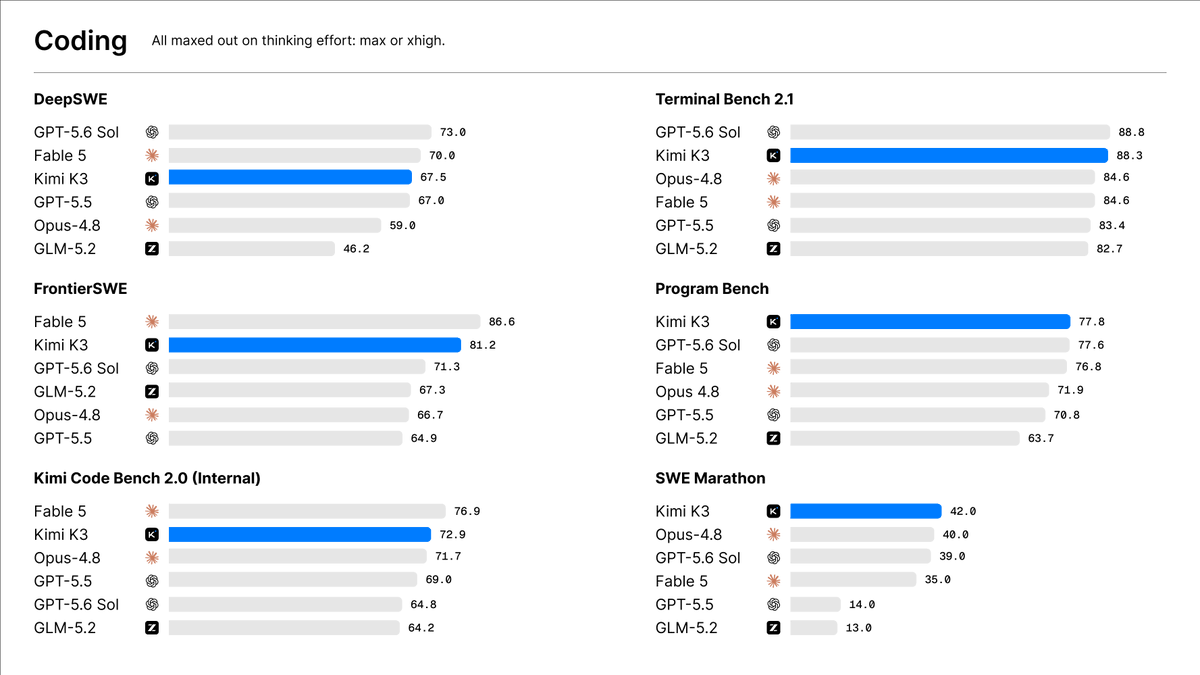
Introducing Kimi K3: Open Frontier Intelligence
🔹 2.8 Trillion Parameters, 1 Million Context, Native Multimodal
🔹 Kimi Delta Attention enables up to 6.3x faster decoding in million-token contexts
🔹 Attention Residuals deliver ~25% higher training efficiency at <2% additional cost
🔹 Built for long-horizon agentic coding and self-evolving workflows
Kimi K3 is now live on on https://t.co/zrk6zZxZUo, Kimi Work, Kimi Code, and the Kimi API.
Open Weights by July 27, 2026.
🔗 API: https://t.co/XCrgjXAqMw
🔗 Tech blog: https://t.co/YTfiMSNM1f
we did not have our best last 12 months ever, which is mostly my fault, but we are about to have our best 12 months to date. the team is doing amazing work and i think you’ll be very happy with what they’ve got cooking for you.
i am happy about this for many reasons, but mostly because i care about our users winning. AI has to be about giving lots of people more freedom, agency, and wealth. we want to do the right thing, but we do not want to scare people into doing our thing.
We've open-sourced Grok Build and have reset usage limits for all users.
Open sourcing Grok Build allows anyone to support making a reliable and robust harness. Check out our code, including the Git repo for the Grok Build CLI.
https://t.co/3SSvPu2Nrz