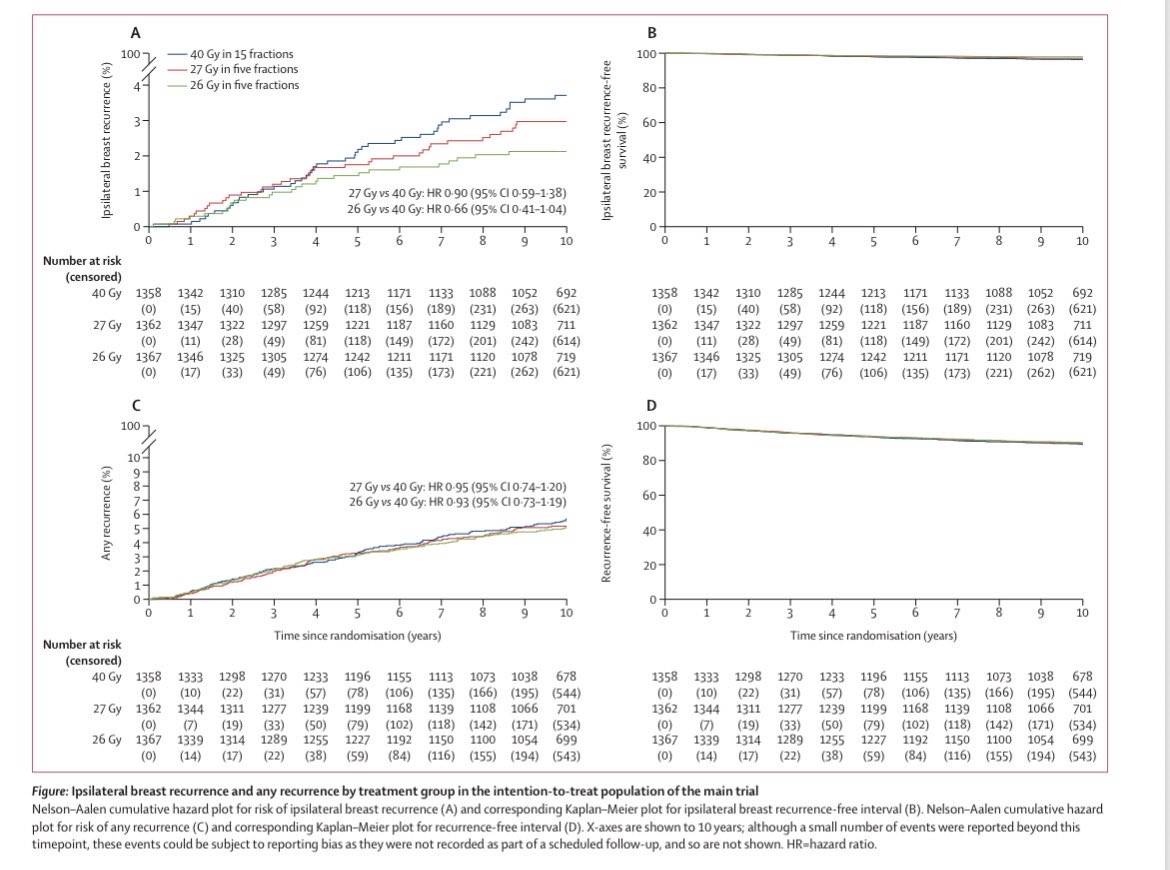
The 10-year results of the FAST-Forward trial, published in @TheLancetOnco, confirm that ultra-hypofractionated adjuvant radiotherapy (26 Gy in 5 fractions over 1 week) provides durable local control with comparable long-term toxicity versus the standard 40 Gy in 15 fractions over 3 weeks in early breast cancer.
Key findings:
10-year ipsilateral breast recurrence: 2.1% (26 Gy/5Fx) vs 3.6% (40 Gy/15Fx)
Similar locoregional recurrence, distant recurrence, and overall survival
Comparable rates of late normal tissue effects
Axillary substudy supports the safety of nodal irradiation with the 1-week regimen
A practice-changing trial that continues to reduce treatment burden without compromising outcomes.
@ESTRO_RT #bcsm #BreastCancer #RadOnc #Hypofractionation #FASTForward #Oncology
#PRIMARY2 trial published in @TheLancetOncol
Can ⁶⁸Ga-PSMA-11 PET/CT reduce unnecessary prostate biopsies after equivocal or non-suspicious mpMRI?
In this phase 3 randomized trial (n=660), PSMA PET/CT in men with PI-RADS 2–3 MRI and high clinical risk:
Avoided biopsy in 49% of patients
Achieved non-inferior detection of clinically significant prostate cancer (12% vs 16%)
Reduced overdiagnosis of clinically insignificant disease (14% vs 32%)
These findings suggest PSMA PET/CT may become an important triage tool after equivocal or negative MRI.
https://t.co/hcWhIrYFLK
Congrats to @ProfMikeHofman, @louiseemmett, @PeterMacCC and the entire #PRIMARY2 team.
#ProstateCancer #PSMAPET #UroOnc #NuclearMedicine
#Missing ASCO26 | EGFR Exon 20 Insertions in 1L NSCLC
EGFR exon 20 insertions account for >12% of all EGFR-mutated NSCLC cases and comprise >100 distinct variants. The most common are A767_V769dupASV and S768_D770dupSVD.
Current approved frontline standard:
Amivantamab + platinum-based chemotherapy (PAPILLON)
Key phase III data:
PAPILLON:ORR 73%, mPFS 11.4 mo → established new standard of care.
EXCLAIM-2:Negative study. Mobocertinib failed to improve outcomes versus chemotherapy.
WU-KONG 28:Sunvozertinib demonstrated promising efficacy (ORR 58.8%, mPFS 10.3 mo) with manageable toxicity and may emerge as a future chemotherapy-free option.
Interesting to see how treatment sequencing evolves as newer exon 20-targeted TKIs move into earlier lines of therapy.
#LCSM #NSCLC #EGFR #OncoTwitter @ASCO@oncoalert1@OncoAlert
I think this was one of the most important datasets for breast oncologists at #ASCO26: the ET-use analysis in the HR+/HER2+ cohort of HER2CLIMB-05.
In HER2CLIMB-05, PFS curves in HR+ patients who received ET appear to be maintained for a longer period, with a lower rate of early progression. In contrast, the curve in patients who did not receive ET starts to decline earlier and more prominently.
This was not an ET-randomized analysis. So it would be methodologically wrong to say directly that “ET improved PFS.” But the direction of the curves is highly consistent with the biology of HR+/HER2+ disease:
Suppressing HER2 while leaving the ER axis untreated may represent undertreatment, particularly in the maintenance setting.
PATINA provides the cleanest comparison here. In PATINA, ET was not the question; it was the backbone. All patients received anti-HER2 therapy plus ET. Even the control arm included ET. Palbociclib was added on top of this backbone and improved PFS from 29.1 to 44.3 months.
So one of the key messages of PATINA was not only “add a CDK4/6 inhibitor.” The more fundamental message was this:
In HR+/HER2+ metastatic breast cancer, the biological backbone of maintenance therapy should be anti-HER2 therapy plus ET.
HER2CLIMB-05 reminds us of the same point from another angle. Disease control appears to be maintained longer in patients receiving ET, while early progression seems more evident in those not receiving ET.
In my view, maintenance treatment in HR+/HER2+ metastatic breast cancer should no longer be thought of simply as “continue anti-HER2 therapy.”
Anti-HER2 therapy is the backbone.
But the ER axis should not be left untreated.
In this patient group, maintenance ET should not be viewed as an optional add-on; omitting it should require a clear clinical justification.
@DrRishabhOnco Impressive progress in stage III disease. However, ALK-positive patients should not receive immunotherapy. With the high ORR of lorlatinib, induction TKI before RT may be an attractive strategy, though prospective validation is needed.
@onder_haka2124@ElisaAgostinett@ErikaHamilton9@OncoAlert Interesting point! However, maintenance T-DXd toxicity may be a limiting factor in clinical practice. Maintenance tucatinib could potentially provide better tolerability while maintaining CNS protection. Future real-world data will help clarify this strategy.
@DrBarbiOnc Very encouraging data in PROC! As more treatment options become available, data on the optimal sequencing of these therapies will be increasingly important, particularly given that the tumor immune microenvironment may change depending on the treatments previously used.
🚨 #ASCO26 Highlights in Metastatic Urothelial Cancer
ADCs continue to reshape the bladder cancer landscape.
Long-term follow-up from EV-302 confirms durable benefit with enfortumab vedotin + pembrolizumab:
• 44% alive at 42 months
• Among patients achieving CR, 83% remain alive at 42 months
A remarkable benchmark in metastatic UC.
New ADCs are entering the post-EV era:
#ASCO26 Abstract 4508 (NEXUS-01) reported early phase 1 data of a novel Nectin-4 ADC carrying a camptothecin payload in EV-refractory mUC.
• 95 heavily pretreated patients
• 69% previously received EV ± pembrolizumab
• Early signals of activity support further development
#ASCO26 #BladderCancer #UrothelialCancer #ADC #EnfortumabVedotin #DisitamabVedotin @ASCO@OncoAlert@Uromigos@urotoday
#ASCO26
In localized dMMR/MSI-H CRC with cCR after PD-1 blockade, stopping immunotherapy appears safe.
3-year DFS:
96.4% (Observation) vs 98.2% (Maintenance)
3-year OS:
100% vs 98.4%
Maintenance therapy increased toxicity:
30.2% vs 1.5% irAEs (P<0.001)
No survival benefit, more toxicity. Active surveillance after cCR may be the preferred strategy.
#CRC #MSIH #dMMR #Immunotherapy @ASCO@OncoAlert
#ASCO26 | Plenary session
SARC041 - ph III Abemaciclib vs pbo in advanced dedifferentiated liposarcoma
1L - 52 vs 50%
EP1 - PFS 9,7 vs 1,5m (HR 0,38 p < 0,001)
OS - NA vs 25,5m (HR 0,28-1,07)
Important advance in relation to previous studies with CT
@WTapMD@Oncoalert
#ASCO26
PROTEUS - periop apa + ADT in localized prostate cancer in RP
Promising data, but:
- Neoadj ADT alone in the control arm (no OS/MFS benefit).
- Is earlier apalutamide use the key driver
- We need OS benefit before practice adoption
@OncoAlert@urotoday#Onctwitter
🚨 #ASCO26 Plenary Session Alert
HARMONi-6 | Lancet 2026
Phase III trial of the anti-PD-1/VEGF bispecific antibody ivonescimab + chemotherapy vs tislelizumab + chemotherapy as first-line treatment for advanced squamous non-small-cell lung cancer (NSCLC).
Key results:
mOS: 27.9 vs 23.7 months (HR 0.66; P=0.0017)
OS at 24 months: 64.7% vs 48.6%
OS benefit including PD-L1 TPS <1% (HR 0.64)
Grade ≥3 TRAEs: 69% vs 59%
A bispecific strategy combining dual PD-1 and VEGF blockade that significantly extended median overall survival, demonstrating a clinical benefit over anti-PD-1 immunotherapy plus chemotherapy in advanced squamous NSCLC.
Published today in The Lancet and to be presented today at the Plenary Session — looking forward to the discussion, especially the detailed subgroup analysis.
@Oncoalert@RManochakian@StephenVLiu@dr_yakupergun