Restake Finance Explained: New Level on Top of Restaking
🔵 Introduction 🔵
In 2023, alongside the active development of LSDFi with the introduction of new primitives and protocols (as detailed in a separate article), a new direction emerged for working with Liquid Staking Tokens (Derivatives) - restaking. This concept was introduced thanks to the EigenLayer protocol, and this direction is evolving at a rapid pace, with new projects actively emerging on top of it. @restakefi is a representative of the ecosystem growing around @eigencloud and LRT.
Before delving into Restake Finance and understanding how it operates, let's first grasp the basics of what EigenLayer represents and how restaking, which stimulated the emergence of Restake Finance, works.
🔵 What is EigenLayer 🔵
At a surface level, the idea of EigenLayer (EL) is quite straightforward: a user stakes their ETH to secure the network in a hypothetical Lido/Rocket Pool or another LSD protocol, receiving LST in return. Subsequently, they can deposit this LST into EigenLayer to yield additional returns. But where does this yield come from?
The key is that EL is not merely a financial protocol issuing derivatives; it is an applied protocol essentially creating a new layer of validators on top of Ethereum. It enables the utilization of LST similarly to how ETH is used on nodes for staking and network security. On the other hand, for validators (node operators) and clients (other projects), EigenLayer offers what is referred to as Actively Validated Services (AVS). In this scenario, security is ensured by the Ethereum chain with legitimate LST.
All AVS (or modules, applications) pay a commission to the EL in their tokens, which is then distributed among the restakers of specific modules.
Since its launch in April 2023, EigenLayer has carved out a significant niche within LSDFi, capturing a substantial volume of LST ($726 million as of January 11, 2023), despite the current storage capacity of EL being rigidly limited:
🔵 Why is Restake Finance needed? 🔵
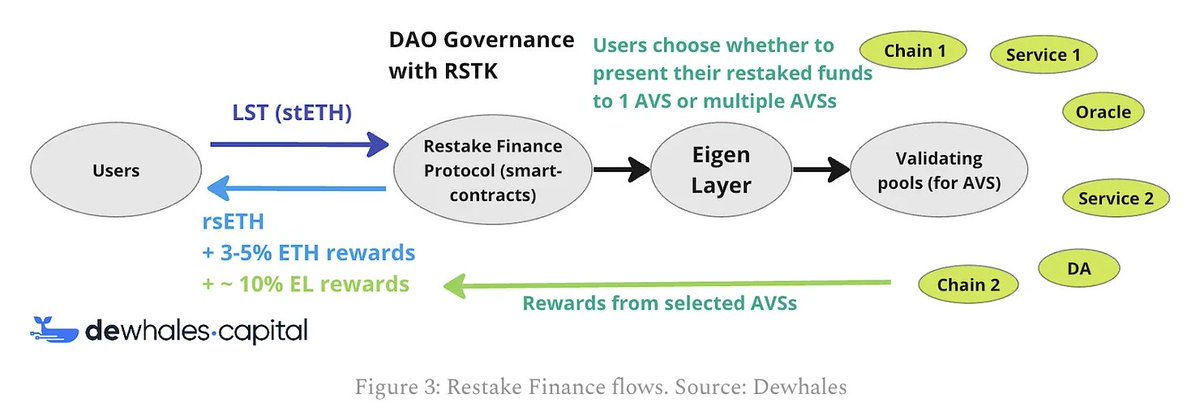
In broad terms, RestakeFi enables users to engage in restaking within EigenLayer through its DApp. Similar to how LSD protocols once provided a liquid wrapper for staked ETH, RestakeFi offers users a liquid primitive for restaked funds - rsETH. With rsETH, users maintain liquidity and can earn rewards from EL. Overall, the concept of RestakeFi is quite straightforward:
Currently, Restake Finance is launched on the testnet and supports only stETH from Lido, which holds a leading position in the LST market (71.2% considering wstETH). However, there are plans to add support for other LST in the future. This is a logical decision as stETH represents more than half of Eigen's total value locked (TVL) ($479 million out of $726 million).
@restakefi will operate based on the Restake Finance DAO, ensuring the project's commitment to the decentralized nature and aligning further development with the interests of stakeholders in the protocol. The DAO will be governed using our utility and governance token — RSTK. Another interesting aspect is that users restaking funds through RestakeFi can choose one or several modules (AVS) to receive desired returns in specific tokens.
🔵 rsETH 🔵
As mentioned earlier, rsETH is a liquid token, LRT, that users receive from RestakeFi in exchange for their LST. Initially, rsETH is presented on the Ethereum network, but the team plans to make it an omnichain token to enhance its usability and applicability across a greater number of protocols and strategies.
Unlike most LSTs, rewards accumulation in rsETH will not be based on the appreciation of value as a reward-bearing token but through a rebase mechanism tied to the stETH exchange rate. The supply of rstETH will grow in line with the updated balance of Ether in the Ethereum beacon chain. Rebase will be performed based on validator performance, executed daily, and the number of tokens in users' wallets will increase depending on the validator's performance. The price peg of rsETH is regulated through arbitrage mechanisms.
🔵 Restaking Finance token: RSTK 🔵
RSTK is the token of the RestakeFi ecosystem and the foundation of the Restake DAO. It is anticipated that RSTK holders will have the ability to govern the protocol, enhance their returns through token staking (both in terms of a share of protocol revenues and native EigenLayer returns), and share in the protocol's earnings.
Restake Finance will impose a fixed fee of 10% on EigenLayer rewards. This fee will be evenly split: 5% will go to our stakers, and the remaining 5% will be directed to their treasury to cover operational expenses.
If a user decides to stake RSTK, they receive sRSTK, which can be exchanged back for RSTK after 45 days from the request date. During this period, users will earn income and have the opportunity to participate in voting.
🔵 Conclusion 🔵
In 2023, we witnessed a rapid development in LSDFi, with the emergence of numerous diverse projects in the ecosystem. The introduction of EigenLayer further complicated the LSDFi landscape, bringing new ways of utilizing Liquid Staking Tokens (LST) with practical applications to ensure the economic security of new projects, along with the additional incentive for LST owners. The emergence of protocols operating on top of EigenLayer, providing users with liquid assets in exchange for LST, analogous to how LSD protocols work with ETH, was only a matter of time.
@restakefi is at the forefront of this movement, offering users an already launched product, and they show no intention of slowing down, continuing the further development of their offering. Due to the potential for additional income beyond the existing returns from ETH, it is natural for people to restake their ETH. Restake Finance aims to facilitate this process, allowing users to seamlessly restake their ETH and capitalize on the opportunity for additional earnings.
📖 Read the full article: https://t.co/3843h8A4I5
💡 For insightful updates & more, connect with us:
• Twitter: https://t.co/CGrGlas5DK
• DeBank: https://t.co/ZphYaoOJvY
Exciting news! $RSTK Revenue share and Staking is now Live.
Stake $RSTK to receive share of the protocol's revenue.
Stake here: https://t.co/rbo7xA7LQq
$RSTK
+ 52% since the tweet yesterday and +86% since my entry - our admin @cryptoronic called it even earlier in our free group.
Let's assume that the $ETH ecosystem will now perform strongly, I am firmly convinced that @restakefi will also continue to perform strongly. The mcap is a joke, compare it with $LDO for example - I'm not saying that it necessarily has to reach this mcap, but the room for growth is massive. Strong volume for days, not yet on any real cex.
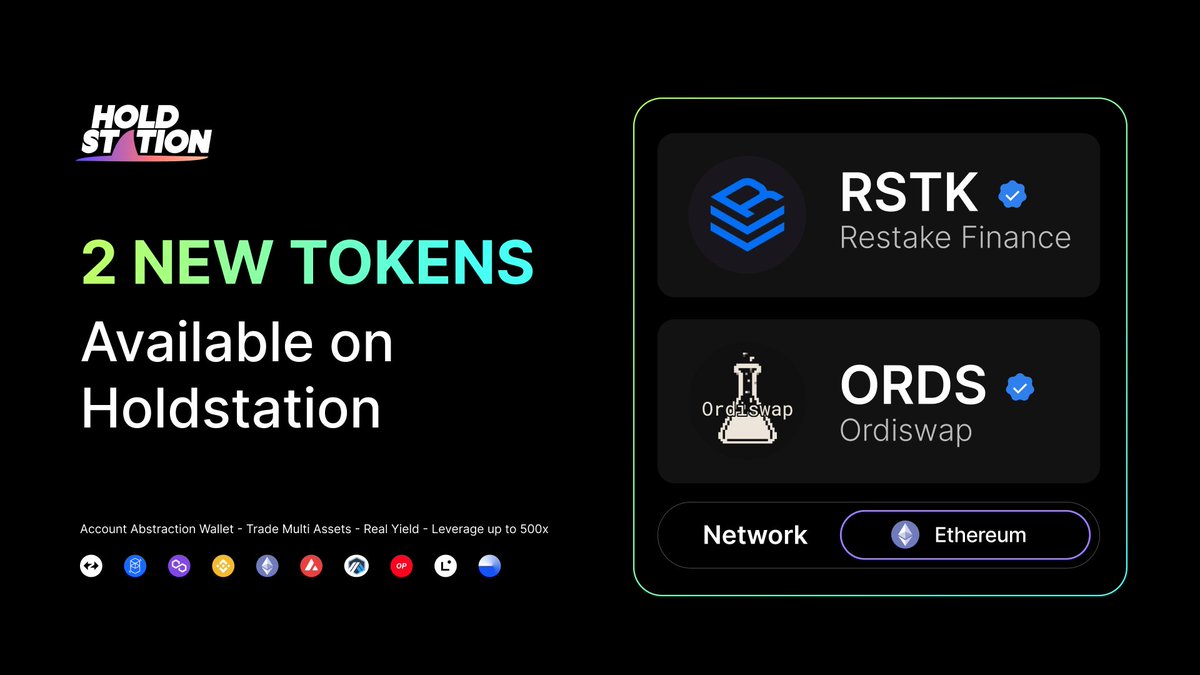
🔔 New Verified Tokens!
#Holdstation Wallet just verified 2 hot tokens 🔥
✪ $RSTK - @restakefi
✪ $ORDS - @OrdiswapLabs
🛡 Swap your verified tokens securely and effortlessly with us
LSDFi represents a significant evolution, using LSDs for creating lending markets, LSD-backed stablecoins, and yield markets. This is just the beginning of possibilities with LSDs.
Restake Finance builds upon this, offering liquid restaking of ETH and maximizing capital efficiency in the Ethereum ecosystem, marking the next step in Ethereum’s evolution.
The transition involved the beacon chain with PoS mechanism, allowing ETH staking. This eventually merged with the main chain, creating the current Ethereum network, ETH 2.0
Post-merge, Liquid Staking Derivatives (LSDs) emerged as a solution to the limitations of traditional Ethereum staking, like the high entry barrier and liquidity issues.
Liquid staking enables users to stake ETH with protocols and receive a 1:1 pegged liquid derivative, allowing participation in various DeFi activities without minimum requirements.
Ethereum initially followed the PoW model, like Bitcoin, but its focus on programmability and heavy usage through smart contracts necessitated a more scalable solution, leading to ETH 2.0.
ETH 2.0 marks a pivotal shift from Proof-of-Work to Proof-of-Stake. This transition wasn't just about efficiency; it was a fundamental change in Ethereum's consensus model, enhancing scalability and speed.
The Ethereum merge, a monumental event in Ethereum's history, occurred just over a year ago. Since then, specifically in the past sixteen months, significant changes have unfolded.
RSTK: The Natural Next Step
We wanted to share an update on our ongoing audit process. We're currently in the thick of auditing with @OpenZeppelin, examining our smart contracts to ensure they meet the highest standards of security and functionality. Progress has been steady, though the holiday season has naturally slowed us down a bit. We're committed to taking the time needed to get this right, focusing on every detail to guarantee the safety and reliability of our platform.
Your patience and understanding during this period mean a lot to us. As we finalise this crucial phase, we want to take a step back to evaluate the broader landscape.
https://t.co/TRuSx4buRA
EigenLayer szn is just getting started. RSTK aims to expand the @eigencloud ecosystem.
We're building an intuitive and innovative experience for our community. Focusing on $RSTK and maximising $rstETH utility and adoption.
A multitude of value-add partnerships with cornerstone DeFi protocols are in the works. We've also begun omnichain exploration, pushing beyond the realm of Ethereum mainnet.
We are fully aligned with EL's vision, and will be live on mainnet before the next restaking cap increase.