The Retention Road by @debgotwired 🥳🎉 has dropped🎙️
This pod is for serious DTC brands that want to focus on retention actively.
Join guests like
- @couuor
- @tayfrays
- @LaCarolinx
and more who share inside secrets to scaling retention.
Episodes 1-3 are out now 🔽
organic social is the one first marketing activity to do when launching a brand.
make native iphone content that’s relevant to the category 👉 attract ICP 👉 get content distribution (views, engagement) going
literally nothing else to do first. even branding. slap some $200 fiver branding on your ig and tiktok and post content while developing the real brand identity.
imagine launching a product but you already have tens of thousands of followers and hundreds of thousands of views that aren’t getting the meta cpm tax
and what does this do for your creator marketing strategy? creators are more likely to work with a pre launch brand w 30k followers and great distribution.
and what does this do for your meta ads strategy? meta targets based on web traffic signal. organic web traffic seasons your pixel faster.
this effect is the real sauce of organic social…
organic social creates the best flywheel.
“but i don’t know what to make” well don’t launch a product in a market you don’t know how to speak to
“but i dont know how to make content im not creator” hire one! heck, hire 5! pay them $ per video.
any brand can run fb ads or pay influencers…
huge arb opportunity in organic social distribution and what it sets in motion.
one the best way to pressure test ideas (how i did it):
- build 2-3 of the v0s for each idea you've got some internal conviction on
- go to niche events where the buyers for each of these ideas are hanging out
- pitch your idea and see how they react (ask questions around how they solve it today and if your product could help, don't argue or force fit)
- if 7/10 folks at each of these individual events say something like "oh bet, i could use that" instead of "yeah, that sounds great - would def try it out", you've got external conviction
no better way, imo, to build conviction than trying to sell the idea itself
If you asked me what @uselayers_ will look like six months from now, the short answer is: agents all the way.
Right now, the product is very good at helping merchandisers automate their work.
You can configure search, adjust sorting, manage collections, and set up rules that save hours of manual effort.
But it still assumes that someone is sitting there making decisions all the time.
The next step is building something that behaves more like a merchandiser than a piece of software.
Layers in six months will have:
1. Agents that can actually do the work
Something like:
“Prioritize products with higher margins in this collection.”
Or
“Push seasonal items higher in search results.”
The agent will then perform those tasks using the logic it has learned from the store’s previous configurations.
2. Agents that suggest improvements
The system constantly reviews customer behavior and catalog data.
When it sees something worth testing, it proposes that change to the merchandiser.
You see the reasoning and decide whether to apply it.
3. Eventually, agents that just run the system
The final stage moves toward autonomy.
The system begins running its own experiments, measuring outcomes, and refining how products appear across the storefront.
The goal is to remove the hours spent on repetitive work so that the human can focus on strategy rather than constant adjustments.
That is what Layers will look like six months from now.
Layers started as a way to automate the work merchandisers already do.
Over the next six months, it will become a system that helps them do that work.
Not many know this, but @uselayers_ started as an agency workaround.
It became a product because the problem kept repeating itself.
At the time, we were running an agency and integrating many search solutions across various ecommerce stores.
That meant we saw the entire market from the inside: the big platforms, their pricing models, their implementation requirements, and the frustration many merchants had with them.
We then started working with a brand that needed something better than the default Shopify search, but the next step up in the market was far outside their budget.
Tools like Algolia worked well, but the pricing and operational overhead made them difficult for many growing brands to justify.
So we began experimenting with open-source search infrastructure and built a thin layer on top of it to give them the functionality they needed.
That internal system became known as Proton Search.
At first, it was nothing more than an internal tool that allowed us to tune search results and control product visibility more precisely for that one store.
But once it existed, we started deploying it across other merchants.
And almost immediately, we realized the same issue existed everywhere.
Over several years, the system evolved into something far more capable than the original experiment.
Eventually, it reached a point where it could compete directly with the platforms we had previously been integrating.
At that stage, we started testing the product with larger merchants through private betas.
The feedback was strong enough that we decided to take the project seriously as a standalone product.
The go-to-market effort began roughly a year ago, although the underlying system had already been in use across multiple stores long before that.
What started as a side project solving a single merchant’s problem gradually became Layers.
6 months ago, I didn't understand sht about coding.
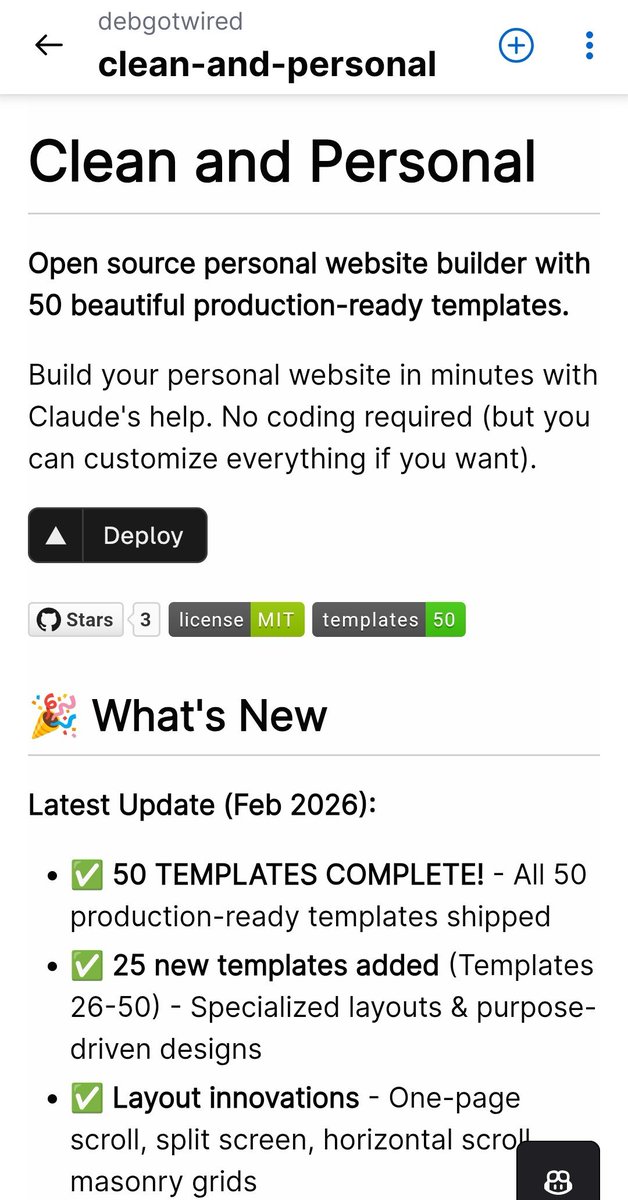
Just last week, I vibe-coded my personal website (debmukherjee .com) with @claudeai code and deployed it on @vercel.
Took the same principles and turned it into an OS personal website builder.