Robin DiAngelo has been MIA ever since I had this heart to heart conversation with her. It’s a shame. I really thought we had a breakthrough moment here.
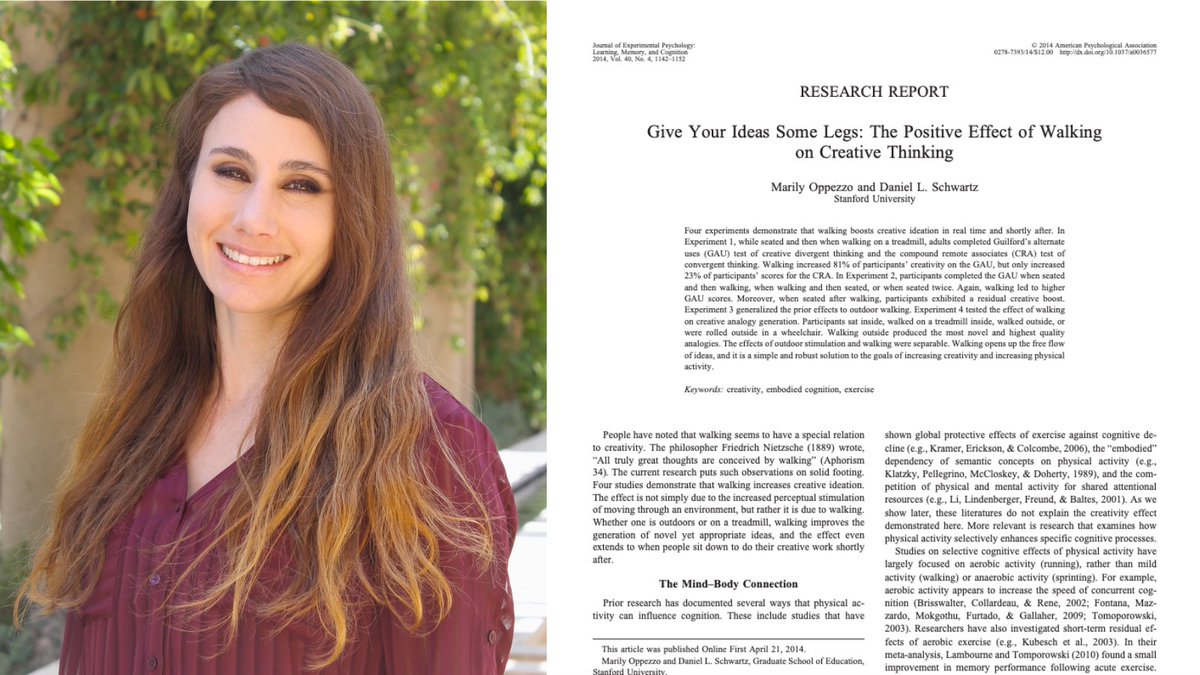
A Stanford psychologist spent 4 years proving that the simple act of walking generates 60% more creative ideas than sitting, and the experiment she designed to kill every alternative explanation is one of the most decisive findings in modern psychology.
Her name is Marily Oppezzo.
She got the idea for the study while walking with her advisor at Stanford to discuss her thesis topic, and the paper she eventually published in the Journal of Experimental Psychology in 2014 is sharp enough that it should have ended the seated meeting on the day it came out.
She ran 4 experiments on 176 people. Same person tested twice. Once sitting, once walking. The creativity tasks were the standard ones psychologists have used for decades to measure how good a brain is at generating novel useful ideas.
The result was almost too clean to publish.
81% of participants in the first experiment produced more creative ideas while walking than while sitting. In the second experiment, 88%. In the third, 100%. Every single person walked into a more creative version of themselves.
On average, people generated 60% more novel useful ideas the moment their legs started moving.
The skeptical question is the obvious one. Maybe it was the fresh air. Maybe it was the scenery passing by. Maybe it was the change of environment doing the work, not the walking itself.
Oppezzo killed every one of those explanations with one experimental decision.
She put people on a treadmill facing a blank wall. No scenery. No fresh air. No environmental change. Just legs moving in place while staring at white drywall. The 60% boost held.
Then she ran the experiment that closed the case completely. She took participants outside in two conditions. Half of them walked through a Stanford courtyard. The other half were pushed through the exact same courtyard in a wheelchair. Same outdoor stimulation. Same scenery passing at the same speed. The only difference was whether the legs were moving.
The walkers produced dramatically more novel high-quality ideas than the wheelchair group. The outdoors did almost nothing on its own. The walking did everything.
This is the part of the study that hit hardest when I read it the first time.
She also tested the opposite kind of thinking. Convergent thinking. The kind where there is one right answer and you have to narrow down to it.
Word puzzles where 3 words share a hidden fourth word that connects them. The seated participants did slightly better on these. Walkers got slightly worse.
Walking is not a general intelligence enhancer. It does one specific thing. It opens up the divergent search inside your brain. The part that generates options. The part that produces unexpected connections. The part that takes a problem and finds five ways into it instead of one.
When you need to converge on the single right answer, sit down. When you need to find the answer in the first place, get up.
The mechanism is now well understood. Walking selectively activates what neuroscientists call the default mode network, the system inside your brain that runs when you are not consciously focused on anything. The DMN is where mind-wandering happens. Where memories cross-reference each other. Where ideas that have been sitting in separate folders inside your head finally bump into each other.
When you sit at a desk and force yourself to concentrate, you suppress the DMN. When you walk at a natural pace, the executive part of your brain gets just busy enough handling the walking that the DMN comes online and starts doing the work that focus was blocking.
The most useful finding in the entire paper is the one almost nobody quotes.
The boost did not turn off the moment people stopped walking. Participants who walked first and then sat back down stayed elevated. Their next round of seated creativity work was still significantly better than people who had been sitting the whole time. The rest lingered for at least several minutes after the legs stopped moving.
You do not need to do creative work while walking. You need to walk before the creative work. The brain holds the state.
The history of this is the part that should haunt anyone who still does meetings in chairs.
Charles Darwin built a gravel loop behind his house in Kent called the Sandwalk and walked it 3 times a day for the rest of his life. The theory of evolution was developed one lap at a time on that path.
Nietzsche walked up to 10 hours a day during the years he wrote his most important books and openly said the work was conceived on his feet.
Beethoven composed for the morning and walked for 5 hours every afternoon with a pencil in his pocket for when something landed.
Kahneman said the best thinking of his Nobel Prize-winning career happened on leisurely walks with Amos Tversky. Steve Jobs refused to take important conversations sitting down. He held them on foot.
Every one of them was using the system Oppezzo would not measure until 2014. They just did not know what to call it.
The question worth sitting with is the one almost nobody asks.
Every meeting you have ever attended sitting around a table was a meeting held at a fraction of the brain power that was actually available to the people in the room. Every brainstorm that got stuck inside a conference room. Every problem you tried to solve at a desk and gave up on. Every idea you could not quite get to.
The intervention is the easiest one in modern science. No supplement. No app. No subscription. No training program. Just a pair of legs and 15 minutes.
The Stanford lab proved it. The philosophers knew it. The neuroscience explains it.
And almost everyone reading this is still trying to think their way out of problems sitting completely still.
The real reason Elon Musk wins has nothing to do with intelligence.
There are thousands of people smarter than Musk. Better engineers. Better physicists. Better programmers. Better managers. He has said this himself publicly and he means it.
His actual edge is something nobody wants to talk about because it can't be taught in a business school or summarized in a framework.
He has an abnormally high pain tolerance for chaos.
Not physical pain. Psychological pain. The kind of pain that comes from having three companies on the verge of bankruptcy simultaneously while your wife is leaving you and the entire internet is calling you a fraud. The kind of pain that makes normal founders sell, quit, pivot, or break down.
Musk doesn't just tolerate that pain. He functions inside it. His decision-making quality doesn't degrade under pressure. It stays constant. Rocket explodes: make calls, fix it, next launch. Stock crashes 40%: ignore it, keep building. Media turns against him: ignore it, keep building. Wife leaves: process it on the factory floor, keep building.
His biographer Ashlee Vance described watching him receive devastating news about a rocket failure and a Tesla production crisis within the same hour. Musk processed both in real time, made decisions on both, and went to dinner. Not because he didn't care. Because compartmentalization is his operating system.
This is the trait that separates founders who build billion-dollar companies from founders who build hundred-million-dollar companies. Not intelligence. Not vision. Not connections. Pain tolerance for sustained chaos without performance degradation.
You can learn strategy. You can hire intelligence. You can build connections. You cannot install a nervous system that doesn't flinch when everything is on fire.
The question isn't whether you're smart enough to build something extraordinary. It's whether you can keep functioning when the building is burning and everyone is screaming and the answer is due in 10 minutes.
Most people can't. That's not a criticism. It's biology. The few who can end up running the world. Not because they deserve to. Because they're the only ones still standing when everyone else has left the room.
DIE AFRIKANER SE ENGELSE PROBLEEM
Ek moet bieg: tot my skande, was my ma op 'n Engelse skool. Jeppe Girls High, in die ooste van Johannesburg. Dieselfde onderwysinstelling wat Ruth First, die aartskommunis en vrou van Joe Slovo, bygewoon het. Blykbaar het die skool haar sedertdien postuum vereer. Dis nou Ruth First, nie my ma nie.
Die Amerikaanse digteres Sylvia Plath het in een van haar gedigte geskryf: "Every woman loves a fascist." Sy moes eerder gesê het: "Every Englishman or -woman loves a communist." Ten minste in Suid-Afrika.
My ma se moedertaal was egter Afrikaans en my ouma was 'n nooi Botha. Haar pa was 'n bittereinder in die Tweede Vryheidsoorlog wat op 12 April 1902 by Rooiwal teen 'n Engelse oormag gewond is. Hy het 'n boek oor sy oorlogsherinneringe geskryf met die titel, "Met ryperd en Mauser".
Daarom het ek nooit 'n woord Engels met my Engels opgevoede moeder gepraat nie. My pa was 'n stoere Afrikaner en hy het toe ek op laerskool was, vir my gedigte van A.G. Visser voorgelees en op die klavier "O Boereplaas, geboortegrond" gespeel en gesing dat die dak daarvan gedreun het. Ek onthou dit soos gister.
'n Ier wie se naam ek nou vergeet, het 'n boek geskryf met die titel, "The Afrikaner's English problem" en as Ier sou hy seker goeie insig daarin hê. Iere is deur Engelse uitgemoor en onderdruk, nes Afrikaners.
Dis 'n baie groot onderwerp. Maar kom ons hou dit by die persoonlike en familieaangeleenthede. Destyds in die ooste van Johannesburg was daar geen Afrikaanse skole nie; vandaar my ma se plasing by Jeppe Girls High. My ooms was ingelyks by Engelse skole, daarna Wits en het agterna met Engelse vrouens getrou. Daarom is my familie aan moederskant geheel en al Engels. My een tante - Shirley was haar naam - het so 'n sproeterige Engelse gesig gehad en het gerook, jenewer gedrink, brug gespeel en eenkeer op TV 'n vasvrawedstryd oor die romans van Charles Dickens gewen.
My een Engelse oom se voorname was Johannes Petrus, wat sy Afrikaanse afkoms weerspieël. Almal het hom "Johan" genoem, maar hy was 'n Engelse Johan. Hoewel ek en my Engelse neefs en niggies kleintyd lekker saamgespeel het, sien ons mekaar deesdae hoofsaaklik by familiebegrafnisse.
My een neef woon in Kalifornië. Sy jonger suster, dus my niggie, is glo baie ryk. 'n Wildvreemde persoon het eenkaar teenoor my genoem dat sy "die helfte van Bedfordview" besit. Bedfordview is 'n redelik gegoede voorstad in die ooste van Johannesburg. Toe ek 'n paar jaar gelede whatsappboodskappe aan haar gestuur het, het ek net blou regmerkies gekry, asof ek 'n vreemdeling was. Deur die riemtelegram het ek ook gehoor dat van my Engelse familie nie daarvan hou dat ek vriende met Steve Hofmeyr is nie. Dalk is dit Steve, dalk het ek nie genoeg geld nie. Ek weet nie.
Ewenwel, ek en my jongste niggie kom nogal goed oor die weg. Sy stel in ons familiegeskiedenis belang en stuur gereeld vir my allerlei brokkies oor wat ons gemeenskaplike oupas en oupagrootjies gedoen het. Onder andere het my oupagrootjie aan moederskant, wat blykbaar die rykste man in Standerton was, sy vrou en kinders na Dresden in Duitsland gestuur toe die Britse konsentrasiekampe in 1900 verrys.
Binnekort gaan ek dalk 'n draai in Dresden maak en dié stad bewandel terwyl ek dink dat my oupa as klein kind hierheen gevlug het om aan die Britse konsentrasiekampe te ontkom. Later sou die Britte en Amerikaners natuurlik 300 000 Duitse burgerlikes in Dresden met brandbomme uitmoor. Sulke "goeie mense", die Engelse. Aan sedelesse teenoor ander volkere, ontbreek dit hulle natuurlik nooit.
Eergister het ek en my Engelse niggie saam gaan koffie drink. Sy woon nou juis in die ooste van Johannesburg en ons het verby my ma se ou skool gery. Sy het ook die huis in Kitchenerstraat, Kensington, waar my ma-hulle gewoon het, aan my uitgewys. Die hele voorstad Kensington wemel van die Engelse name wat Kitchener, Roberts, Milner en Rhodes verheerlik. Daar is ook 'n "Queenslaan".
Ek en my niggie praat Afrikaans. As sy 'n sekere Afrikaanse woord nie verstaan nie, vra sy my om dit te vertaal. Maar vir 'n tweedetaalspreker praat sy eintlik goed. Sy vra so half om verskoning vir al die verskriklike imperiale straatname in Kensington. Daar is glo sprake dat van die name verander gaan word, maar die nuwe name sal ANC-name wees, dus die name van swart Britte.
Ná die warm drankies, eet ons 'n ligte middagete in 'n plek wat sy 'n "bistrot" noem, steeds in Kensington. Ons praat oor familie, maar ook 'n hele verskeidenheid ander onderwerpe. Ek ontvang geraamde foto's van ons stamvaders en -moeders van haar, Bothas en Venters. Na die einde van die gesprek toe, vertel sy my heel ernstig dat haar ma "Afrikaners nie kon verdra nie". Ook haar een ouer suster haat dit steeds om vir sake platteland toe te moet gaan, want "almal daar is só Afrikaans".
Teenoor haar merk ek skertsend op dat Engeland se enigste bydrae tot die wêreld 'n paar verengelste Ierse skrywers was, asook enkele fabrieke vir manskoene in Northamptonshire. Vergeleke met Frankryk of Italië, is Engeland 'n afskuwelik lelike plek vol mense wat baie drink en oneetbare kos verorber.
Wat is Engelse kultuur? Drank, hebsug en status. Op Engels klink dit amper nog beter: "Booze, greed and status."
Ongelukkig het baie Afrikaners die Engelse etos hulle s'n gemaak. Maar gelukkig is "ons nie almal so nie". Om nou Jeanne Goosen, een van die mees oorskatte en waarskynlik anglofiele skryfsters in Afrikaans, aan te haal. My hele lewe lank probeer ek myself verontengels. Ek vlug weg van die Britse Ryk soos my oupa van die Britse kampe.
Hier in die verre noordelike voorstede van Johannesburg, is ek omring daardeur: drank, hebsug en status. Ek is bevrees die swart elite het dié moraal hul eie gemaak. Wit of swart, die Brit kom net in een model. Hy ry 'n Land Rover en koop drank by die kratte vol. Hul huise is so groot soos hul ego's. Hulle sien neer op Afrikaners, want sedert 1806 werk dit mos só. En al regeer die ANC, die Engelsman bly baas. Of ten minste, hy of sy dink so. Kyk maar vir Zille, wat Johannesburg gaan "herower".
Mense hier rond behandel my soos 'n vreemdeling, as iets wat die kat ingedra het. Al het ek beter maniere, al trek ek soveel beter as hulle aan... Maar in hul Engelse wêreld is ek nie belangrik nie, net nog 'n "hardkoppige Afrikaner wat weier om te verdwyn". Jare gelede het ek by 'n sosiale geleentheid in 'n argument oor Afrikaans betrokke geraak met 'n Engelsman wat hom verbeel het dat hy 'n groot finansiële kenner was. Hy was ook 'n vurige ondersteuner van die ANC. Oplaas het hy teenoor my uitgeroep: "You're just a fucking tenacious Boer!"
Hy het dit as 'n belediging bedoel. Maar ek sien dit as iets van 'n kompliment. Dit herinner my aan daardie onsterflike reël aan die einde van "Bart Nel": “My kry hulle nooit. Ja, ek is Bart Nel van toe af, en ek is nog hy.”
Germany has a high GDP, yet Germans remain relatively poor. They don’t own stocks, prefer to rent instead of buying property, spend a fortune on useless insurance, and then complain about inequality.
Folks, you need to take some risk in life if you want to become wealthy.
The haunting sound that Roman soldiers would have heard from their Celtic enemies before battle came from the Carnyx, an ancient wind instrument used between 200 BC and 200 AD.