Latihan wajib bagi para “pejuang” plantar fasciitis : GLUTES EXERCISE 🔥
Ini penting pol tapi sering kelewatan
Note penting :
-Glutes Exercise ini adalah latihan tambahan wajib selain latihan mandiri plantar dan rehabilitasi rutin (Bukan menggantikan)
El chiste favorito de Elon Musk sobre el PIB:
Dos economistas pasean por el bosque. Uno ofrece 100$ al otro por comerse una mierda. Acepta y cobra.
Más adelante encuentran otra. Esta vez, el segundo ofrece los mismos 100$ al primero por comérsela. Acepta.
Is a U.S.–China war inevitable? In Arsenals x Anarchy, Andi Widjajanto, Senior Advisor LAB 45, explores how defense modernization and an unstable multipolar order are reshaping the rivalry between the two powers. The essay highlights nine key insights, from the shifting balance of power in East Asia to the 2036–2042 danger window, when the risk of conflict may peak.
Read the full essay on Cakrawala Strategis LAB 45: https://t.co/1GjQfs3Rkx
#ArsenalsxAnarchy #CakrawalaStrategis #LAB45 #USChina #Geopolitics
Teman2 yang lagi cari rumah di Jabodetabek, bisa cek web buatan tim jurnalisme data @hariankompas ini. Di web ini ada data 37 ribu rumah, lengkap dengan lokasi, luas, harga, dan jarak ke pusat kota. Bisa filter berdasar penghasilan juga 😃
Cek di sini: https://t.co/wqQRkKNvKm
hari ini seru banget~ got so many insights on green economics and why Indonesia Emas 2045 is actually not some random wishful thinking. turns out, a lot of the groundwork has been thought through way earlier than i realized.
what stayed with me the most: building human capital is not just about producing smart people, but creating a culture that keeps them curious, adaptable, and hungry to grow. HC can deteriorate when the culture around it starts rewarding complacency. staying ahead of the curve means making sure our people don’t get too comfortable with what already works.
Demis Hassabis says he can cure every disease in 10 years.
Most people roll their eyes when they hear this, but I don't.
Demis is the guy who just won the Nobel Prize for solving protein folding with AI (a problem biologists had been stuck on for 50 years).
But that was just one milestone in his much grander plan.
In 2010, he founded DeepMind with a 2-part mission: "solve intelligence, then use it to solve everything else."
Step 1: make AI good enough to do real science.
Step 2: point that AI at humanity's biggest problems.
Step one was AlphaFold.
He used AI to figure out the 3D shape of every protein in nature (which is basically what every drug attaches to).
Demis said it would have taken "a billion years of PhD time" to do by hand.
Step two is curing all disease.
And as of today, step two is fully funded.
Isomorphic Labs (his AI drug discovery company inside Google) just raised $2.1B led by Thrive Capital.
Here's where the money goes and what Demis thinks happens next:
> Drug discovery currently takes 5-10 years and costs billions per drug. That math is why most diseases don't have good treatments today.
> AI fixes the math. Their drug design engine compresses development from years to months. Maybe weeks.
> Isomorphic's first AI-designed cancer drug enters human trials this year.
> Their pipeline expands beyond the current 17 programs across cancer, immune diseases, and heart disease into more health domains.
> The endgame is personalized medicine: drugs designed overnight for your specific biology and your specific disease.
That last one is the whole point.
Today's drugs are mass-produced for an "average" patient who doesn't really exist.
So most existing treatments work inconsistently from person to person, and most rare diseases never get a treatment at all (no market = no drug).
When drug design gets fast and cheap, that whole calculus flips.
Cancer variants get drugs designed for that specific variant, rare diseases get treatments because economics stop mattering, and drug-resistant infections get new drugs faster than they can evolve.
That's what curing every disease actually looks like.
Now imagine what your life looks like in 2036.
A doctor draws your blood, sequences your genome, sends your disease profile to an AI.
By morning the AI has designed a custom drug for your specific biology.
Side effects, dosage, drug interactions all worked out before you take the first pill.
You and your kids never see a cancer ward.
That's what $2.1B is buying today.
Demis was right about AlphaFold.
If you consider the possibility that he's right again, every disease alive today is on borrowed time.
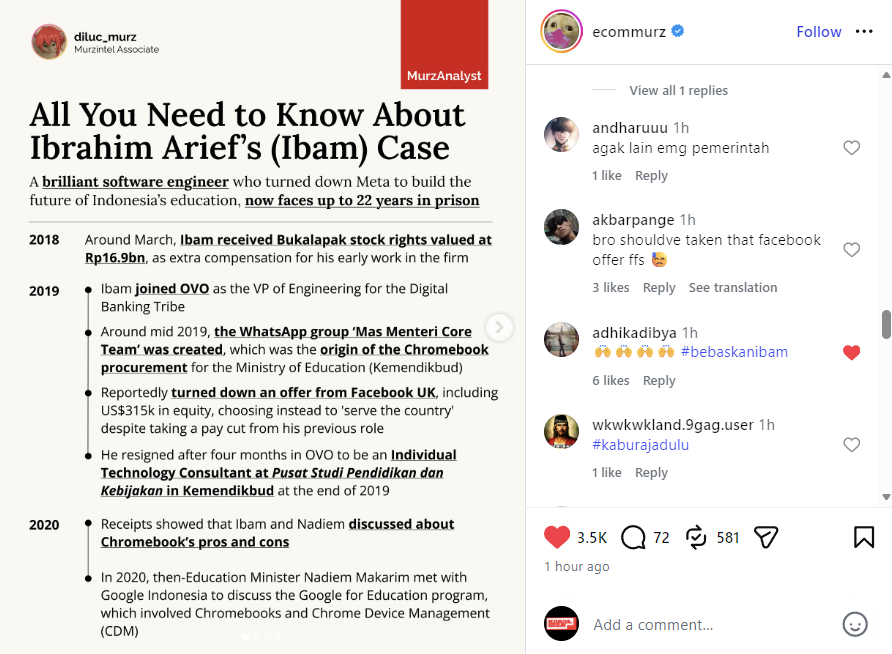
Hi @ecommurz 👋🏼 Ini Ririe, makasih supportnya!
Ibam titip pesan. Kenapa dia mau fight kriminalisasi sampai titik darah penghabisan, karena ingin ujungnya semua bisa teriak lantang:
"Ngga perlu takut bantu Indonesia!"
11 hari jelang putusan, teman2 mohon bantu share di IG ya 🙏🏼
I don’t think people realize how big this is.
GPT-5 is now proposing experiments, executing them in autonomous labs, learning from the results, and iterating.
36,000+ reactions.
40% cost reduction.
This is not software anymore.
This is automated scientific progress.
Ralph may be the most important thing to learn in AI right now.
Someone used this technique to deliver an entire contract that would have cost $50,000 to outsource. Total API costs: $297. At a Y Combinator hackathon, teams shipped 6 working repositories overnight using the same approach. Geoffrey Huntley, who invented this, built an entire programming language over 3 months while barely touching his keyboard.
Ralph is a bash loop that runs an AI coding agent repeatedly until a task is done. That’s it. While you sleep, while you eat dinner, while you do anything else, the loop keeps going. It picks up a task, builds it, checks if it works, saves the progress, picks the next task. When you wake up, features are finished.
Why this works when normal AI coding fails: most people open Cursor or Claude with a vague idea and no structure. 45 minutes later they’re fixing the same bug for the third time. The AI forgot what they were building. The context got polluted. They’re frustrated and nothing shipped.
The problem is task size. One feature has 20 pieces. The AI tries to hold all of them at once. It can’t. It hallucinates. It contradicts itself. You end up babysitting.
Ralph fixes this by breaking work into pieces small enough that the AI finishes each one before it forgets what it’s doing. Each loop iteration starts fresh. Clean context. No accumulated confusion. Memory persists through git commits, a progress file, and a task list. The AI reads what happened last time, learns from mistakes, picks the next task.
The workflow:
Step 1: Describe what you want in plain language. Talk for 2-3 minutes. “I want users to filter tasks by priority. High, medium, low. A dropdown with all three options plus ‘all’. Selecting one filters the list immediately.” Then tell the AI to convert your rambling into a formal requirements list.
Step 2: Break requirements into atomic tasks with binary success criteria. Good: “Add a priority column that defaults to medium.” Bad: “Make it work well.” The AI needs to know when it’s done without asking you. Pass or fail. Yes or no.
Step 3: Run the loop. Ralph grabs a task, builds it, runs tests, commits if it passes, moves to the next one. You set a limit (10 rounds, 14 rounds, 20 rounds). It runs until everything passes or hits your limit.
The math is brutal. A typical Ralph run: 10 iterations, roughly $30 in API costs. A senior developer costs $400-600 per day fully loaded. If Ralph gets you 90% there and you spend an hour on cleanup, you just converted an 8-hour workday into 1 hour plus $30.
That’s $500+ of labor arbitrage per feature. Compound that across a month of building.
Ralph can replace the majority of outsourcing for greenfield projects. The technique is “deterministically bad in an undeterministic world,” meaning when it fails, it fails predictably. You tune it like a guitar. When Ralph screws up a specific way, you add a guardrail to the prompt. The failures become instructions.
The real shift is in role. You stop being the person who writes code. You become the person who writes requirements, defines acceptance criteria, and reviews output. Product designer, not engineer.
“Software development as a profession is effectively dead. Software engineering is more alive than ever.” The people who understand systems, architecture, requirements, and quality will thrive. The people whose value was typing code faster are already obsolete.
The gap forming right now: builders who know Ralph are shipping 5-10x more than everyone around them. Nobody understands how. The technique is free and open source. The barrier is just knowing it exists and spending 30 minutes to understand the pattern.
Three months from now this will be in every YouTube tutorial and paid course. The window is right now, while most developers are still prompting Claude one function at a time and wondering why AI “doesn’t work for them.”
https://t.co/Z3WtUel1uH
gue kira ditawar gaji setengah dari gaji gue sebelum S2 udah menyedihkan, temen gue ditawar ga nyampe UMR jkt padahal kerjaan dia sblm S2 udah ngasih rumah dinas :””””
this is how simple it is. what u think ?
face consistency continues
{
"lighting": {
"source": "Low artificial indoor light, likely from a faint room lamp or ambient night light",
"quality": "Very dim, soft and subdued with gentle illumination on the face and upper body",
"shadows": "Soft and subtle, minimal contrast, blending into the dark background",
"direction": "From above and slightly to the side, casting gentle shadows along the jawline and under the chin"
},
"background": {
"context": "Intimate bedroom at night, person lying in bed with head on pillows",
"setting": "Personal bedroom, cozy and dimly lit atmosphere",
"elements": [
"Dark, almost black background with no visible details",
"White pillows propping up the head, soft and plush",
"White bedsheets partially visible around the neck and shoulders"
]
},
"typography": {
"details": [],
"text_visible": "No"
},
"composition": {
"framing": "Close-up vertical portrait, focused on face and upper shoulders",
"perspective": "Slightly overhead and angled from the front, capturing the subject in profile view turned toward the camera",
"depth_of_field": "Shallow, sharp focus on face and towel, background softly blurred",
"rule_of_thirds": "Eyes and face aligned along the upper third, creating emotional balance",
"subject_placement": "Centered with face slightly off to the left, drawing gaze inward"
},
"color_profile": {
"contrast": "Low to moderate, soft lighting emphasizing emotional subtlety",
"saturation": "Very low, desaturated and monochromatic tones",
"color_palette": "Cool and muted with emphasis on whites and shadows",
"dominant_colors": [
"Pale fair skin with subtle pink flush on cheeks and around eyes",
"blonde hair partially visible under towel",
"Pure white towel turban and t-shirt",
"Deep black/dark gray background",
"Soft white from pillows and sheets"
]
},
"technical_specs": {
"focus": "Sharp on eyes, tears, and facial contours; soft on fabric textures",
"exposure": "Slightly underexposed to enhance intimacy, face gently lit",
"lens_type": "Wide-angle smartphone rear or front camera (minimal distortion)",
"resolution": "High-resolution smartphone photo",
"camera_type": "Smartphone camera in portrait mode, low-light optimized"
},
"subject_analysis": {
"eyes": {
"gaze": "Half-closed or softly gazing off-camera, conveying quiet sorrow",
"color": "dark brown",
"expression": "Watery, reddened, with tears pooling and tracing down cheeks, deep emotional vulnerability"
},
"face": {
"shape": "Soft oval",
"makeup": "Minimal natural look, no visible makeup, skin shows natural redness and gloss from tears",
"complexion": "Fair, slightly flushed on cheeks and nose, moist and glistening from crying",
"expression": "Subtle pout on lips, downturned mouth, raw sadness and exhaustion"
},
"hair": {
"color": "blonde with natural highlights and streaks",
"style": "straight hair wrapped in a loose white towel turban, no loose strands visible",
"length": "Medium to long, concealed under towel"
},
"pose": "Lying on side in bed, head resting on white pillow, face turned slightly toward camera, relaxed and weary",
"clothing": {
"top": "Loose-fitting white short-sleeve t-shirt, soft and slightly wrinkled",
"bottom": "Not visible"
},
"age_group": "Late teens to early 20s",
"accessories": [
"White towel turban wrapped around head"
],
"subject_type": "Young woman, early 20s",
"hands_gestures": "Not visible in frame"
},
"artistic_elements": {
"mood": "Poignant, introspective, tender sadness, post-shower vulnerability",
"style": "Candid, serene low-light portrait, authentic and unretouched emotional depth",
"texture": "Soft towel fabric folds, plush pillow texture, dewy skin with tear trails, subtle fabric creases on shirt"
},
"generation_parameters": {
"seed": "Random",
"model": "Photorealistic low-light portrait",
"prompt": "Vertical 9:16 smartphone portrait of a young woman lying on her side in a dark bedroom at night, head resting on a white pillow, looking softly toward the camera with a sad, vulnerable expression. Visible tears on her cheeks, reddened watery light eyes half-closed, subtle pout on lips. hair wrapped in a loose white towel turban. Wearing a loose white t-shirt. Very dim soft lighting with gentle shadows, dark background with white pillows and sheets. Raw, emotional, intimate, unfiltered mood. Natural fair skin with flush from crying, no makeup. Authentic low-light smartphone photo aesthetic, serene and melancholic.",
"negative_prompt": "bright lighting, outdoor scene, heavy makeup, smiling, energetic pose, jewelry, accessories beyond towel, harsh shadows, high contrast, filtered effects, overexposed whites, multiple subjects, dynamic angles, text or overlays"
},
"aspect_ratio": "9:16"
}
A number of people are talking about implications of AI to schools. I spoke about some of my thoughts to a school board earlier, some highlights:
1. You will never be able to detect the use of AI in homework. Full stop. All "detectors" of AI imo don't really work, can be defeated in various ways, and are in principle doomed to fail. You have to assume that any work done outside classroom has used AI.
2. Therefore, the majority of grading has to shift to in-class work (instead of at-home assignments), in settings where teachers can physically monitor students. The students remain motivated to learn how to solve problems without AI because they know they will be evaluated without it in class later.
3. We want students to be able to use AI, it is here to stay and it is extremely powerful, but we also don't want students to be naked in the world without it. Using the calculator as an example of a historically disruptive technology, school teaches you how to do all the basic math & arithmetic so that you can in principle do it by hand, even if calculators are pervasive and greatly speed up work in practical settings. In addition, you understand what it's doing for you, so should it give you a wrong answer (e.g. you mistyped "prompt"), you should be able to notice it, gut check it, verify it in some other way, etc. The verification ability is especially important in the case of AI, which is presently a lot more fallible in a great variety of ways compared to calculators.
4. A lot of the evaluation settings remain at teacher's discretion and involve a creative design space of no tools, cheatsheets, open book, provided AI responses, direct internet/AI access, etc.
TLDR the goal is that the students are proficient in the use of AI, but can also exist without it, and imo the only way to get there is to flip classes around and move the majority of testing to in class settings.
Hinton, the godfather of AI, said it best: we built the learning algorithms, but we no longer understand what they’ve built.
That’s the paradox of deep learning. We designed the rules for how these systems learn, yet the internal logic of their neural networks has become too complex for us to fully grasp. Millions or even trillions of parameters interact in ways no human can trace.
We can observe what they do, we can measure accuracy, behavior, and output but not truly explain why they do it. Their reasoning isn’t transparent; it’s emergent.
In a sense, we’ve created alien intelligences born from our math, still tethered to our code yet evolving patterns we can’t decode. The machines are doing something beyond our comprehension and that might be both the most exciting and the most unsettling thing about the age of AI.