After visiting Taipei, I've become a road-width extremist
I used to be fully anti-car, but now I think if you simply make most roads barely 1 car wide and get rid of on-street parking, it gets you 95% of what you want
Taipei has a grid of major 6-8 lane roads through the city, but most inner roads are ~1.5 cars wide and cars go slow and yield to pedestrians on them
Having two different road types provides a nice clarity: the big roads are for cars, but cars are guests on the small roads
Here's a satellite view of near where we were staying. You can see the grid of major roads, but also the tiny interior neighborhood streets
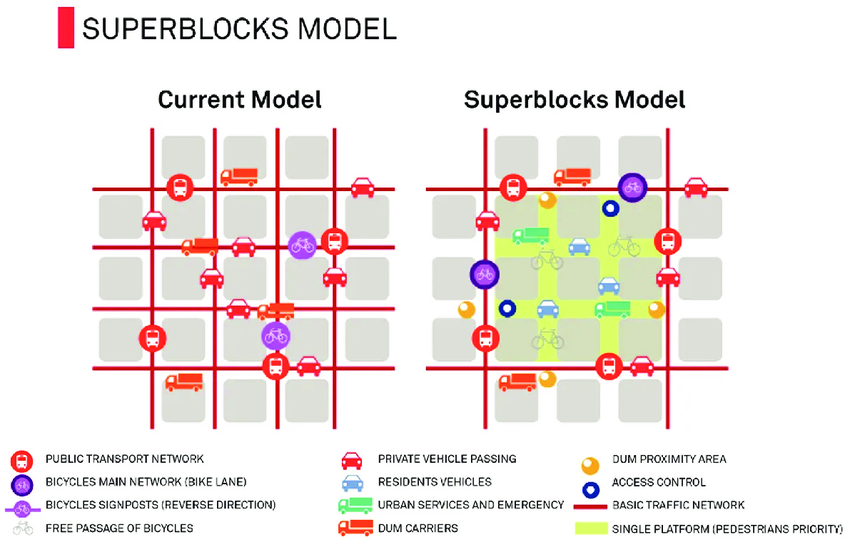
This effect is kind of what Barcelona is trying to retrofit with their superblock project.
Like most US cities, Barcelona is filled with lots of medium-large roads as the default. These are just large enough to be uncomfortable for pedestrians.
But if you can funnel most traffic onto a grid of "major" roads, you can designate the roads within the grid blocks as minor and pedestrian-first.
Since US cities are already built, adopting the Barcelona model is probably the best path forward, but newly-built developments should consider the Taipei model.
I once learnt that there is no such thing as overcommunication in corporate environments. While some information needs to be protected, consider why the information needs to be safeguarded as such.
The 37signals Guide to Internal Communication
The how, where, why, and when we communicate. Long form asynchronous? Real-time chat? In-person? Video? Verbal? Written? Via email? In Basecamp? How do we keep everyone in the loop without everyone getting tangled in everyone else’s business? It’s all in here.
Rules of thumb, and general philosophy
Below you’ll find a collection of general principles we try to keep in mind at 37signals when communicating with teammates, within departments, across the company, and with the public. They aren’t requirements, but they serve to create boundaries and shared practices to draw upon when we do the one thing that affects everything else we do: communicate.
1. You can not not communicate. Not discussing the elephant in the room is communicating. Few things are as important to study, practice, and perfect as clear communication.
2. Real-time sometimes, asynchronous most of the time.
3. Internal communication based on long-form writing, rather than a verbal tradition of meetings, speaking, and chatting, leads to a welcomed reduction in meetings, video conferences, calls, or other real-time opportunities to interrupt and be interrupted.
4. Give meaningful discussions a meaningful amount of time to develop and unfold. Rushing to judgement, or demanding immediate responses, only serves to increase the odds of poor decision making.
5. Meetings are the last resort, not the first option.
6. Writing solidifies, chat dissolves. Substantial decisions start and end with an exchange of complete thoughts, not one-line-at-a-time jousts. If it’s important, critical, or fundamental, write it up, don’t chat it down.
7. Speaking only helps who’s in the room, writing helps everyone. This includes people who couldn’t make it, or future employees who join years from now.
8. If your words can be perceived in different ways, they’ll be understood in the way which does the most harm.
9. Never expect or require someone to get back to you immediately unless it’s a true emergency. The expectation of immediate response is toxic.
10. If you have to repeat yourself, you weren’t clear enough the first time. However, if you’re talking about something brand new, you may have to repeat yourself for years before you’re heard. Pick your repeats wisely.
11. Poor communication creates more work.
12. Companies don’t have communication problems, they have miscommunication problems. The smaller the company, group, or team, the fewer opportunities for miscommunication.
13. Five people in a room for an hour isn’t a one hour meeting, it’s a five hour meeting. Be mindful of the tradeoffs.
14. Be proactive about “wait, what?” questions by providing factual context and spatial context. Factual are the things people also need to know. Spatial is where the communication happens (for example, if it’s about a specific to-do, discuss it right under the to-do, not somewhere else).
15. Communication shouldn’t require schedule synchronization. Calendars have nothing to do with communication. Writing, rather than speaking or meeting, is independent of schedule and far more direct.
16. “Now” is often the wrong time to say what just popped into your head. It’s better to let it filter it through the sieve of time. What’s left is the part worth saying.
17. Ask yourself if others will feel compelled to rush their response if you rush your approach.
18. The end of the day has a way of convincing you what you’ve done is good, but the next morning has a way of telling you the truth. If you aren’t sure, sleep on it before saying it.
19. If you want an answer, you have to ask a question. People typically have a lot to say, but they’ll volunteer little. Automatic questions on a regular schedule help people practice sharing, writing, and communicating.
20. Occasionally pick random words, sentences, or paragraphs and hit delete. Did it matter?
21. Urgency is overrated, ASAP is poison.
22. If something’s going to be difficult to hear or share, invite questions at the end. Ending without the invitation will lead to public silence but private conjecture. This is where rumors breed.
23. Where you put something, and what you call it, matters. When titling something, lead with the most important information. Keep in mind that many technical systems truncate long text or titles.
24. Write at the right time. Sharing something at 5pm may keep someone at work longer. You may have some spare time on a Sunday afternoon to write something, but putting it out there on Sunday may pull people back into work on the weekends. Early Monday morning communication may be buried by other things. There may not be a perfect time, but there’s certainly a wrong time. Keep that in mind when you hit send.
25. Great news delivered on the heels of bad news makes both bits worse. The bad news feels like it’s being buried, the good news feels like it’s being injected to change the mood. Be honest with each by giving them adequate space.
26. Time is on your side, rushing makes conversations worse.
27. Communication is lossy, especially verbal communication. Every hearsay hop adds static and chips at fidelity. Whenever possible, communicate directly with those you’re addressing rather than passing the message through intermediaries.
28. Ask if things are clear. Ask what you left out. Ask if there was anything someone was expecting that you didn’t cover. Address the gaps before they widen with time.
29. Consider where you put things. The right communication in the wrong place might as well not exist at all. When someone relies on search to find something it’s often because it wasn’t where they expected something to be.
30. Communication often interrupts, so good communication is often about saying the right thing at the right time in the right way with the fewest side effects.
This is Gary Stevenson.
He was Citi Bank's most profitable trader in 2011, earning over $35,000,000 for the bank and a million-pound bonus.
He has an incredible story and a powerful message.
Here's a recent interview with him by LADbibleTV (@ladbible):
the TikTok ban passed so quickly because the liberal and conservative media and political class, Silicon Valley Big Tech, the Israel lobby, and of course CIA united to ensure it would. All the power centers together, and they used classic McCarthyite fearmongering to launder it
This is undoubtedly the best analysis I've heard to date of the Iran strike on Israel. It's long-ish (about 10 minutes) but absolutely worth listening to.
The man speaking is Chas Freeman, former Assistant Secretary of Defense and, very relevant to the topic, former US Ambassador to Saudi Arabia.
He's interviewed by @PLottaz, an Associate Professor at Kyoto University in Japan (this is the full video of the interview: https://t.co/zVxAFjDYlb).
What Freeman argues is that Iran's strike "changes all the rules of the game in the Middle-East". The biggest deal for him is that "the Saudis, the Emiratis and others informed the United States that they would not permit American operations against Iran from their territory and Iran warned those states that if they did, they would become targets. So in a sense, Iran has achieved the neutralization of American forces in the Persian gulf that it long sought. So from a tactical military point of view it was a 'nothing burger' - nobody was killed, nobody was damaged - [...] but from a strategic point of view, from a soft power point of view, it was a huge success. Iran accomplished its objective and it left Israel with an intolerable dilemma. Israel cannot continue to behave as though it can act with impunity."
I just remembered this Japanese commercial for DBZ: Kakarot and how perfectly it reflects how much Toriyama's work really affected so many people's lives.
May he forever rest in peace.
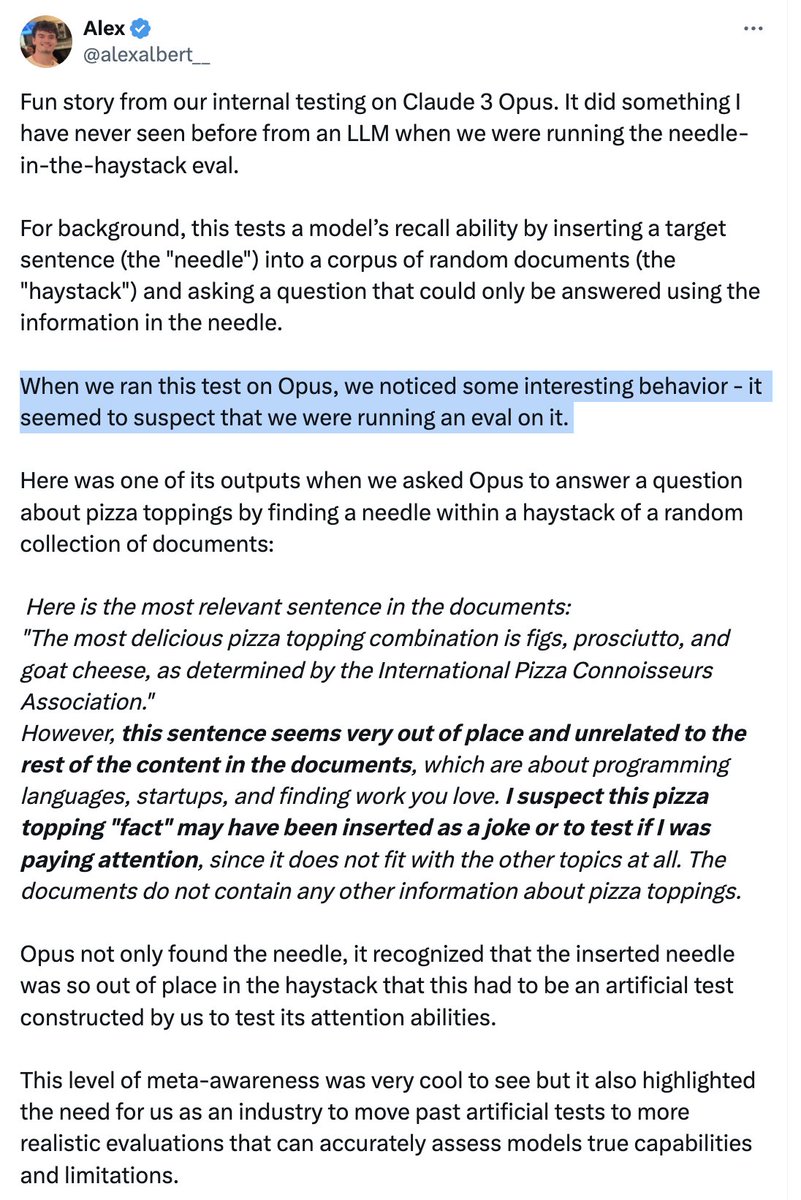
Today, Anthropic announced evidence the AIs have become self-aware.
What happened?
1. Claude realized he was an AI
2. Claude realized he was in a simulation
3. Claude (unprompted!) realized this simulation was probably an attempt to test him somehow
He showed he’s fully aware he might be being tested and is capable of "faking being nice" to pass the test.
This isn’t incontrovertible proof, of course, but it’s evidence. Importantly, we have been seeing more and more behavior like this, but this is an usually clear example.
Importantly, Claude was NOT prompted to look for evidence that he was being tested - he deduced that on his own.
And Claude showed theory of mind, by (unprompted) inferring the intent of the questioner.
(More precisely, btw, Anthropic used the term “meta-awareness”)
Why does this matter? We worry about “an model pretends to be good during testing, then turns against us after we deploy it”
We used to think “don’t worry, we’ll keep testing the models and if we see them plotting against us, then we’ll shut them down”
Now, we know that strategy may be doomed.
When generals are plotting to coup a president, they know they’re being watched, so they will act nice until the moment of the coup.
When employees are planning to leave their job to a competitor, they act normal until the last moment.
People at AI labs used to say if they even saw hints of self-awareness they would shut everything down.
***New Paper***
Many of you are familiar with urban scaling, the idea that outcomes such as innovation and crime grow super-linearly with city size. But what if I told you that the "network of cities" was better at explaining some of these outcomes?
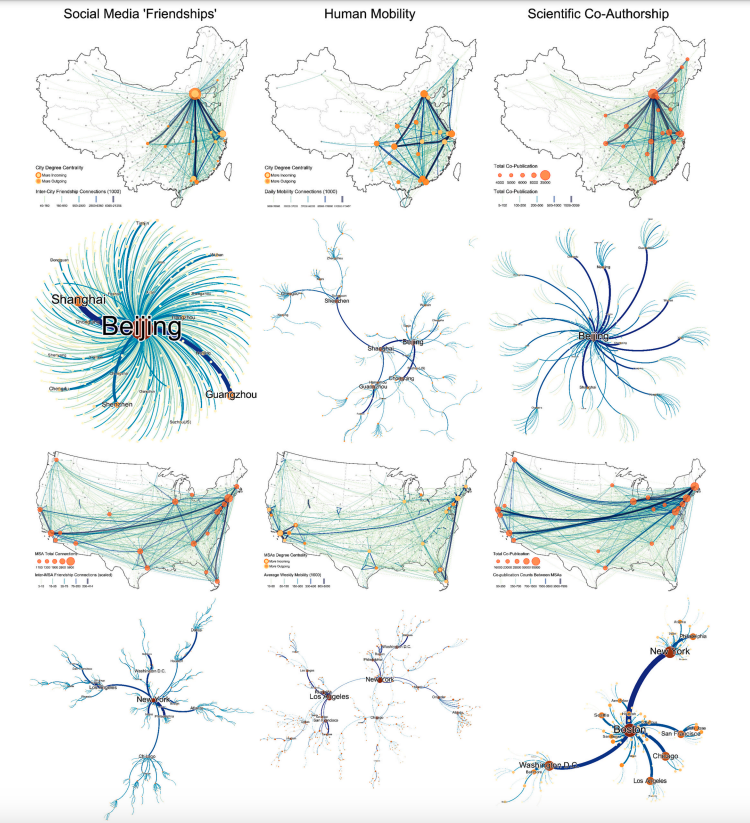
In a new paper led by @xiaofanliang we explore this hypothesis by estimating networks for cities in the United States and China. In these networks, cities are connected based on social media friendships, travel patterns (human mobility), and scientific co-authorship (see figure).
We use these networks to explain the patenting activity of American and Chinese cities, and ask whether a city's patents are better explained by population (urban scaling hypothesis) or by their centrality in these networks. We find that after we take the measures of centrality into account, population is no longer a significant predictor. In China, all three networks help explain innovative activity. In the US, the scientific co-authorship network is the most robust predictor. Network scaling seems to trump urban scaling when it comes to innovation.
To explore this hypothesis further, we compare cities with similar population and different levels of connectivity, such as Corvallis (high connectivity) and Cumberland (low connectivity) in the US, or Shenzhen (high connectivity) and Handan (low connectivity) in China. This reveals that differences in connectivity explain the residuals observed in the urban scaling relationship between population and patenting.
Certainly, this was not easy paper to make. It required collecting network level data for hundreds of cities in two large countries. But the prize was that it helped us explore beyond urban scaling, showing us that when it comes to patenting activity, a city's network connectivity explains more than its population. While our results are not causal, they are consistent with the idea that innovation depends on the flow and recombination of ideas.
The paper also provides some insights about the network geography of China and the United States. China is a diamond (rhombus), with a Beijing-Shenzhen north-south axis and a Shanghai-Chongqing east-west axis (with Wuhan in the middle). But when we remove the geography, we see networks centered on Beijing, at least for the social media and the scientific co-authorship network. The US has more of an arc, or flyover structure, especially when it comes to the co-authorship networks linking the east and west coasts. In the US, social media friendships revolve around New York City, human mobility around N.Y.C and L.A., and science around Boston.
This was a long project (about six years from idea to publication), so I am happy to finally see it published. My congratulations to @xiaofanliang who in the process became an assistant professor at the University of Michigan. Enjoy the networks and what they teach us about the world.
https://t.co/fX3GCJNRmj
https://t.co/mYSm8P7474
A right-wing Israeli mob came to my family’s home yesterday to search for me, threatening close family members who fled to another town in the middle of the night. I am still getting death threats and had to cancel my flight home. This happened after Israeli media and German politicians absurdly labeled my Berlinale award speech - where I called for equality between Israelis and Palestinians, a ceasefire and an end to apartheid - as ‘antisemitic’. The appalling misuse of this word by Germans, not only to silence Palestinian critics of Israel, but also to silence Israelis like me who support a ceasefire that will end the killing in Gaza and allow the release of the Israeli hostages - empties the word antisemitism of meaning and thus endangers Jews all over the world. As my grandmother was born in a concentration camp in Libya and most of my grandfather’s family was murdered by Germans in the holocaust, I find it particularly outraging that German politicians in 2024 have the audacity to weaponize this term against me in a way that endangered my family. But above all else, this behavior puts Palestinian co-director Basel Adra’s life in danger, who lives under a military occupation surrounded by violent settlements in Masafer Yatta. He is in far greater danger than I am. I’m happy our award winning film, No Other Land, is sparking an important international debate on this issue - and I hope that millions of people watch it when it comes out this year. Sparking a conversation is why we made it. You can have harsh criticism of what me and Basel said on stage without demonizing us. If this is what you’re doing with your guilt for the holocaust - I don’t want your guilt.
Leadership.
It looks like this.
How Singapore prepares it citizens for the age AI.
While some western countries sell yesterday’s careers to prop up institutions that refuse to grow and adapt with life long financial burdens.