For a DEX to emerge, an internal value for Pi must first be established to protect the Pi ecosystem.
This requires the Clarity Act. Without the Clarity Act,
a DEX cannot move forward. It may happen later this
year, but other developments will definitely come first.
The same logic applies to Launchpad DApps.
These launchpads create their own internal rules for
their tokens—such as earning points for likes and
dislikes on a news app, or accumulating rewards
based on game playtime.
The tokens within these individual apps might use Pi
as a utility within the DApp itself. However,
if the DApp wants to connect to the external ecosystem
and attract outside users, it must be able to prove
the actual monetary value of its token.
For this to work, the system can only operate
if a stable standard is set defining exactly how much
"1 Pi" is worth within the internal Pi ecosystem.
Ultimately, official legislation is an absolute
prerequisite to practically prove and
support this value.
Technological superiority does not
automatically translate into public trust.
An identity system is more than
just a clever algorithm; its true value is
built on long-term data integrity and network persistence. Even mature Web2 platforms are
struggling with adoption plateaus,
so the idea that XRPL can secure a massive,
reliable user base in such a short time feels
more like marketing hype than a statistically
grounded reality.
Furthermore, while Zero-Knowledge
Proofs (ZKP) are mathematically perfect,
they crash against the reality of global regulations.
Authorities like the FATF demand
traceable entities when issues arise.
The moment you introduce a master key or a
backdoor to satisfy these mandates,
the system devolves into just another form of
centralized KYC under a different name.
If the concentration of control remains
unchanged, you’ve simply moved data from a t
raditional database to a blockchain.
This kind of pseudo-decentralization fails to
solve the fundamental flaws of the market."
눈으로 보는 감각은 즉각적이고,
'아름답다'는 생각을 빠르게 내놓는다.
하지만 시각 데이터는 가장 쉽게 없어진다.
매 시간 우리가 보는 엄청난 양의 데이터를 처리하기 위해
우리 뇌는 끊임없이 이전 데이터를 덮어쓰기 때문이다.
반면, 후각과 미각, 그리고 촉각은 다르다.
시각 정보와 달리, 시스템의 가장 깊숙한 곳에 기록되는
로우 데이터에 가깝다.풍경은 잊혀도
그때의 공기 냄새와 혀끝에 닿았던 온기, 피부를 스치던 질감은
메모리 영역에 깊이 저장된다.
평소에는 기억되지 않아 잊힌 듯 보이지만,
미세한 트리거만으로도 수십 년 전의 기억을 복구해낸다.
이것은 논리적인 '생각'의 영역이 아니라,
하드웨어적인 '반응'의 영역이다.
시각 정보와 달리, 시스템의 가장 깊숙한 곳에 기록되는
로우 데이터에 가깝다.
우리가 몇년이지나도 어렸을적 어머니가 해주셨던
김치찌개의 맛, 고향집에 들렀을때의 분위기와
향기를 맡았을때 기억나는 그 알고리즘과 동일하다.
우리가 스스로 '나의 취향'이라 부르는 것들은
이 정교한 감각적 반응들의 누적된 결과값이다.
우리가 인지하지 못하는 사이,
코끝과 손끝이 수집해온 이 파편화된 데이터들이
거대한 데이터베이스를 형성하고, 그
것이 필터가 되어 우리의 선택과 기호를 결정하는
잠재적 알고리즘을 만든다.
"나는 이것을 좋아한다"라는 의식적인 판단 이전에,
이미 내 저장된 감각 데이터를 대조하며
결론을 내리고 있는 것이다.
미래는 어쩌면 보여지는 것보다,
더 깊숙한 후각, 촉각, 미각을 활용하는 데이터가
트렌드를 지배할지도 모르겠다 생각했다.
@PiNetworkUpdate Your comment shows you clearly don't understand the significance of having 330k verified users. I'd suggest doing a quick search or studying up before speaking.
Labeling other chains 'insufficient' based on raw
TPS is a fundamental engineering fallacy.
Pushing throughput by mandating
workstation-grade hardware for a tiny,
restricted validator set (~100 nodes) isn't
an architectural breakthrough—it's just vertical
scaling to minimize communication overhead.
This is effectively a centralized cloud cluster,
not a decentralized protocol.
True innovation in Web3 lies in maintaining a
global trust graph on consumer-grade hardware
through inclusive consensus models like FBA.
If a system requires 128GB of RAM and dedicated
fiber lines just to stay in sync,
it hasn't solved the Blockchain Trilemma;
it has simply surrendered decentralization for the
sake of a vanity metric.
Real engineering is about optimizing for node
inclusivity and censorship resistance,
not just raw power in a controlled environment.
sake of a marketing metric.
True technology is built on layers,
not empty leaps.
Many are hailing the fusion of AI and
Blockchain as 'Web 4.0',
calling it the next big wave.
But make no mistake: A Web 4.0 without a fully
realized Web 3.0 (Data Sovereignty) is
nothing more than a 'League of Machines'
where humans are left behind.
AI can only truly serve us as a tool for
expansion after unique Human Value is
securely recorded and proven on the blockchain.
Stop chasing mirages wrapped in fancy buzzwords.
We haven't even properly defined 'Human Value' yet.
From my perspective,
this 'barrier removal' is actually setting up a
secure arbitrage channel, not a pump for retail. Institutions are not charities.
I believe they will buy cheaper in their private,
KYC-only pool and sell higher to the public pool
when the gap opens.
So my take is that retail essentially becomes
the exit liquidity for that arbitrage,
rather than partners.
@Mrcryptoxwhale Saying 'All roads point to XRP' exposes your lack of engineering knowledge. The US Gov will never build its economy on a private decentralized ledger they can't control. The future is programmable stablecoins. XRP is just a liquidity tool for banks, nothing more.
@InvestWithD@Ripple That 'chaos' was actually the birth pangs of true innovation. If Jed hadn't left Ripple, we wouldn't have the Stellar Consensus Protocol (SCP) today. It wasn't damage; it was evolution.
사람이 자신의 사망 시각을 알게 된다면,
삶의 풍경은 어떻게 달라질까.
확신하건대, 80% 이상의 사람들은
지금과는 전혀 다른 삶을 선택할 것이다.
우리에게 부여된 시간은 분명 한정된 자원이다.
그러나 우리는 그 끝이 가려져 있다는 이유만으로,
마치 시간이 영원할 것처럼 무감각하게 소비하곤 한다.
만약 그 '끝'이 눈앞에 보인다면,
우리가 시간을 사용하는 방식은 그 즉시 예전과 다르게
변할 것이다.
정해진 끝을 모르기에 낭비하고,
끝이 다가와서야 후회하는 것.
사람들은 참으로 똑똑하면서도,
슬플 만큼 무지한 모순덩어리이자
바보같은 존재일지도 모르겠다.
@SimplyBitcoin Billionaires can wait 10 years and withstand a 50% drop. Retail investors need rent money next month. Different timeline, different scale, different survival rate. Stop pretending we are in the same boat.
예전엔 모두 물리 키패드에 집착하며
그것이 영원할 거라 믿었다.
터치스크린을 본 적이 없으니까.
고정관념은 눈을 가리고,
정보의 비대칭은 귀를 막는다.
세상이 스마트폰으로 바뀌는 순간,
키패드를 붙잡고 있던 사람들은 도태되었다.
정보의 비대칭은 늘 대중의 눈과 귀를 막는다.
할 수 있는 건 흩어진 정보 속에서
필연적인 미래를 읽어내는 것뿐이다.
하지만 정말 재밌는 사실은,
모든 패러다임의 변화 뒤엔 언제나 그것을 예고한
뉴스가 있었다는 것이다.
로보택시의 승자는 테슬라일 것이다.
(너무 당연한 이야기라 쓰지 않으려고 했지만 오랜만에 시간이 나서 써보겠다)
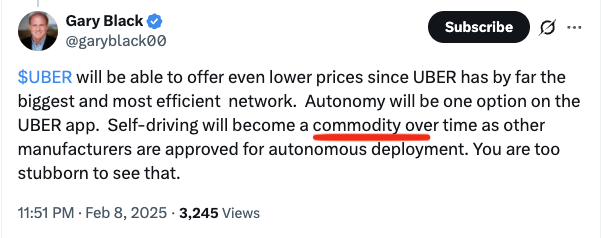
얼마 전에 전설적인 헤지펀드 매니저인 빌 애크맨이 우버에 투자를 시작했다는 보도를 봤다. 꼭 애크먼이 아니더라도 사람들은 왜 우버에 투자를 할까? 로보택시들이 오는데?
간단하다. 많은 사람들은 로보택시 서비스는 commodity와 비슷하게 될 것이라고 생각하기 때문이다. 여기서 말하는 Commodity란 상품이라는 뜻이 아니라 품질이 비슷비슷해서 차별화가 어려워진 상품들을 일컫는다. 예를 들어서 애호박을 살 때 어느 농장에서 키웠는지 신경을 쓰는가? 대부분 아니다. 이런 경우 승자는 플랫폼이 되는 경우가 많다.
많은 사람들은 로보택시도 언젠가는 commodity가 될 것이라고 믿는다. 사실 가능성이 있는 말이긴 하다. 택시를 부를 때 대부분 사람들은 개인택시인지 어떤 회사인지를 따지지 않는다. 로보택시도 가격과 사고 날 확률이 비슷하다면, 소비자들은 회사를 크게 신경 쓰지 않을 것이다. 고로 플랫폼이 더 중요해질 것이라는 뜻이다.
많은 사람들은 웨이모를 예시로 들며, 이런 회사들이 많아지면 테슬라나 웨이모나 다 commodity가 될 것이고, 결국 우버 같은 플랫폼이 중요해진다는 주장이다.
진짜 그럴까? 웨이모에 대해서 더 알아보자. 웨이모는 2018년도에 서비스를 시작했고, 2020년부터 웨이트 리스트 없이 일반인들에게 확대를 했다. 근데 지난 5~7년동안 서비스를 얼마나 확장했을까? 현재 피닉스, 샌프란시스코, LA, 그리고 오스틴에서 운영을 하고 있다. 그리고 도시 전체를 커버하지도 않는다.
웨이모는 왜 이렇게 확장이 느릴까? 내가 추측하기에:
-운영비가 높아 영업손실을 기록하고 있거나
-빨리 확장하기가 기술적으로 힘들거나
왜 이렇게 생각하냐고? 만약에 운영비가 낮고 빨리 확장할 수 있는 기술력이 된다면, 웨이모는 지난 5년동안 서비스를 미국 전역으로 확장했을 것이다. 안 할 이유가 없다. 참고로 영업손실도 크지 않고 인간이 운전하기에 기술적으로 문제가 없었던 우버는 2010년 서비스를 시작했고 2013년에는 미국의 거의 모든 중요 지역에 진출했었고, 2014년에는 전 세계적으로 250개 지역에서 영업을 하고 있었다.
만약에 웨이모가 비용 절감을 하는데 애를 먹고 있다면, 이건 사실 기술보다 더 큰 문제라고 본다. 일반 차량을 사서 개조를 한다면, 처음부터 2인승 로보택시를 설계하고 제조하는 회사를 이길 수 있다고 보는가? 난 거의 불가능하다고 본다. 처음부터 2인승 로보택시로 설계된 차와, 아닌 일반 차의 차이를 비교해 보자:
-2인승 차는 물리적으로 더 작아서 자체가 더 쌀 뿐만 아니라, 배터리도 덜 필요로 한다.
-내연기관차보다 전기차가 연료 및 정비 비용이 덜 든다.
-로보택시는 모델3처럼 강력한 모터를 필요로 하지 않는다.
-핸들 및 드라이버를 위한 부품들이 필요하지 않다.
-페인트나 여러 옵션이 필요 없기 때문에 제조가 매우 단순해진다.
-일반 차는 문의 디자인부터 틀렸다. 사람들이 문을 안 닫고 내리면? 이것도 다 개조를 하면 시간과 비용이 추가된다.
이것 말고도 많다. 포인트는, 이런 장점들은 결국 낮은 운행 비용, 혹은 테슬라의 이윤이 될 것이다. 참고로 일론은 로보택시를 3만달러 이하로 팔겠다고 했지, 제조가가 3만 달러라고 하지는 않았다.
그리고 시간이 갈수록 단가는 더 낮아질 것이다, 특히 옵티머스가 투입되기 시작되면. 고로 웨이모가 테슬라만큼 빨리 확장을 한다고 해도, 제조업의 차이 때문에 로보택시가 대량생산되기 시작하는 시점부터 서서히 경쟁력을 잃을 것이라고 본다.
예전에 일론은 테슬라의 경쟁력은 제조업이라는 말을 한 적이 있는데, 이 말을 이해하기까지 나도 시간이 많이 걸렸다. 하지만 생각해 보자. 로보택시 소프트웨어 개발에 진심인 회사들은 매우 많다. 하지만 로보택시 자동차 개발에 진심인 회사는? 난 하나밖에 없다고 본다.
스프트웨어의 우위는 5년, 10년 뒤에 어쩌면 평준화가 될 수도 있다. 하지만 제조업의 우위는 앞으로 따라잡기 매우 힘들 것으로 본다.