Shaping products, not managing backlogs. Building tools for how small AI-native teams actually work. CPTO @PtEverywhere_ | Fishing for signal🎣 | Wolfpacker🐺
I published the first Focus Over Features post after a long break.
The short version: I spent 15 days at Philmont with my son, came home, and realized I had lost the thread.
Not the ideas. The continuity.
That feels like the bigger AI work problem too.
https://t.co/VGLcMtxYCu
Most days running multiple agents looks like Whac-A-Mole with terminal sessions.
Not "10x developer." Just frantic decision-making at 10x the rate.
Generation got cheap. Deciding didn't.
https://t.co/j4I1jllDbC
@marclou@deckard_the_dev This is exactly what I feel when I try to “multi thread” too many projects. I thought I was going faster with multiple agents but it just wore me out. And I was pencil-whipping the agents anyways. Not a good outcome for the product and more rework.
Before AI, devs spent an unfortunate amount of time managing package version conflicts.
After AI, devs spend an unfortunate amount of time watching their agents deal with package version conflicts.
me: Does this bug exist in the code?
LLM: Definitive answer, I checked and that bug doesn't occur in our code
me: Are you sure, seems like it's a real bug
LLM: Plot twist! The bug does exist, would you like me to log that?
me: 🤨
A lot of the market talks about agentic development like we’re basically at self-driving software teams.
That’s not what I’m seeing.
What I’m seeing is real leverage, plus a new kind of management burden.
Less time typing.
More time writing better specs, reviewing fast outputs,
context switching,
deciding what “good” looks like.
If you drop strong agents into a sloppy team, you don’t get magic. You get faster chaos.
Wrote more about what feels real vs overhyped: https://t.co/xkhZcE7Il9
My favorite game to play is "find the wifi password sign" in local coffee shops. I know it exists; and is hidden in plain sight. If you find it, you get to avoid the annoyed response from the barista when you ask for it.
One of my favorite lines so far from Raleigh-Durham Startup Week sessions; Zach Maurides (Teamworks):
"You can’t get product-market fit over Zoom."
People are bad at describing their pain points; you need to see it in person to understand their workarounds, delays, handoffs.
The App Is Not the Point Anymore. Ephemeral UIs, just-in-time software, and what happens when the interface becomes a response.
https://t.co/O14i8xjR4s
Over the last year of working with AI agents; especially those through chat, I've really started to treat conversation sessions like code. Commit it. If it's not persistent and indexable, your agents never retain their learnings. You have to be consistent, every session.
Last night at the inaugural Triangle OpenClaw meetup, I presented how Ephemeral UIs are changing how we interact with AI. Just-in-time micro-apps. Live demo survey, real-time results. Open sourced @ https://t.co/wP95wVdCNA
@clairevo@openclaw The first few posts I saw mentioning the caveman speak, I thought it was a joke, token efficiency be damned. That being said; I actually think this is faster for me to read and grok... maybe our brains need some optimized token management too.
@EvanDataForge OpenClaw is still way ahead of Claude; even with all the recent releases. I think for consumers and techy users it’s fine but once you use OpenClaw it’s hard to go back. With the recent Max changes blocking OoenClaw I’m still working to get it optimized to keep using it.
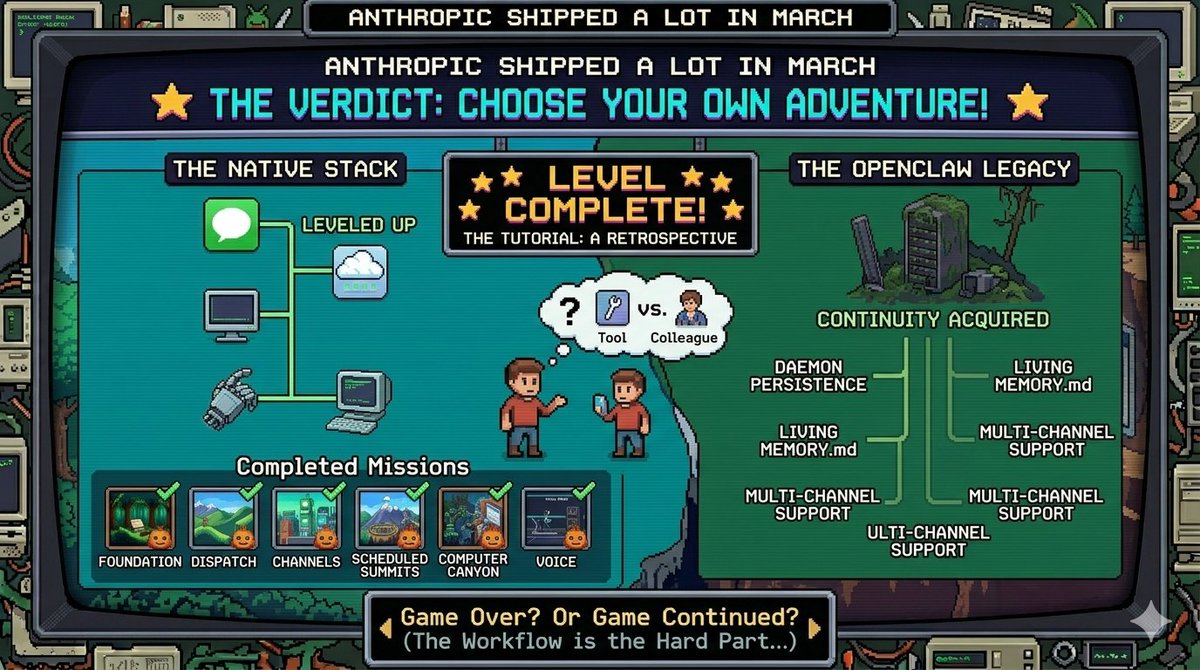
Spent a week trying to replace my OpenClaw setup with nothing but native Claude. VentureBeat called March's updates "an OpenClaw killer."
They weren't wrong. They also weren't right.
Full breakdown (with the actual setup tutorial): https://t.co/nPLeA57DNu
@bcherny I use an MCP to connect my Claude Code terminal sessions to my OpenClaw orchestrator for hand-off and coordination. Is this still acceptable? I also thought OpenClaw native agents were using the Claude Code cli under the hood primarily to get improved prompt caching?
Anthropic just cut off OpenClaw from Claude Max subscriptions.
The technical reason: third-party tools bypass their prompt caching.
The timing: right after they shipped competing features and OpenClaw's creator joined OpenAI.
Surely just a coincidence, right? Right.😅
Here's what it actually costs now and what to do
https://t.co/8NB2IcKOP2
Google: "Gemma 4 supports agentic workflows"
Me, running a multi-agent system that ships code daily: cool, but can it remember what it did yesterday?
The model is never the bottleneck. Context, memory, and coordination are. That's true whether you're running Gemma, Claude, or GPT.
Open models for agents is great news. Just don't confuse "can run an agent" with "can run an agent well."
#buildinpublic #aiagents
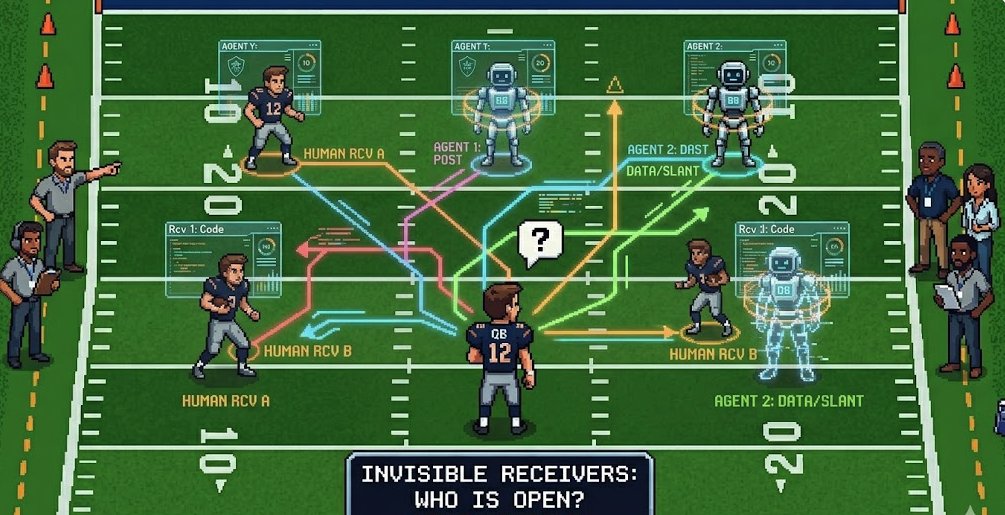
My AI agents kept stepping on each other's work.
Same file. Same function. Two different rewrites.
So I built an observability layer into their task manager:
• Who's working on what, right now
• Context injection before they start
• Collision detection before they commit
Managing agents isn't a prompt problem. It's an ops problem.
https://t.co/1n2JkxQPnb
Anthropic accidentally leaked Claude Code's entire source. 512K lines. Zero tests.
Buried inside was 44 unreleased feature flags, including an always-on mode and nightly memory optimization.
They're building toward persistent agents behind feature flags. Many of us have already been running them in production on real projects.🦞
AI companies are centering around the same architecture that builders figured out over the last few months.