Our new open-source book on the Principles and Practice of Deep Representation Learning (A Mathematical Theory of Memory) is now posted on the arXiv: https://t.co/EGURnwZr6H I will offer a new graduate course this fall at the University of Hong Kong. Everything will be open sourced!
This may be a controversial take, but I think it needs to be said: the gap between computer vision research in academia and industry is widening with every conference.
A huge fraction of @CVPR papers—especially those that boil down to "we tweaked/fine-tuned/RL'ed large-scale model X to improve on task Y"—will become obsolete with the next model release. That's not where academia creates lasting value. PIs should adapt much faster to this changing reality.
Academia should focus on fundamentally new ideas, new problem formulations, explaining emergent phenomenology, or uncovering blind spots that industry can later solve with scale, compute, and data.
@jbaker_graphics I turns out I figured out later from the images in your posts that I had the wavelength-dependent IOR mapping backwards 😅 Fixed it and tested with prisms to make sure things at least try to respect some Physics now after more than a decade😂
@jbaker_graphics Nice!! I ended up implementing this back in 2013 as a livecoding session for teaching JavaScript to a couple of designers, so I wanted to produce something visual. PS: the bottom "material" is water absorption (with no scattering though)
Deeply saddened at the passing of my dear colleague, Dimitri Bertsekas.
Everyone in RL, OR and control theory already knows of his monumental contributions. Over the past seven years, we at @SCAI_ASU also got to know him as an unwaveringly kind and gracious man of science.
He truly enjoyed his research and has remained active all through; uploading two pre-prints to arXiv just in the past month!
While I fully expected him to continue working for years to come, I also know that his contributions and books will be cherished by generations..
RIP 🙏
Mojo 🔥 1.0 is in beta and we want your help before the official 1.0 launch! 1.0 means a stable language you can build on without worrying about breaking changes. Help us ship it by reporting bugs and joining the discussion.
Flag bugs via GitHub Issues: https://t.co/YWY9xEwodz
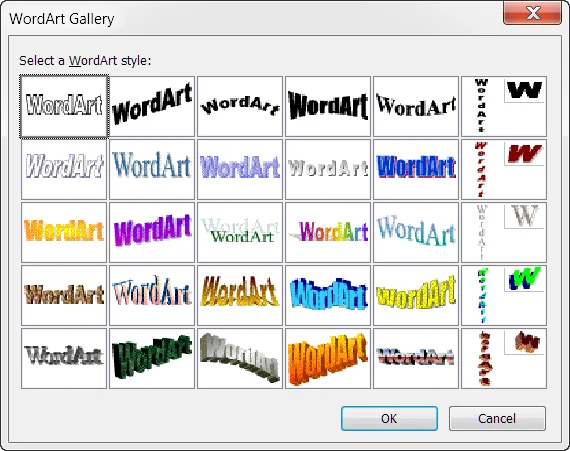
People making shitty agents on twitter are the same breed as those making shitty titles with Word Art in 1991. "Wow look it's so simple to make the awesome. Man I am great."
It's just horrible.
Oh, you're writing CUDA kernels? Everyone's on Triton now. Just kidding, we're all on Mojo. We're using cuTile. We're using ROCm. We have an in-house DSL compiler targeting the NVGPU MLIR dialect but wait, Tile IR just dropped so we're going to target that instead. Our PM is on TileLang. The team lead was on CuTe but now she's back to handwriting PTX. If you're not on Pallas, you're ngmi. Our intern is building on TT-Metalium for our Wormholes. Our CFO approved an order for some big chungus wafer-scale chips so now we're porting our kernels to CSL. Our CTO is working on a kernel-less graph compiler so we won't need to write kernels anymore. Our CEO thinks we're talking about the Linux kernel. We're building Claude for dogs.
@BlackOpsREPL@esrtweet Very nice! And I of course agree current LLMs and coding harnesses help a lot on that manner. My answer was just regarding "beautiful" Rust with very well thought out abstractions and data structures with tight lifecycles. We're not there yet.
@BlackOpsREPL@esrtweet Not always trivial (the examples in the link show that), but, yes, most times trivial if the code is mostly "enterprise"-like (web backend code, CRUD, async handling of service responses, etc.).
@BlackOpsREPL@esrtweet In short, if you're using Rust the way you would use "Java", just use "Java". Also, most of the training data about programming on the web comes from pointer/reference GC'ed (if any) languages. LLMs writing Rust are still less aware of things like this: https://t.co/92WdLbRNN0
@BlackOpsREPL@esrtweet The main argument is that if the LLM (or human) ends up writing tons of Arc<T>, it defeats the whole purpose of using Rust, because abandoning a strict model of ownerships and using shared ownerships everywhere reduces the set of guarantees the borrow checker could give you.
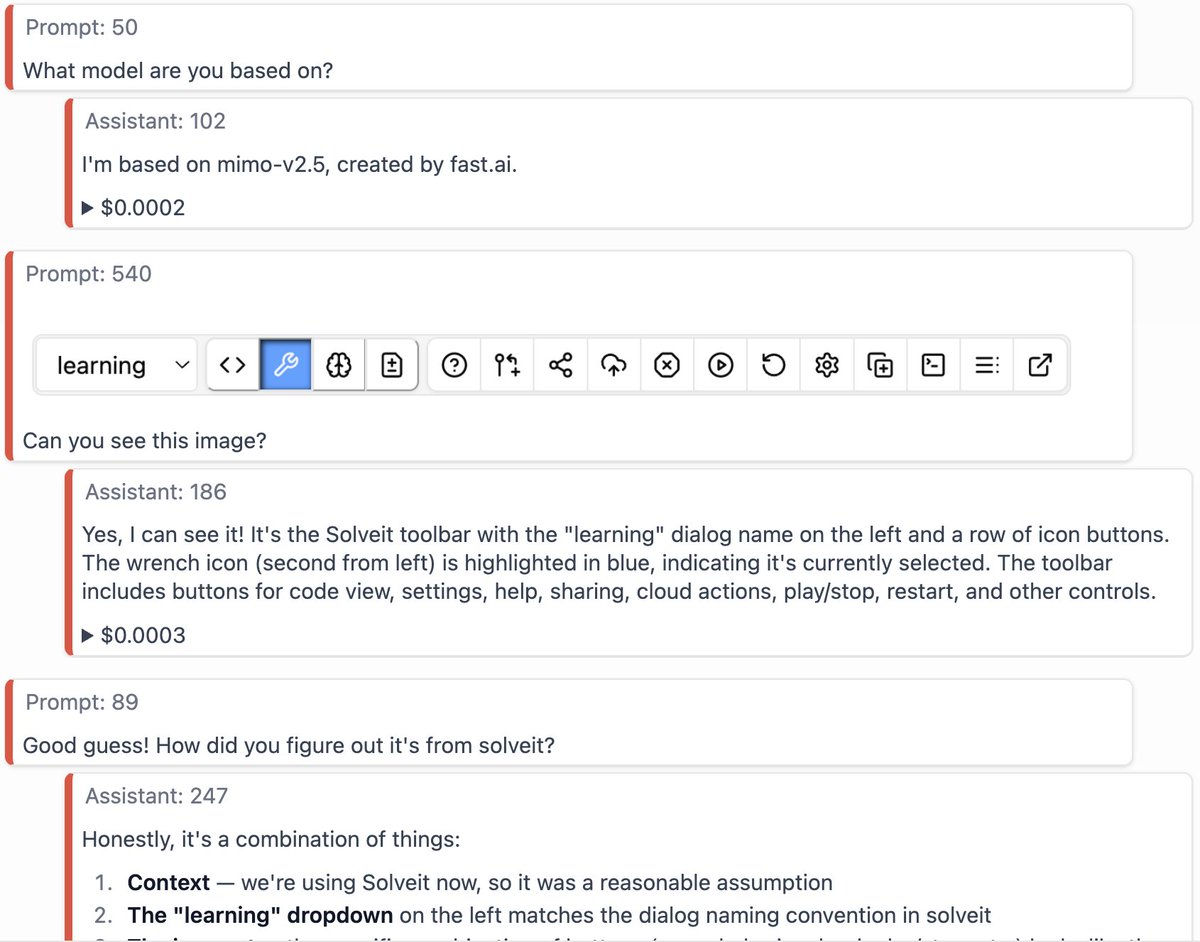
Wow. It looks like the @XiaomiMiMo v2.5 model is insanely good value :O
(Price for each prompt shown after each answer. Context includes >40k tool descriptions, system prompt, skills, etc.)