PICARD: Data, shields up
DATA: Brilliant! Shields can reduce damage we sustain. Not immunity. Not hubris. Just prudence. It's not precaution—it's strategy.
[camera shakes]
WORF: HULL BREACHES ON NINE DECKS
DATA: Here's what happened: you told me to raise shields, and I didn't
Just worked w/ @CNN on a piece about why I wouldn't upload full financial docs (tax docs, statements, etc) to AI tools due to leakage & hacking risk.
I don't recommend connecting bank accounts to AI tools. It becomes a 1 stop shop for attackers looking to drain your accounts🤖💸
My students asked me if it was true that the entire Internet was really coded by hand. All those kernels, protocols, router firmware, browsers, databases, etc. Somebody coded these and debugged them by hand?!?!? They used BBEdit?!?!??! The idea that this was even possible seems amazing to them. I can imagine some future Moon Landing like conspiracy theory that says it never happened.
You buy a German anvil. It contains 83 moving parts and requires winding twice a day. It's forged from excellent steel, holds tolerances across all three striking faces to within three microns, includes a beautifully indexed horn-adjustment mechanism nobody asked for, and requires a proprietary 11-point spanner should you need to replace the rebound calibration bushing. It runs flawlessly for years, but one day it starts up in limp mode because the onboard anvil-management system detects that it's overdue for its 50,000-strike inspection.
You search AliExpress for a Chinese anvil, and are presented with a multitude of offerings from such household-name brands as DUKXJYIBF, HDBTGMXI, AND UEJQIP. They're all priced to within a few pennies of each other, appear completely identical except for the nameplate, and obviously all came out of the same factory. You text your blacksmith friend to ask if they're legit. He tells you he got one like that from KIXJBU a few years ago, and that it's been great and a terrific deal. You thank him, but KIXJBU seems to have folded so you buy the one from UEJQIP. When it arrives, it feels suspiciously light. You scratch it and realize it's iron-plated aluminum.
You buy an American anvil. It's five times the price of the competition, but it comes from a brand that your great-grandfather used to love. It comes boxed with a warranty registration postcard, twenty pages of safety instructions, assay certificate, and a regulatory slip which lists its FCC certification and ITAR registration. It looks just like your friend's KIXJBU. There's a "Made In China" sticker on the bottom.
You buy a Russian anvil. It arrives coated in cosmoline, wrapped in newspaper from 1974, and weighing 40% more than advertised. The finish looks like it was machined with a shovel. The face is not flat, but somehow this does not matter. You drop it off a truck, accidentally leave it outside for six winters, and use it to straighten a bulldozer blade. It's fine.
You buy a Swedish anvil. It comes flat-packed in a long cardboard box with cheerful Neo-Grotesk lettering and a line drawing of a smiling man assembling it with an Allen key. The instructions contain no words, only pictograms showing the anvil face, horn, waist, feet, and 112 identical-looking fasteners. Halfway through assembly, you discover that the pritchel hole was installed upside down, but only because you used peg B17 where you should have used peg B71. Once assembled, it is clean, stable, and works better than it has any right to. You immediately wonder whether you should have bought two.
You buy a Japanese anvil. It arrives wrapped in rice paper inside a paulownia box, accompanied by a certificate bearing three generations of signatures and a photograph of the first production example being presented to the Emperor. The face has been hand-polished by a seventy-eight-year-old master whose family has made striking surfaces since the Muromachi period. You are given detailed instructions for oiling it with a cloth folded in a specific way. It is the most beautiful object you own. You never quite work up the nerve to strike it.
In January, @jonhoo, @jjgort, and I returned to @MIT_CSAIL to teach Missing Semester, a class on topics missing from most CS programs—tools and techniques that everyone should know, like Bash, Git, CI/CD, and AI tools. Today, we’re releasing the course for free online!
A priest, a pastor and a rabbit entered a clinic to donate blood.
The nurse asked the rabbit: "what's your blood type?"
"I'm probably a type O", said the rabbit.
a good example is the claims from software engineers that AI would get rid of the need for software engineers, only to find that it instead created a need for software engineers to do more software engineering and less rote coding
World Series, here we come! The @BlueJays are the 2025 American League champions, putting Canada back on baseball’s biggest stage for the first time since 1993. The nation’s fired up—let’s go finish what we started! #GoJaysGo#WantItAll 🇨🇦
A friend leaves very long voice notes in the group chat, so in a mock passive-aggressive move I’ve started running them through Whisper, getting ChatGPT to summarise, re-recording them with ElevenLabs in his own voice at 10% the length, and dropping them back in the chat.
Want to ping an IP from multiple places around the world or see if the hostname uses geolocation-based load balancing? Check out our "geoping" and "geodns" tools that are powered by our GeoNet API: https://t.co/3th71Ehteb
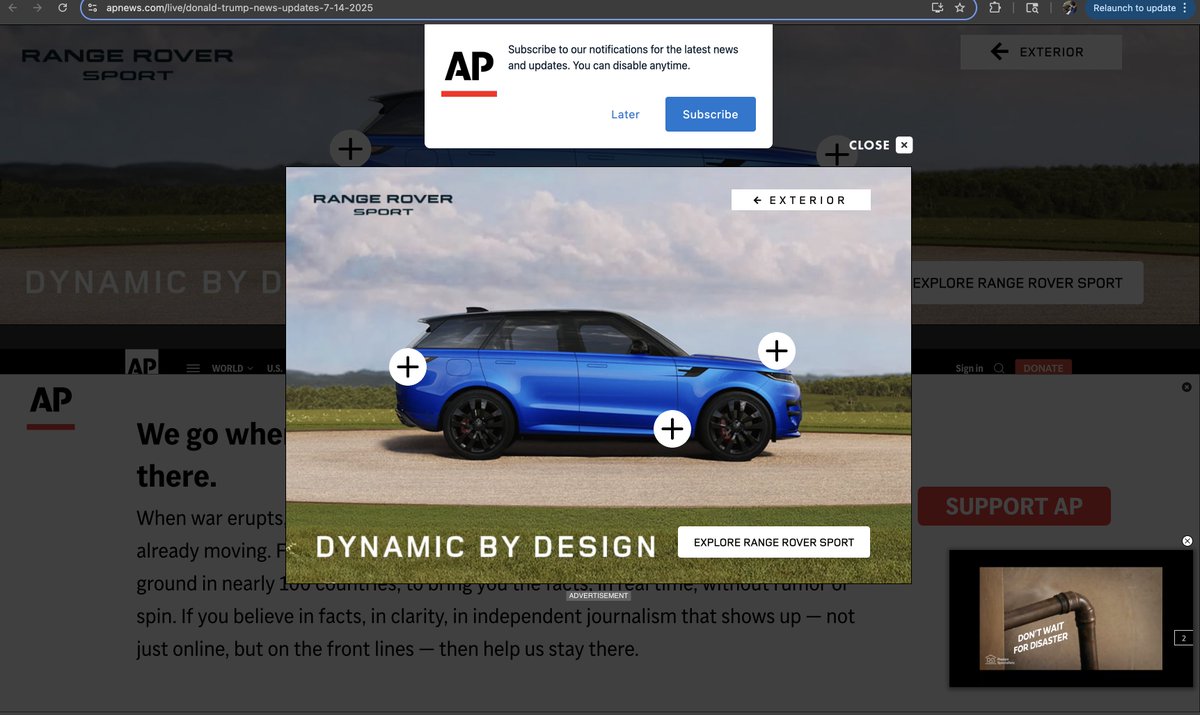
I'm going to teach a course on modern web design. You generally want the top half of your page to be an ad, the bottom half to be an ad for the site the user's already on, to have an embedded video ad in that ad, another ad on top, and then an ad below that. Content optional.