Every organization has a question it can't answer but desperately wants to.
Not because the analytical capability doesn't exist, but because the data that would answer it cannot travel to a central location due to privacy, regulatory, or governance concerns.
In part 3 of the Decentralized Intelligence blog series Adrish Sannyasi (@DataDrivnHealth) details how Federated Intelligence Networks let organizations answer those questions together and build a capability that compounds as the network grows, without moving the data.
Read the blog 👉 https://t.co/uzUAuwkMtr
You don't need to be an engineer to have a say in how your organization shares sensitive data. But you do need to know enough to ask the right questions.
We wrote a plain-English guide for the leaders who approve, fund, or explain these projects. Read the full blog for guidance on:
✅ What encryption, de-identification, and tokenization do (and don't) protect
✅ The one question that decides your options: can your data leave its source?
✅ Federated computing, confidential computing, MPC, homomorphic encryption, clean rooms, and more without the jargon
✅ Questions to ask any vendor before you sign
✅ Who needs to be in the room, and who to talk to first
Read it here 👉 https://t.co/ruwKNSVcnt
In healthcare, when data is spread across dozens of institutions and behind firewalls you can't touch, it stalls multi-site research initiatives.
Federated computing resolves this by running AI where the data lives — no raw records cross a firewall, and no bilateral data-sharing agreement that takes 18 months to negotiate.
This guide covers what a federated research consortium is, how to evaluate joining one, how to build one from scratch, and what separates a network that compounds in value from one that stalls at the pilot stage.
Read it here 👉 https://t.co/r9wqMBIXzc
Did your AI pilot fail because the model wasn't good enough, or because it didn't have access to critical data?
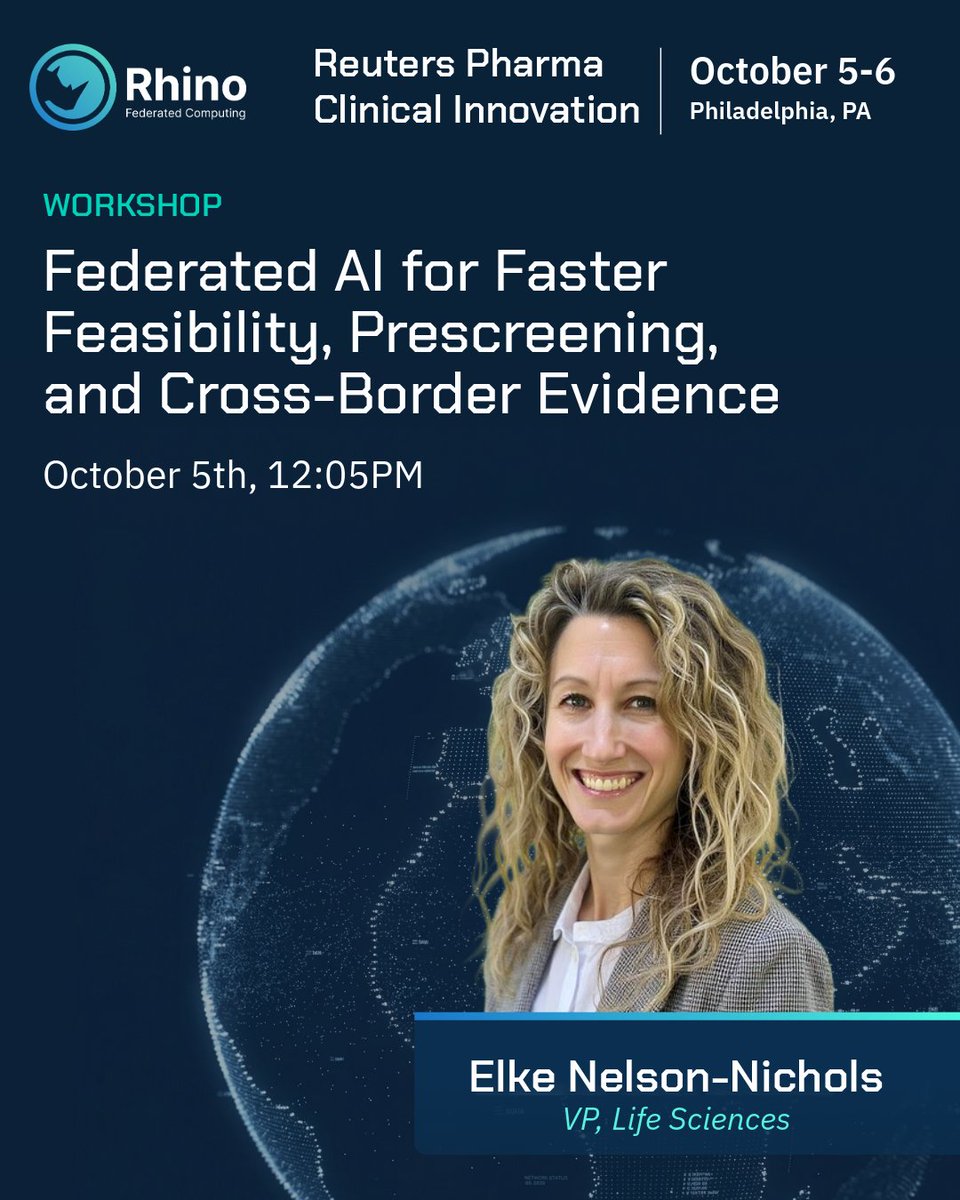
At Reuters Pharma Clinical Innovation, Elke Nelson-Nichols will be hosting a hands-on workshop focused on: Federated AI for Faster Feasibility, Prescreening, and Cross-Border Evidence. Daniel Feller will host a live demo showcasing how the Rhino FCP harmonizes data across geographic borders.
What you'll do:
✅ See federated AI in action
Watch one eligibility question run across multiple sites simultaneously—harmonizing local data and identifying patients without moving a single patient-level record.
✅ Pressure-test your own portfolio
Leave with a practical framework showing which feasibility, prescreening, and cross-border evidence use cases can scale now—and what is still blocking them.
Can’t make it to the workshop? Book some time to chat here 👉 https://t.co/0KcXyKgbVh
The most valuable data for drug discovery and precision medicine is often the hardest to reach: spread across sites and locked behind privacy rules.
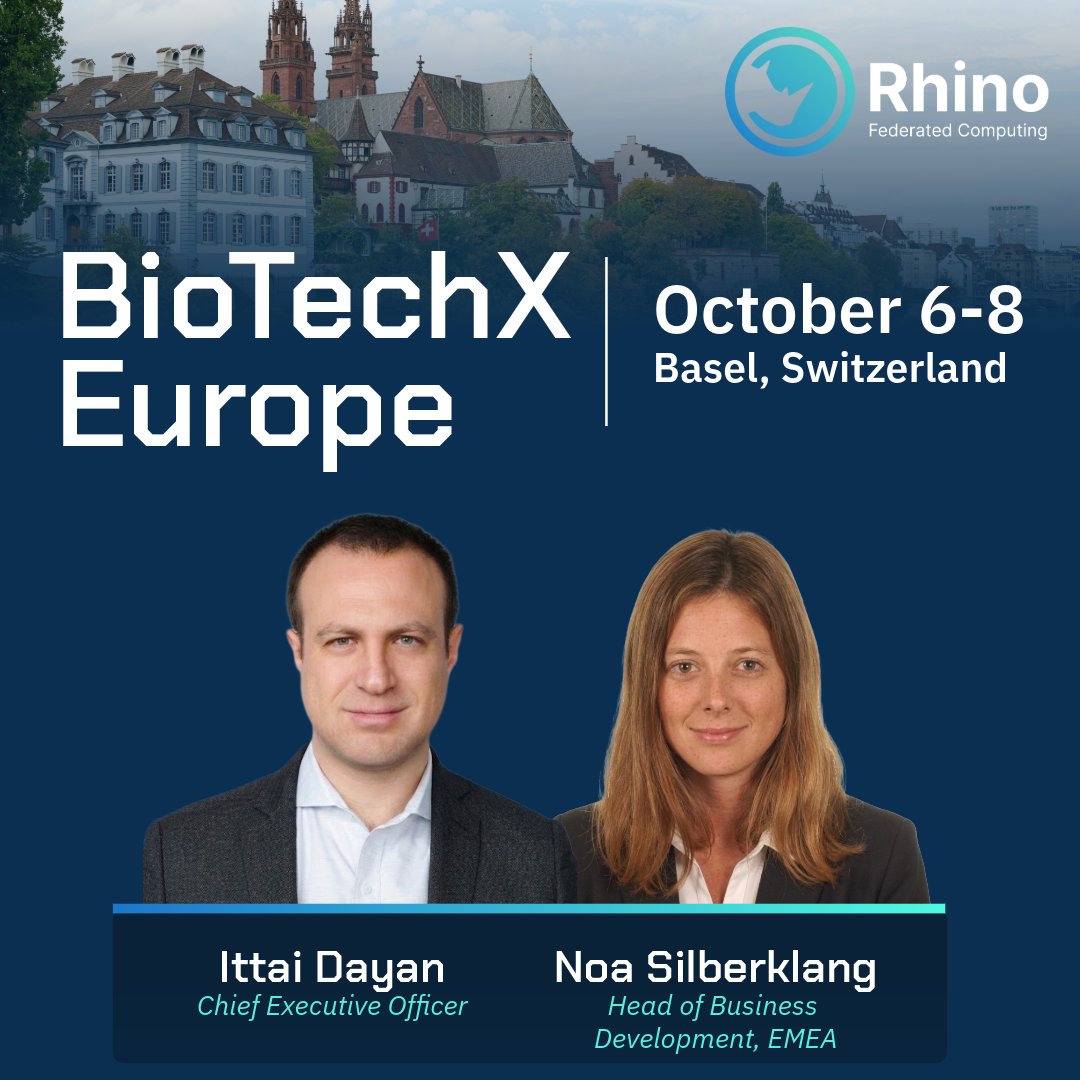
Federated computing changes that. At @BioTechX_ Europe, see how the Rhino Federated Computing Platform lets teams train models and run analytics on distributed data without moving it.
Stop by our booth in the Emerging Business Zone to:
✅ See the Rhino FCP in action
✅ Talk through your multi-site data and AI use cases
✅ Learn how pharma, biotech, and healthcare teams are working together on sensitive data without compromising privacy
Want to lock in time with the Rhino team? Drop us a message or book a meeting here: https://t.co/tirD1mjghg
Data harmonization has always been a labor-intensive process as skilled data engineers and subject-matter experts must collaborate to write bespoke pipelines for each dataset.
Rhino's Data Harmonization Engine (DHE) streamlines that work, using AI to power data transformation workflows that run remotely.
So how do users get from messy, non-standardized local data to clean, standardized data on the Rhino FCP? It takes four steps:
1. Data Ingestion & Cataloging
2. Syntactic Mapping
3. Semantic Mapping
4. ETL Orchestration
In this clip, Daniel Feller shows how users will accomplish the first step, data ingestion and cataloging, to connect data sources and generate table context.
Watch the full demo to see Daniel walk through all four steps 👉 https://t.co/pPNh4V6yOC
🔥 Federate AI Summit Fireside Chat: Cloud Infrastructure's Role in the Federated AI Era
Federated AI shifts the hard problems from the model to the infrastructure underneath it — orchestrating training across sites that never share raw data, securing the aggregation layer, and scaling compute that has to live everywhere at once rather than in one central cluster.
This chat explores what it actually takes to build cloud infrastructure for federation at scale, and where the cloud provider's role starts and stops as organizations move federated AI from pilot to production.
Olivia Choudhury, PhD, Principal Partner SA, Worldwide Healthcare and Life Sciences, @AWS
Kimberly Cline, Head of Cloud Partnerships, Rhino Federated Computing
View the full agenda 👉 https://t.co/EJrguJTNu5
Apply to attend 🎟️ https://t.co/OT6oZZHPGS
This edition of the Rhino Reporter covers the growing conversation around decentralized AI architecture, secure data sharing, and what it takes to build the trust that makes federation work at scale — alongside a customer milestone worth celebrating and a look at the events the Rhino team will be attending this fall.
Read and subscribe to the newsletter 👉 https://t.co/nEQ1QgZEWB
Edition Highlights
✅ Lilly TuneLab turns one: Running on the Rhino Federated Computing Platform, it now has 125+ member companies and 10M inferences made, all without patient data leaving its source.
✅ New in Product, VM Pools: Sites can reserve GPU compute ahead of time and scale one run across multiple pools and regions, while their data stays sovereign.
✅ Upcoming webinars and events: Join our October 15 webinar on Federated Intelligence, then meet us at the Federate AI Summit at Boston Seaport on October 19-20.
Almost no AI use cases in financial services are solvable by one team, one department, in one institution, operating on one dataset.
Yet for most institutions, centralizing data isn't on the table.
Federated computing changes the paradigm by moving the compute to the data. The results speak for themselves:
➡️ @swiftcommunity and @Google ran a federated fraud detection initiative across 13 global banks using Rhino's platform — shared intelligence that outperformed anything a single bank could build alone.
➡️ @jpmorgan and @BNYglobal reached the same conclusion through Project Aikya, where models trained collaboratively across institutions beat anything trained on a single institution's data.
Read our latest blog to see how 👉 https://t.co/kYCp1iNiHV
If you'll be at SIBOS next week, meet with Johan Bryssinck to talk through what this looks like for your institution https://t.co/TbjgPukKvY
Supporting EHDS build can be scoped two ways: as a compliance project, or as the data foundation every other initiative in the hospital needs.
In March 2029, EHDS will turn data engineering into a recurring legal obligation. For the 68.8% of European hospitals that don't have data quality teams, satisfying these requirements will be painful, and all the more so if they wait.
But, what if hospitals started to think of compliance as a positive driver for change? Instead of a burden, they can treat the mandate as funding for the data foundation that so many initiatives across the hospital need:
✅ One data catalogue
✅ One harmonized data layer
✅ And one governed access path
Rhino Data Activation helps health Data Holders launch this larger business transformation without moving any data or creating massive data engineering projects.
Read the blog for a full breakdown on what hospitals and health systems can do now 👉 https://t.co/Yo4eHzQ26S
As cancer research increasingly depends on data too sensitive and too fragmented to centralize, a growing set of institutions are building the infrastructure to collaborate without moving patient data at all.
This session at the Federate AI Summit brings perspectives together from organizations working on different layers of that challenge and how they are establishing the governance frameworks, model cards, and technical standards that let cancer centers train and share AI models.
➡️ Federated Machine Learning: A Practical Framework to Accelerate Multi-Institution Collaboration
Nevenka Dimitrova, Computational Oncology Consulting Scientist, @MSKCancerCenter
➡️ Constructing Privacy-Safe Multi-Modal Data Ecosystems
Chalapathy Neti, AVP AI, @FordhamNYC
Falguni Sen, Director of the Global Healthcare Innovation Management Center, @FordhamNYC
➡️ Federated Fine-Tuning: Improving Outcome Predictions and Clinical Trial Matching
Ghulam Rasoo, Associate Member, Department of Machine Learning, @MoffittNews
Umit Topaloglu, Chief of the Clinical and Translational Research Informatics Branch, @theNCI
Moderator: Adrish Sannyasi @DataDrivnHealth, VP Customer Solutions, Rhino Federated Computing
View the full agenda 👉 https://t.co/KYh8uQpvcI
Apply to attend 🎟️ https://t.co/BnI8SqGAaj
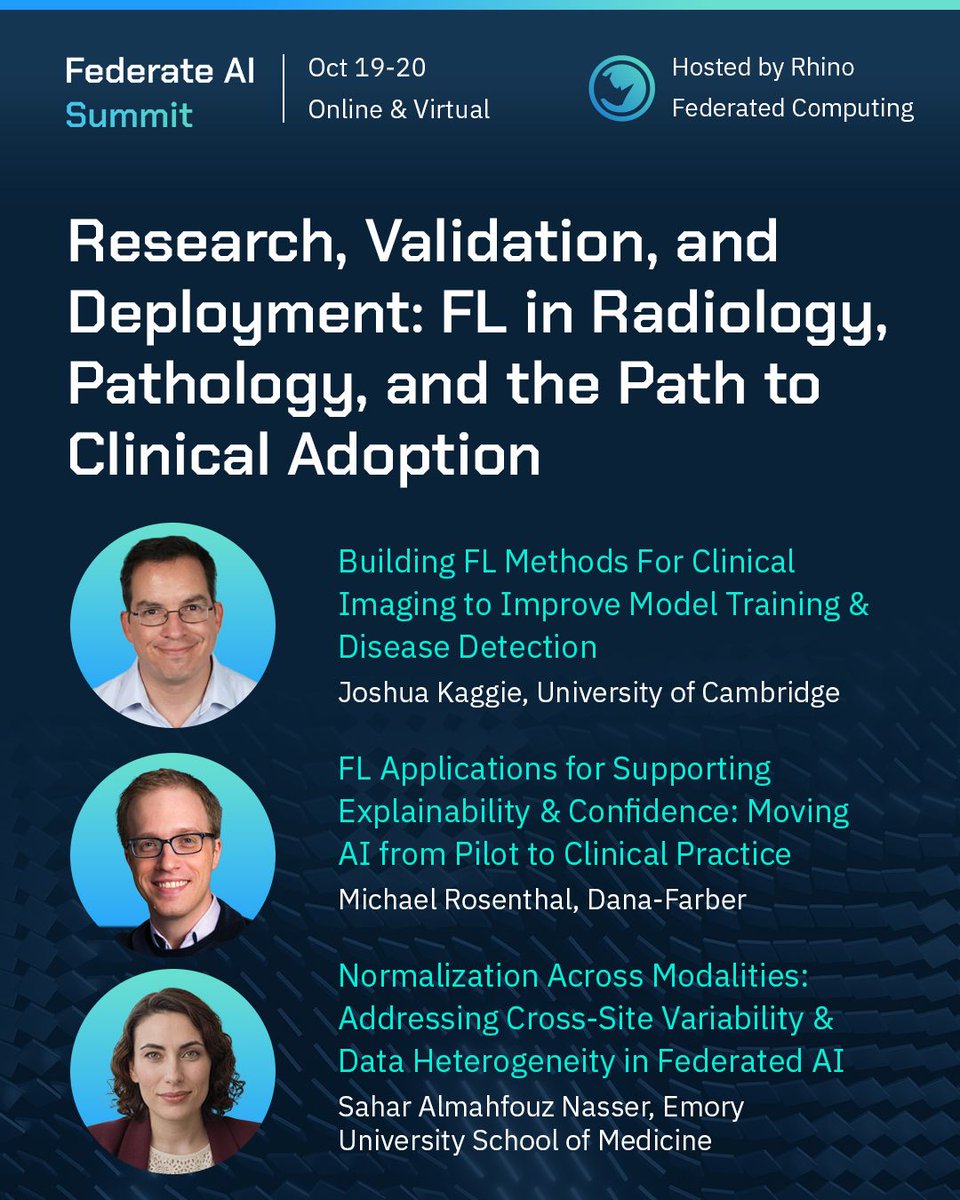
What does it actually take to move federated learning into clinical practice?
At our Federated AI Summit, three researchers at different stages of the FL pipeline — MRI methods development, pathology AI, and clinical imaging leadership — will discuss what's standing between promising federated learning research and adoption in day-to-day clinical practice.
➡️ Building FL Methods For Clinical Imaging to Improve Model Training & Disease Detection
Joshua Kaggie, Senior Research Associate, @Cambridge_Uni
➡️ FL Applications for Supporting Explainability & Confidence: Moving AI from Pilot to Clinical Practice
Michael Rosenthal, Assistant Director of Radiology, @DanaFarber
➡️ Normalization Across Modalities: Addressing Cross-Site Variability & Data Heterogeneity in Federated AI
Sahar Nasser, Postdoctoral Fellow, @EmoryUniversity
Moderator: Adrish Sannyasi, VP Customer Solutions, Rhino Federated Computing
View the full agenda 👉 https://t.co/w96eJqFxFc
Apply to attend 🎟️ https://t.co/WZWYYB0CSZ
The data that matters most (patient records, molecular designs, proprietary research) can't move to meet foundation models.
As a result, innovation can't happen and collaboration moves to the backlog.
That's where Federated Intelligence comes in. It's an always-on ecosystem where models, data products, agents, and infrastructure travel to the data instead of the reverse, coordinated through a neutral orchestration layer built on privacy-enhancing technology and confidential computing.
In this webinar, our CCO Chris Laws will break down how federated intelligence is becoming core enterprise infrastructure — with real examples from networks already operating at scale.
Sign up 👉 https://t.co/RS2rgbeLKE
Research shows one vehicle can generate 20–40 TB of data per day.
Now multiply that by a fleet — and the data crosses organizational lines. You can't backhaul it, centralize it, and regulation often won't let you pool it.
But, what if the data never has to move? Federated learning (FL) is the answer, but only if the operations hold up.
At ASME DRIVN, David Solooki laid out what it actually takes to bridge that gap and the infrastructure that makes fleet-scale FL possible.
Swipe through for the four things separating FL pilots from production systems 👉 https://t.co/2GB7JeXHVp
Thank you to the session chairs, Adian Cook and Vishnu Pandi, for hosting this conversation.
Organizations have been sitting on years of potential insight because the data-access problem was never fully solved.
In part 2 of the Decentralized Intelligence blog series, @DataDrivnHealth gets into the architecture, and what it makes possible when organizations start building intelligence networks with their business units and partners.
Read the full blog 👉 https://t.co/TR6nryVJmC
Your data is valuable. Your partners' data is valuable. But getting them to work together, securely, compliantly, and at scale, has always been the hard part.
That's the problem Rhino Federated Computing solves.
At the @AWS Startup Partner Summit, our Chief Commercial Officer Chris Laws broke down how Rhino helps organizations with highly regulated, proprietary data work together:
➡️ Harmonize disparate datasets across institutional boundaries, no matter how different the schemas, formats, or governance requirements
➡️ Run analytics, train models, execute inference pipelines, and deploy agents all while preserving privacy and without centralization
We're proud to partner with the team at @AWS to bring federated computing to the enterprises that need it most.
#StartupPartnerSummit2026
300 million people live with rare diseases and 95% have no approved treatment.
The data that could change patient lives exists, but it’s scattered across hospitals and research centers around the world.
Privacy laws, institutional policies, regulatory constraints, and patient records that are legally tied to the institutions that hold them often makes bringing this data together in one place impossible.
Federated computing flips the model, so the analysis moves and the data stays put.
Elke Nelson-Nichols details why this infrastructure works so well for rare disease data in our recent blog.
Read it here 👉 https://t.co/25AJL9xcxp
Are you still trying to harmonize your data the hard way?
Rhino's Data Harmonization Engine (DHE) uses a blend of human-guided and AI-assisted capabilities to quickly map local data models to another target data model, without sharing or exposing the data.
See the RhinoDHE in action in this upcoming webinar with Tom Heys and Daniel Feller. They'll show you how to transform complex real-world data (RWD) into common data models such as OMOP as well as custom project-specific data models, and more.
Sign up here 👉 https://t.co/QpxnwDDACX
Why does moving to decentralized intelligence matter now?
@DataDrivnHealth examines this question and why it's is suddenly urgent in the blog.
➡️ The public data for model training and evaluation ran out
➡️ AI stopped answering questions and started doing work
➡️ Data owners need help
Read the blog 👉 https://t.co/BeNtvC0Nyp
Stay tuned for part two, where he'll dig into the architecture and what it makes possible when organizations start building intelligence networks with their peers.
The Rhino Federated Computing Platform (Rhino FCP) is now listed on @Microsoft Marketplace!
Microsoft Marketplace connects enterprise buyers with solutions that meet its standards for security, reliability, and integration. The Rhino FCP's presence there signals alignment on what enterprise AI infrastructure should look like — trusted, compliant, and built to work within the environments organizations already run.
For Rhino, this marks a meaningful expansion of how regulated industries can access and deploy federated AI infrastructure.
Read the full blog to know what this means for Rhino FCP customers and prospects 👉 https://t.co/koWR7wXw2J