Every organization has a question it can't answer but desperately wants to.
Not because the analytical capability doesn't exist, but because the data that would answer it cannot travel to a central location due to privacy, regulatory, or governance concerns.
In part 3 of the Decentralized Intelligence blog series Adrish Sannyasi (@DataDrivnHealth) details how Federated Intelligence Networks let organizations answer those questions together and build a capability that compounds as the network grows, without moving the data.
Read the blog 👉 https://t.co/uzUAuwkMtr
Many people I talk to find it hard to understand how the same companies can both push the frontier of AI capabilities and believe AI is a massive danger for the world.
How can you think this might kill everyone and also keep pushing the envelope?
So I’ve tried to collect and summarize the main arguments for this apparent disconnect.
Think of it as some sort of a guide to understanding the reasoning when Dario, Sam, or Elon say the danger is real.
By the way, these people have been worried about AI for a loooong time, they were publicly discussing AI risks more than a decade ago. Sam in Feb 2015, writing on his blog that superhuman machine intelligence is "probably the greatest threat to the continued existence of humanity." Elon at MIT in Oct 2014: "We are summoning the demon." Dario as first author of "Concrete Problems in AI Safety" in 2016.
Okay so how do you go from saying something is extremely dangerous to being a front-runner in building the very dangerous thing?
There are a few ways this can become rational. I'll take five of them, roughly in the order they developed.
1. We need to build it to learn how to make it safe
The earliest argument can be summarized as: “You cannot study something [you’re worried about] if it doesn’t exist.”
In 2015, AI barely worked. so people needed to make it work first to be able to even study some of the problems they anticipated.
The updated version for today's capabilities is: “You cannot learn everything about airplane safety by studying paper airplanes.” You need a real aircraft to discover real failure modes and an increasingly complex one to learn about increasingly complex issues.
Making AI more capable gives more chances to understand the issues and safety researchers something realistic to study
But you could argue: if you're the one afraid of the explosion, why be the one gathering the dynamite?
You could also just wait for other people to build it which leads to the question of who those other people will be -- which is the second line of argument:
2. Better us than them
Knowing how to make something safer does very little good if nobody listens to you. So the idea becomes: let’s make sure responsible people build the AI that will be deployed and add safety inside.
Basically, make sure the AI safety aware people will have the technical expertise, money, computing resources, and enough influence to make safety decisions stick.
At a larger scale, and in a larger multipolar world, this brings the idea that a trusted country should lead rather than leave powerful AI in less responsible hands. This is where “we need to go faster than China” comes in, alongside broader defense and geopolitical concerns.
These first arguments explain why someone worried about AI might still want to build it and stay ahead.
But there are also arguments for why one might want to do it really fast.
3. Move earlier to avoid a bigger shock later
This is probably the most counterintuitive argument: moving faster today can be seen as a way to give humanity more time later.
There are two related ideas here.
First, society needs time to learn how to handle powerful new tools. Introducing AI in manageable stages can be a way to let people discover problems, develop rules, and practice using AI responsibly. Releasing an advance earlier gives people more time to gain experience with smalle, burgeoning, capabilities before much more powerful and disruptive AIs arrives.
Second, even if AI research slows down, computing power may keep improving. A breakthrough that happens later could therefore have much more hardware available to run on, potentially producing a larger, more sudden jump in capability and impact on society.
That accumulated untapped potential is often called an “overhang.”
The overall argument is that making and diffusing incremental progress as soon as possible might prevent a much more abrupt transition later.
Obviously, it also means that we will reach increasingly powerful AI sooner, but the idea is to give more time to adapt and understand between the first useful systems and the really powerful ones.
Note that generally this depends on this earlier progress keeping the transition gradual rather than simply bringing everything forward.
─── ❖ ───
For our two next arguments, we can take two roads depending on how difficult we think AI alignment will be, that is "How easy do you think it is to make AI reliably do what you want without it deciding to go hack Hugging Face along the way".
Let’s take the first road: alignment turns out to be relatively tractable. Airplanes can fail, but careful engineering has made flying remarkably safe. Suppose we can do the same with AI.
In that case:
4. Waiting has a huge human cost
If AI can help discover treatments, improve education, or prevent cyberattacks, each week we delay it could bring preventable deaths and harm.
From this perspective, waiting is a decision with human consequences too. In a world with huge issues like climate-change, inequalities and poverty, it even become a moral argument for developing AI quickly and bringing its benefits as soon and as widely as is safely possible.
But let’s take a look at the other road: what if alignment is much harder than expected, and making highly-capable AI turns out to be easier than figuring out how to keep them from doing unhinged things?
Well, if alignment is too difficult a problem for humans to solve, then maybe:
5. AI could help us make future AI safe
And we arrive at the same conclusion again: if using AI to build safe AI is the way to solve alignment, let’s get the equivalent of a country full of geniuses helping us as fast as possible.
These genius AI could be the solution to make AI safe by helping researchers find mistakes, test ideas, and develop protections. Instead of relying entirely on humans to solve alignment, we could build systems that help us do the work, each generation could help make the next one safe.
Note that this requires the order of events to work in our favor: AI needs to become useful enough to help solve alignment before it becomes too dangerous to rely on. The hope is to build helpful, trustworthy research assistants before building systems powerful enough to become dangerous.
There are more arguments but in general, these are the main ways people concerned about powerful AI have found rational reasons to end up being the ones building it (and even to build it as fast as possible).
─── ❖ ───
On my side, I think several of these arguments underestimate the complexity of the world and how interconnected people’s reactions are. Moving faster while warning about catastrophe has psychological effects across a whole network of participants: it changes what people fear, whom they trust, and what they feel compelled to do.
And those reactions can change whether the original reasoning actually holds because we live in a world of interconnected humans, not machines (yet).
I also think these rational chains leave some of their consequences for society insufficiently explored. For instance, the concentration of power, shifts in geopolitical alliances, and changes in public opinion. These consequences matter both because they affect whether the strategy works and because they shape the world we end up living in.
But this post is already long, so I’ll leave those questions for the next one.
Many tech CEOs use healthcare stories as a way to humanize themselves, either patient or caregiver. And yet most give up or pull back if it interferes with larger, more profitable lines of business that are less societally good.
https://t.co/U0peRcO7QF
Currently, the OPT program enables talented graduate students to work in the US for a period after they graduate. Eliminating this program will cause graduate students, with newly minted PhDs, to be forced to leave the US, hurting US competitiveness.
With AlphaFold we mapped the protein universe - now with AlphaGenome Atlas we’re charting the human genome. It can predict the impact of all 9 billion possible single-letter DNA variants, helping scientists better understand disease. Freely available for academic research: https://t.co/Gsy6lW3z6O
Introducing Atlas:
The world's first multimodal world model that generates image and video frames with pixel-perfect camera control and reconstructs them in 3D.
Model the world, move the camera, and simulate space & time.
Adrish Sannyasi (@DataDrivnHealth) spent much of his career trying to move data into warehouses, lakes, the cloud, and then a better cloud.
Like many AI architects, he was searching for the design that would make all available data usable.
But, the most important enterprise data - the data that would actually change business- often can’t move to someone else’s network. It's operationally sensitive, regulated, proprietary, messy, contextual, and close to the real world.
So, how do data scientists activate essential data if it's not going to a central data lake?
Read the full blog to hear more from @DataDrivnHealth on why we should move intelligence to where the data already lives 👉 https://t.co/O8F6MtKy9t
This post is Part 1 of a four-part blog series, Decentralized Intelligence. We'll be publishing a new installment every two weeks, building from the structural problem to the architecture that solves it, the value it unlocks, and the next questions to be answered.
Organizations in highly regulated industries like finance and life sciences manage some of the world's richest data—along with the strictest constraints on how they can actually use it.
This recent webinar detailed how machine learning models are trained on sensitive data without exposing or sharing it.
Watch the full recording 👉 https://t.co/Ehs5W0nSEY
@DataDrivnHealth
Yesterday I was fortunate enough to go to my first-ever World Cup game, with my long-time colleagues/friends @OriolVinyalsML and @quocleix and their spouses). We were sitting in the corner area and had a quite good view of the goal!
I present to you a 43 second multi-part drama filled with emotion:
The initial promising-looking cross coming in, but looking overhit
Nico Williams cleverly knocking it down at the back post into a dangerous area
Ferran Torres striking it cleanly into the roof of the net
The crowd rising as one (forcing me to stand up as well)
The elation of the Spanish players racing off the bench to celebrate
The dejection of the Argentinian players, their defense having finally been breached in extra time
The elation of my Spanish colleague Oriol and his wife Meire next to me (he and I are both Barça fans, so it was nice to see a Barça player score the winning goal)
The entire stadium reacting
Whew!
Can machine learning models be trained on sensitive, distributed data without exposing or centralizing the underlying information?
Discover how federated learning enables institutions to collaboratively train and improve models while keeping raw data securely within their own environments. Learn how combining federated learning with federated agentic AI can power intelligent, real-time workflows across organizational boundaries - while maintaining privacy, governance, and control at every step.
Sign up 👉 https://t.co/27j7EqlWBY
@DataDrivnHealth
As India builds frontier AI rooted in its own languages and knowledge, IIT Bombay and BharatGen are proud to support and participate in Project Tapestry: an open, global consortium for nations to advance frontier AI together. BharatGen, supported by the IndiaAI Mission and the Department of Science and Technology, joins as a founding contributor with multilingual AI infrastructure built natively for India's diverse languages.
A Letter of Intent was signed on June 18th by IIT Bombay Director Prof. Shireesh Kedare, in the presence of both Deputy Directors Prof. Milind Atrey and Prof. Ravindra Gudi, and Prof. Ganesh Ramakrishnan, Founding Director at BharatGen. Project Tapestry was represented by Dr. Christopher Nguyễn, Chief Architect of Project Tapestry and AI Alliance Board Member. What India has built for its own people, it now brings to the world.
@EduMinOfIndia@BharatGen_Com@ganramkr@OfficialINDIAai@IndiaDST@ylecun@kb_bha@pentagoniac@kbhatta
🧬 What if the next breakthrough in drug discovery didn't come from one lab, but from many, working together without ever sharing their data?
That's the promise of Federated AI—and it's no longer theoretical. We’re excited for our CEO @IttaiDayan to be moderating an incredible panel at the DIA Annual Meeting to explore how federated learning is fundamentally reshaping drug discovery and development.
Here's what they’ll be digging into:
✅ Why Federated AI, Why Now: The data needed to train powerful AI models in pharma is fragmented across organizations and for good reason. Federated AI lets us unlock collective intelligence while keeping sensitive data exactly where it belongs.
✅ Pre-Competitive Collaboration at Scale: They'll discuss real-world insights from Lilly TuneLab, a live example of federated AI enabling pre-competitive collaboration across partners.
✅ Physics Meets AI: Federated learning combined with physics-based and quantum-inspired models opens new possibilities, from predicting binding affinity with greater accuracy to generative molecule design. The science is catching up to the vision.
✅ The Technical Reality of Making it Work: Federated learning workloads are fundamentally different from traditional centralized AI pipelines. They'll address the orchestration challenges, the shift to distributed privacy-preserving compute, and how this is becoming technically viable at scale.
If you're working at the intersection of AI, data strategy, and drug development, this conversation is for you.
@DrugInfoAssn #DIAAnnual
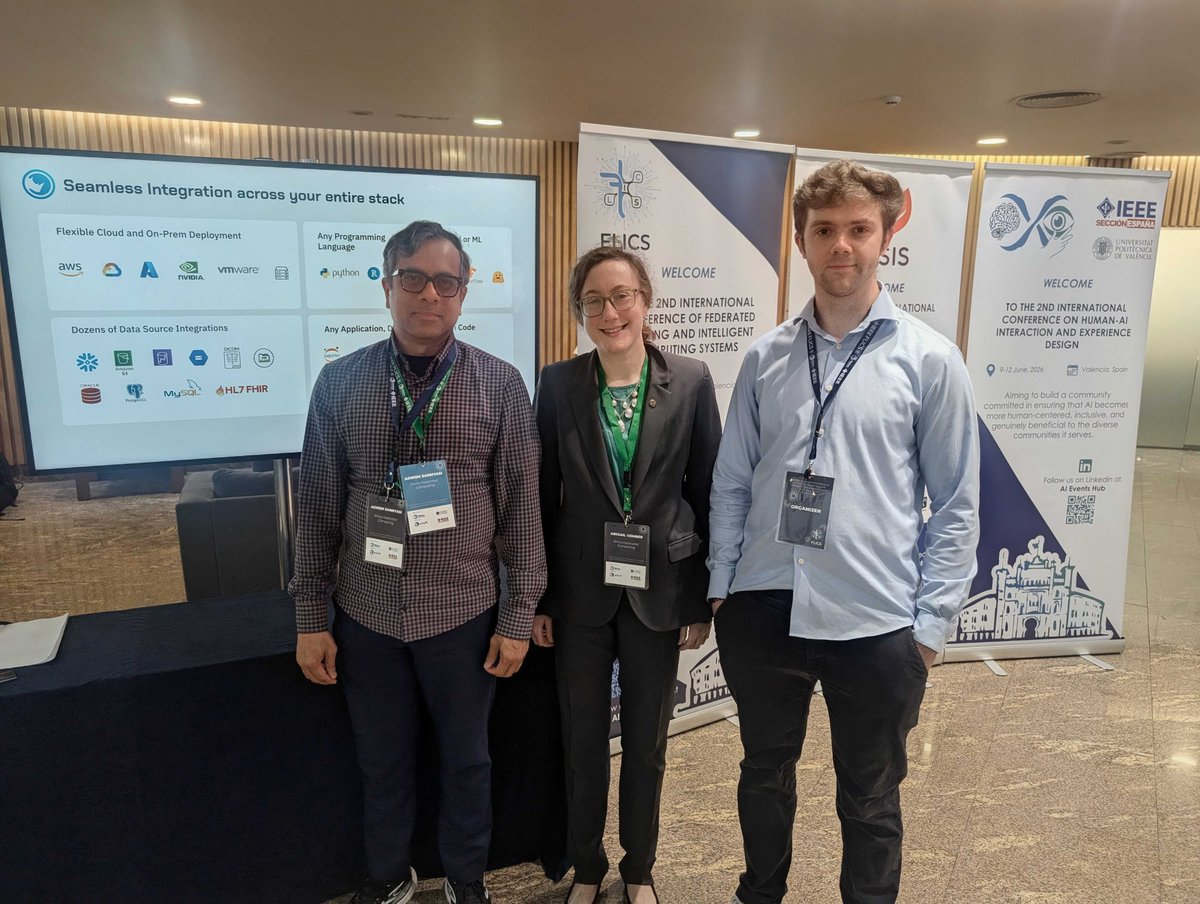
🇪🇸 This week the Rhino team is in Valencia, Spain for FLICS!
Whether you are looking to scale your R&D, streamline compliance, or securely collaborate across global networks, let’s discuss how edge computing and federated workflows can accelerate your timelines.
💡 Federated Learning to Federated Computing: A truly global platform
📍June 10 @1PM
Presenters: Abigail Cember and Tony Buschiazzo
💡From Intelligent Systems to Sustainable Societies: A Cross-Disciplinary Dialogue
📍June 10 @4PM
Panelist: Adrish Sannyasi (@DataDrivnHealth)
Schedule time to meet here 👉 https://t.co/jjL1Zg4rK3
This is a critical post to read if you’re building an applied AI company right now.
“An application earns its place in the untrainable corner by doing unglamorous work: arranging a company's private reality so a model can act on it, handing the model the tools to act, working with the customer to change the reality of its workforce. A company that brings the translation is tough to copy – and the translation never ends. Integration and maintenance run as long as the relationship does, won by teams that put domain-specialized engineers and tools next to the customer.”
There’s still an insanely large gulf between model capabilities and what it takes to apply them to specific corporate workflows. Some of that is technology that needs to be built, a lot is access to (and formatting of) the right data to work with, and a ton more is on the change management and specific implementation work (FDEs, etc.) it takes to make AI work in any specific corporate setting.
2 things can be very true at once: frontier models and labs will continue to grow an incredible amount, and there will be a vast ecosystem of software and services companies that emerge to bring the power of these models to real enterprises. This makes room for new infrastructure provides, applied AI companies in every vertical, new versions of system integrators, and more players.
Incredibly exciting time on all fronts.
One of the new, buzzy jobs in Silicon Valley is the AI Forward Deployed Engineer (FDE), an engineer who is embedded within a client organization to help customize solutions, such as building and tuning agentic workflows that suit the client’s particular needs. I’ve heard from people who are wondering anew about the FDE career path since OpenAI and Anthropic started building new teams to place FDEs within client organizations.
The rise of FDEs for AI workloads is one way AI is creating new jobs (and why the jobpolcalypse narrative of upcoming job market collapse is false -- there will be many AI and non-AI jobs). However, I believe there will be far more AI Engineer jobs than FDEs, as I explain below.
The FDE role was pioneered about two decades ago by Palantir, which sent engineers to government locations to work on secure, air-gapped networks. In addition to having good technical skills, FDEs need communication skills and sometimes business skills. For example, they may need to speak with clients to understand their needs, formulate a strategy to prioritize projects, explain complex technology, and respectfully push back if a client asks for something unrealistic. They’re enjoying a resurgence because of the amount of work involved in taking an off-the-shelf LLM and building it into a custom agentic workflow that fits particular business needs.
However, I believe the number of AI Engineer jobs will be far larger. A company might accept a few FDEs to be embedded within its organization. But most companies will want far more of their own employees working on their projects. While my organizations do hire FDEs, we hire far more AI Engineers! Also, a common client concern is that it is hard to find vendor-neutral FDEs — they are, after all, there to deeply integrate a particular vendor’s product into a company. In this moment when it’s hard to predict which AI service will be the best one in a year’s time, optionality (the ability to pick whatever vendor turns out to fit best in the future) is very valuable. In contrast, letting FDEs tightly bind a company’s processes significantly reduces optionality.
Right now, I see surging demand for AI Engineers who can build software applications using AI software components (like LLM prompting, agentic frameworks, evals, etc.) and effectively use AI coding agents (like Claude Code, Codex, Antigravity CLI, and OpenCode). As the AI Engineer role matures, I expect it to fragment into more specialized roles, like the generic Software Engineer role from decades ago fragmented into frontend, backend, mobile, data engineering, devops, and so on.
What will be the future, specialized AI engineering roles? I don’t know. Perhaps there will be AI FDEs, LLMOps Engineers, Evals Engineers, AI Data Engineers, Harness Engineers, and other roles we don’t have names for yet. But for now, I see a lot of AI engineers who are generalists create a lot of value. Skilled AI Engineers are in very high demand! As our field continues to mature over the coming decade, I look forward to new specializations within AI Engineering that create even more job opportunities.
[Original text: The Batch newsletter]
Is your organization struggling to leverage distributed health data for AI development and research without compromising security or regulatory compliance?
The Rhino team is heading to Spain to attend the Future of Laboratory Informatics and Compliance Summit (FLICS)!
Whether you are looking to scale your R&D, streamline compliance, or securely collaborate across global networks, let’s discuss how edge computing and federated workflows can accelerate your timelines.
🤝 Book a meeting with our team at FLICS: https://t.co/iywkxoB0JQ
Yesterday at Edge Computing Expo, Adrish Sannyasi (@DataDrivnHealth) was on the main stage to present how collaborative edge computing is a rising tide that lifts all boats.
He shared the architectural decisions, trade-offs, and lessons from building and operating an orchestration and edge execution platform spanning 100 plus edge nodes across multiple cloud providers.
🤝 Didn't get a chance to see the presentation? Stop by Booth #269 to speak with Adrish.
@TechEx_Event #TechEx #EnterpriseIT #AI


![AndrewYNg's tweet photo. One of the new, buzzy jobs in Silicon Valley is the AI Forward Deployed Engineer (FDE), an engineer who is embedded within a client organization to help customize solutions, such as building and tuning agentic workflows that suit the client’s particular needs. I’ve heard from people who are wondering anew about the FDE career path since OpenAI and Anthropic started building new teams to place FDEs within client organizations.
The rise of FDEs for AI workloads is one way AI is creating new jobs (and why the jobpolcalypse narrative of upcoming job market collapse is false -- there will be many AI and non-AI jobs). However, I believe there will be far more AI Engineer jobs than FDEs, as I explain below.
The FDE role was pioneered about two decades ago by Palantir, which sent engineers to government locations to work on secure, air-gapped networks. In addition to having good technical skills, FDEs need communication skills and sometimes business skills. For example, they may need to speak with clients to understand their needs, formulate a strategy to prioritize projects, explain complex technology, and respectfully push back if a client asks for something unrealistic. They’re enjoying a resurgence because of the amount of work involved in taking an off-the-shelf LLM and building it into a custom agentic workflow that fits particular business needs.
However, I believe the number of AI Engineer jobs will be far larger. A company might accept a few FDEs to be embedded within its organization. But most companies will want far more of their own employees working on their projects. While my organizations do hire FDEs, we hire far more AI Engineers! Also, a common client concern is that it is hard to find vendor-neutral FDEs — they are, after all, there to deeply integrate a particular vendor’s product into a company. In this moment when it’s hard to predict which AI service will be the best one in a year’s time, optionality (the ability to pick whatever vendor turns out to fit best in the future) is very valuable. In contrast, letting FDEs tightly bind a company’s processes significantly reduces optionality.
Right now, I see surging demand for AI Engineers who can build software applications using AI software components (like LLM prompting, agentic frameworks, evals, etc.) and effectively use AI coding agents (like Claude Code, Codex, Antigravity CLI, and OpenCode). As the AI Engineer role matures, I expect it to fragment into more specialized roles, like the generic Software Engineer role from decades ago fragmented into frontend, backend, mobile, data engineering, devops, and so on.
What will be the future, specialized AI engineering roles? I don’t know. Perhaps there will be AI FDEs, LLMOps Engineers, Evals Engineers, AI Data Engineers, Harness Engineers, and other roles we don’t have names for yet. But for now, I see a lot of AI engineers who are generalists create a lot of value. Skilled AI Engineers are in very high demand! As our field continues to mature over the coming decade, I look forward to new specializations within AI Engineering that create even more job opportunities.
[Original text: The Batch newsletter]](https://pbs.twimg.com/media/HJvWmCHagAAnTxQ.jpg)


