@hadikhantech I write for myself. Writing is thinking. My view is you write not for "who will read it" but rather what clarity will I achieve if I write this long form article. Readership is just a bonus
I wrote a book on AI safety, and it's free.
AI Safety from Zero to the Open Frontier — 81 pages, ten chapters, written in collaboration with @claudeai
Free under CC BY. Link in comments 👇
@poolsideai is one of those super underrated labs! I was pleasantly surprised by the Laguna series while using the @OpenRouter free endpoints, and now it is a driver in one of my Hermes Agents. Super bullish on these guys!
Today we are releasing Laguna S 2.1.
At 118B total parameters, with 8B active per token, it does the work of models several times its size on agentic coding. It is remarkably persistent across long-horizon tasks. And it is small enough to run on a single NVIDIA DGX Spark.
It is far more capable than anything we have created before, and I think it redefines what a model in its weight class can do.
Laguna S 2.1 is an important model for Poolside. What it represents is even more important.
If, five years ago, I had read a book that said that by 2030 everything economically valuable, scientifically interesting, and personally meaningful would be built on intelligence contracted from three or four companies, I would have called it dystopian science fiction.
We are at a fork in the road of what kind of world we can have.
I believe intelligence should and will become a commodity. The question is whether that intelligence comes from three companies, or from many people who can build it, own it, and shape it.
The open ecosystem will not win by being the best in its own category. No one cares who is king of the open-source kingdom. People want the best intelligence for the task they are trying to do, with the right balance of quality, speed, cost, and control.
If we want a different future, open models have to be on par with, or better than, their closed equivalents.
Laguna S 2.1 is a meaningful step in that direction: capable enough to compete far above its weight class, efficient enough to run on hardware you can own, and open-weight so anyone can build on it.
Open-weighting our models is the contribution we can make today toward a world where intelligence can be built and owned by many. And we will keep doing it.
I am very proud of this team’s work. A big shout out to everyone at Poolside who made this possible, from infrastructure and data to architecture, pretraining, post-training, evaluations, and inference.
Laguna S 2.1 is available today under the OpenMDW-1.1 license, with weights on Hugging Face and access through OpenRouter and our API.
We are building toward a future where the most capable intelligence in the world can be owned and shaped by anyone. Laguna S 2.1 is one step. We are going to keep building until that future exists.
https://t.co/eTV7iNATrB
Introducing Unsloth for AMD 🚀
You can now train & run LLMs on your AMD hardware
• We collaborated with AMD to enable you to train & run 500+ models on AMD GPUs
• Works on Windows, WSL, Linux
• Train Qwen, Gemma on 3GB VRAM
GitHub: https://t.co/2kXqhhvLsb
Works on Radeon, Instinct, Ryzen and data center GPUs with up to 2× faster with 70% less VRAM and no accuracy loss via our custom Triton kernels and math algorithms. We also support optimized ROCm builds for GGUF & Safetensors inference.
Unsloth is an open-source local UI for faster LLM training and inference, with tool-call healing, code execution, secure web search, remote APIs, and HTTPS deployment. Connect local models to Claude Code, Codex agents and run the latest Kimi, GLM, DeepSeek, Qwen3.6, and Gemma 4 models.
🔗Blog + Guide: https://t.co/U9LqyRjFdj
A mentor once told me this: Fall in love with feeling like a work in progress. Resist the urge to look polished. You don’t need to pretend you have it all figured out. Nobody does. Embrace your unfinished form. Just commit to getting a better each day and trust where it leads.
Mind boggling to me that I can make a thing faster and there's always people that ask "but why?" What kind of mentality is that? The pursuit of excellence does not need justification. Also, I find in so many cases, we can't know the impact of an improvement until we do it.
For example, one I've talked about before: Ghostty's high IO throughput has enabled terminal program (emulator and TUI) fuzzing at a speed thats incomparably fast to prior solutions. This has resulted in upstream patches to resolve issues in popular projects like btop, tmux, and more.
Speed enabled that anecdotally example that lifted the tides of adjacent communities that don't rely on Ghostty technology at all. I didn't predict this.
Make things better because they can be better and let the results naturally play out.
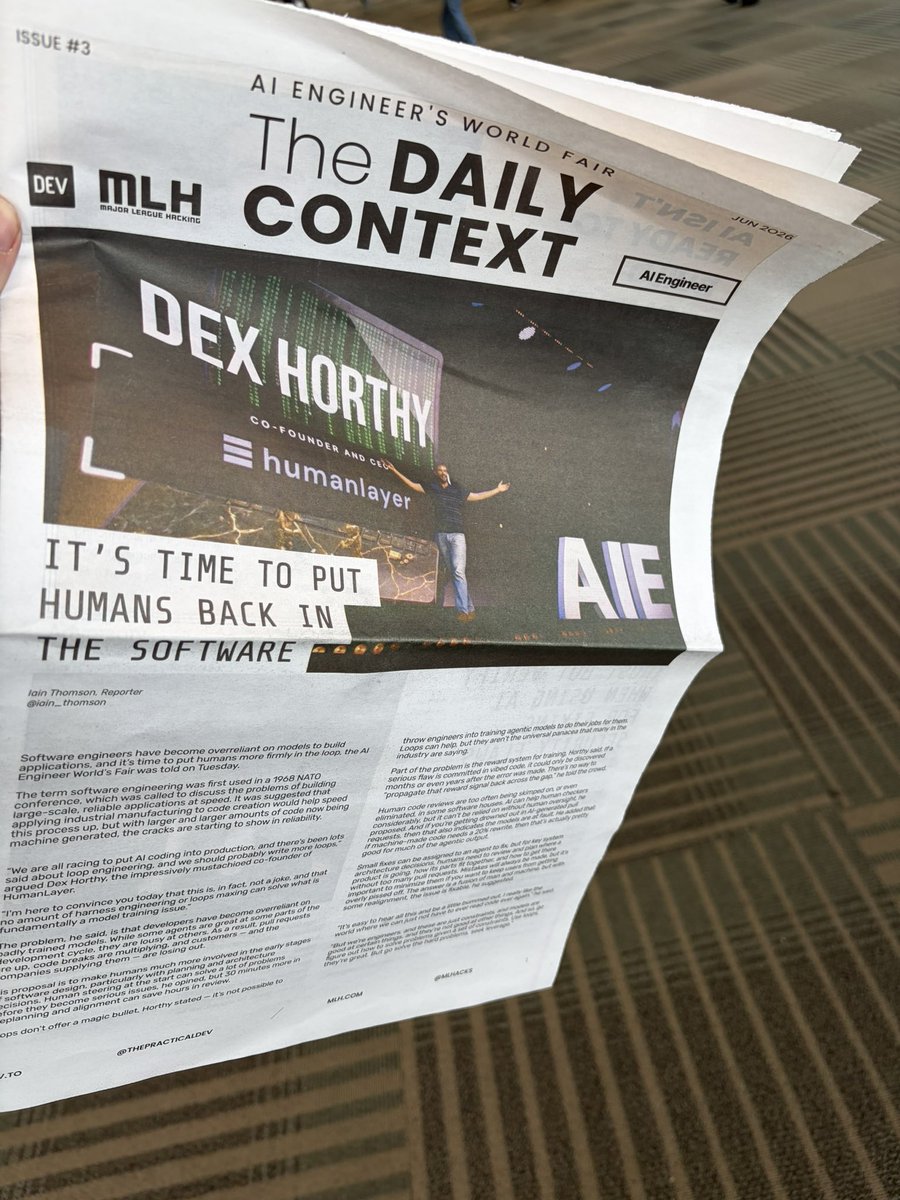
Insane week at @aiDotEngineer !! @swyx and team are legends
If you’re around today, humanlayer is holding office hours on the second floor by the food stand, come say hi, bring your laptop, let’s ship!