On Nov 1, 2025, Amaira, a Class 4 student, died by suicide after jumping from the fourth floor of the Neerja Modi School in Jaipur.
She had been bullied for 18 months, with classmates targeting her using "bad words," many of which carried sexual undertones. However, her class teacher repeatedly dismissed complaints from both Amaira and her parents, telling them instead that she needed to adjust to the other kids.
The parents have now released the school CCTV footage they obtained to the public. The footage reveals that even on the day of her death, Amaira approached the teacher multiple times for help but was ignored.
Hard to believe that teachers, even at such posh schools, are not trained to handle severe bullying or recognize a child in deep psychological distress. Totally preventable death.
Who is next after the Ramanujan?
In the mid-20th century, Western academic cartels claimed that advanced mathematics was a European construct, brought to a colonized India via British education. Tekkath Amayankottukurussi Kalathil Sarasvati Amma responded by spending decades deep in the forgotten archives of Kerala, translating archaic Sanskrit palm-leaf manuscripts with razor-sharp mathematical precision.
She proved that centuries before Sir Isaac Newton/Gottfried Leibniz were even born, unheralded Indian astronomers had already built the foundations of calculus & high-level geometry. This is the story of how an Unsung Scholar reclaimed the Intellectual Sovereignty of a Nation.
For generations under colonial rule, a deeply damaging psychological narrative was hammered into the Indian psyche: Your ancestors were mystics & poets, but they lacked the rigorous, logical discipline for advanced science & mathematics. The global academic consensus was that high-level geometry, infinite series, & calculus were the exclusive property of Europe.
India was viewed as a nation that needed to be civilized with Western numbers, completely oblivious to the fact that it had once been the mathematical capital of the world.
T.A. Sarasvati Amma was born in Kerala, a land with a deeply hidden, rich intellectual undercurrent. She was not an "uneducated" woman in the literal sense, she was a brilliant scholar of Sanskrit & Mathematics, but to the global elite who only validated degrees from Oxford/Cambridge/Harvard, she was an outsider working in the shadows.
In the 1950s & 60s, while working under the guidance of legendary scholars like Dr. V. Raghavan at the University of Madras, she realized that the history being taught in schools was a lie. She did not seek validation from Western journals. She went straight to the dirt, the dust & the decaying private libraries of old Kerala families.
She began unearthing 100s of brittle, centuries-old palm-leaf manuscripts written in a highly technical, coded astronomical Sanskrit.
Sarasvati Amma undertook a brutal, lonely intellectual pilgrimage. For yrs, w/o the aid of computers/digital databases/massive research grants, she painstakingly translated & mathematically mapped out texts like the Yuktibhasa, the Karanapaddhati & the Tantrasangraha.
Her pitch to the skeptical academic community was uncompromising: "I will not give you theories. I will give you the exact geometric proofs, calculated centuries before your European heroes walked the earth."
She discovered that in the 14th century, a mathematician named Madhava of Sangamagrama & his disciples in the Kerala School of Mathematics had already solved problems that Europe would not touch until the late 17th century.
Against all odds, in 1979, Sarasvati Amma published her magnum opus: "Geometry in Ancient and Medieval India." It was a masterclass in mathematical archaeology that fundamentally shook the foundations of global history.
She systematically proved that:
The Madhava-Gregory Series: The infinite series for pi*(4 X (1 - 1/3 + 1/5 - 1/7.......), attributed to the Scottish mathematician James Gregory in 1671, was recorded in India 300 yrs earlier.
For the 1st time in modern history, the West could not look down its nose. The proofs were right there, written on palm leaves, preserved by a quiet woman who refused to let her nation’s history be erased.
Sarasvati Amma’s work didn't build corporate empires/software companies, but it did something far more powerful: it restored the intellectual self-respect of an entire civilization. Her book became the absolute gold standard reference for the history of mathematics worldwide, forcing global historians to slowly & reluctantly rewrite their textbooks.
She lived a fiercely quiet, simple life, retiring as a prof & spending her final yrs in her hometown in Kerala, completely disconnected from the blinding lights of fame. She passed away in 2000, largely unknown to the millions of Indian students who daily study the very calculus her work reclaimed.
T.A. Sarasvati Amma proved that the ultimate form of patriotism is the preservation of truth. She showed that a nation’s backbone is nott just built by industrial concrete/military might, but by its memory.
T.A. Sarasvati Amma proved that a lone Indian woman, armed with nothing but dusty palm leaves & an iron will, could rewrite the mathematical history of the world.
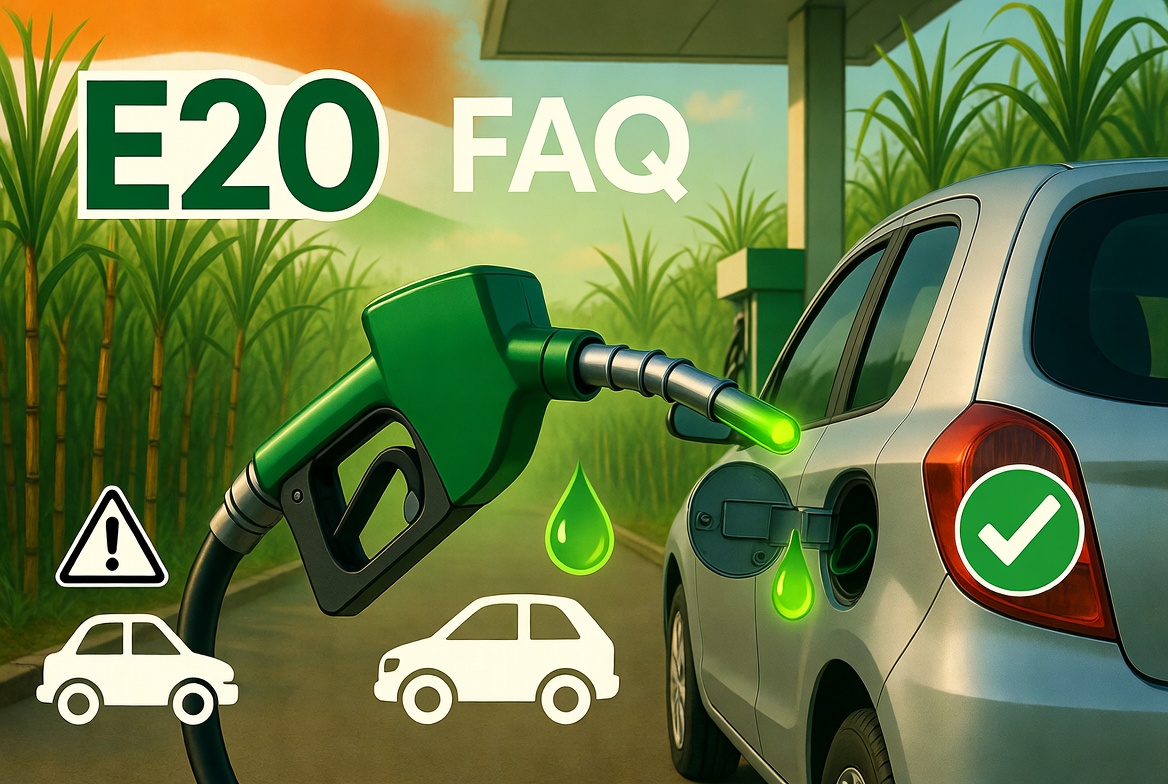
The govt shifted the country's baseline fuel to E20, but left the actual vehicle owners entirely in the dark. Since the Ministry should have circulated a clear, honest blueprint to prevent panic & confusion, let me do their job for them :))
E20 & Flex-Fuel Consumer FAQ:
Q1: Is my current car/bike compatible with E20 fuel?
Vehicles built AFTER April 2023: Yes. Your engine, fuel lines & gaskets are fully E20-compliant.
Vehicles built BEFORE April 2023: Materially Vulnerable. These engines were optimized for a maximum of 10% ethanol (E10). While the car will run on E20, the higher solvent properties of ethanol can accelerate the degradation of legacy rubber hoses, plastic seals & older aluminum fuel lines over time.
Nuance: Many manufacturers (e.g., Honda since 2009 models, Skoda post-2020 BS6) confirm their older vehicles are materially compatible with E20 & will not void warranties. Some pre-2023 cars may experience accelerated wear on rubber/plastic parts over time due to ethanol's solvent properties, but it is not an immediate failure for most. Long-term risks (corrosion, degradation) exist for legacy components.
Q2: Why exactly does my vehicle’s mileage drop with blended fuel?
This is a fixed law of thermodynamics, not a mechanical malfunction. Pure gasoline has a high energy density (~44 MJ/kg). Pure ethanol contains roughly 35% less thermal energy per unit volume (~27 MJ/kg).
Because the fuel blend has less net energy density, our engine must burn a higher volume of fuel to produce the exact same mechanical power. Expect a 3% to 10% drop in mileage on standard engines running E20.
Q3: Is there a way to upgrade my older vehicle for E20?
Yes. The automotive industry is addressing the compatibility gap for pre-2023 vehicles. Maruti Suzuki & some aftermarket suppliers have developed/are rolling out E20 retrofit/upgrade kits. These kits primarily replace vulnerable components like fuel lines, rubber seals, gaskets & certain hoses with ethanol-resistant materials.
Typically covers Maruti models up to 10-15 yrs old. Estimated cost: ₹4-6K for the kit (depending on the model) + labour charges at a service centre. Total cost is usually < ₹10K.
Q4: What is the difference b/w 1G & 2G Ethanol, & what are we using?
1G (First-Generation): Made directly from food crops & cash crops (sugarcane molasses, maize, & surplus rice). Currently, over 99% of the ethanol in India is 1G.
2G (Second-Generation): Made from agricultural waste & non-food biomass (like paddy straw/stubble).
Why it matters: 1G strains water resources. 2G is superior because it turns waste into fuel w/o impacting food security, but it is currently highly expensive & complex to scale commercially.
Q5: Is ethanol-blended petrol actually "better" for my car or the country?
For your car: It acts as a high-octane oxygenate. It helps the fuel burn more cleanly & uniformly, which reduces engine knocking & lowers toxic tailpipe emissions like CO.
For the country: It is a massive economic hedge. India imports ~85-90% of its crude oil. Blending saves billions in FX reserves & channels those payments back into the domestic agricultural economy.
Q6: Will using E20 fuel void my motor insurance policy?
No. The Ministry of Petroleum & Natural Gas & the govt have explicitly clarified that all motor insurance policies remain 100% valid. Insurers cannot reject standard accident/damage claims based on the % of ethanol flowing through your engine.
Q7: Minister Nitin Gadkari recently approved E85 & E100 regulations. Can I use these in my current car?
Absolutely not. The govt officially finalized the regulatory framework for E85 (85% ethanol) & E100 (100% pure ethanol).
These fuels are strictly designed for a new class of vehicles called Flex-Fuel Vehicles (FFVs). Mass-market manufacturers like Maruti Suzuki (with the WagonR FFV prototype), Toyota, MG, Hyundai & Hero MotoCorp are launching these vehicles specifically to handle high-concentration ethanol. Pumping E85/E100 into a regular, non-flex-fuel petrol car will cause immediate engine & fuel system failure.
Q8: What is "Phase Separation" & how do I prevent it?
Ethanol is hygroscopic, meaning it acts like a sponge for atmospheric moisture. If your vehicle sits completely idle for weeks, the ethanol will pull water into the tank. If the moisture level crosses 0.5%, the water & ethanol will separate from the petrol & settle as a sludge at the bottom of your tank.
Prevention: If you plan to leave your vehicle unused for an extended period, keep the tank as full as possible/ensure you top it up with fresh fuel regularly to keep the mixture stable.
Q9: Can a petrol pump deliberately manipulate the E20 blend? How do I check it on the spot?
You cannot use a standard Density Meter (lactometer equivalent) to catch extra ethanol. Because the density of petrol (~740 kg/m^3) & ethanol (~789 kg/m^3) are relatively close, an extra 10% of hidden ethanol gets easily masked within the daily allowable temperature-density variance chart. A density test only catches water/heavy kerosene adulteration.
To catch exact ethanol percentages, you must exploit ethanol’s chemical property of hygroscopy (its intense attraction to water). You can buy a cheap, graduated testing cylinder (often sold as an Ethogage).
How to execute the test: Pour exactly 10 ml of water into a 100 ml graduated cylinder. Fill the rest of the cylinder with the pump's petrol up to the 100 ml mark (giving you 90 ml of fuel). Shake it vigorously for 1 minute & let it settle for 3 minutes.
How to read the data: Because ethanol completely abandons petrol to bind with water, the fluid layer at the bottom will expand: If it is perfect E20 Petrol: The bottom line will rise exactly to 28 ml (10ml water + 18ml extracted ethanol). If the pump is cheating (Over-blending), the bottom line will shoot way past 28 ml. If it hits 35 ml, they are dumping illegal quantities of ethanol into your tank.
I have no affiliation with any political party. My only allegiance is to Bharat. Thank you. 🙏🙏
Dost, you will not understand the army way of life. Let me try. This is unlike any other profession where people switch off their laptop and go home in the evening and that's it. Fauj is part of every breath of your life - for the faujis, and their families.
You live in a cantonment which is also home to army units and their equipment, including tanks and guns and what not.
Your friends and you could be playing cricket in corner of open space and tanks could be driving from their Unit/Regiment area to another area on the other side.
When I say I drove a tank, do you think it was parked in front of my house, I hopped on it and drove away?🤣
I went to the regiment which had the tanks, I had already requested in advance through my father to his acquantance in the regiment to show the tanks to us kids. Otherwise they won't even allow you to enter the regiment area.
Someone took us to the parked tank, told us about various equipement and how things work. I sat in the gunner's seat, driver's seat and the comander's seat.
Next, the tank was taken to the adjoining open training area, and we got to sit in the driver's seat and drive it for few hundred meters in a big open ground.
That is the sum-total of my privilidge as a fauii kid! And I did this because I was interested. 8/10 fauji kids won't even do this because they're not interested.
This is going to be unpopular but the comparison is unfair and the blame is misplaced.
Yes, our streets look worse. But the reason isn't just the municipality, MLA, or MP. The reason is us.
Let me explain.
Sri Lanka has a population of 2.2 crore. Thailand has 7 crore. Vietnam has 10 crore. Dubai has 35 lakh people. India has 145 crore. That's roughly 14 times Vietnam's entire population in just one of our metros.
Now think about what that means for waste. Mumbai alone generates more garbage in a day than Sri Lanka's entire capital city does in a week. Delhi produces 12,000 tonnes of waste daily. Bangalore 5,000 tonnes. Even Indore, India's cleanest city for 7 years running, handles 1,200 tonnes a day.
No municipality on earth can keep streets clean if its citizens treat the street as a dustbin.
Think about where Indian garbage actually comes from.
> The chai cup tossed on the road by the office-goer.
> The biscuit wrapper thrown out of the moving car.
> The paan masala spit on the wall by the well-dressed man.
> The construction debris dumped on the empty plot by the contractor.
> The household waste thrown out of the apartment window because "yahan toh sab karte hain."
> The plastic bottle left at the picnic spot.
> The diapers on the highway.
> The flowers in the lake.
> The wedding waste left for someone else to clean.
Every single one of these is a citizen choice. Not a municipality choice. Not an MLA decision. Not a system failure.
Compare with what happens in Singapore.
Throwing a cigarette butt is a 1,000 SGD fine, roughly Rs 62,000. Throwing chewing gum is illegal entirely. Spitting in public is a 1,000 SGD fine.
In Japan, school children are taught to clean their own classrooms. There are almost no public dustbins in Tokyo and yet the city is spotless because everyone carries their own trash home.
In Switzerland, residents sort their garbage into 7 categories. Wrong sorting attracts fines that can hit 200 EUR. Compliance is nearly 100% because the citizens see it as their responsibility.
In Dubai, a piece of trash on the floor is a 500 AED fine, roughly Rs 11,000. Spitting in public is 1,000 AED. Indians in Dubai don't litter Dubai. Same Indians in Delhi litter Delhi. Same person. Different behaviour. Why?
Because the system catches them in Dubai. In India, it doesn't. But the deeper issue is that we don't even need the system to catch us. We just need to not litter in the first place.
Indore became India's cleanest city not because their municipality is uniquely competent. It's because they spent 5 years building citizen behaviour.
> Door-to-door garbage collection at fixed times.
> Public shaming of litterers.
> Heavy fines actually enforced.
> Citizens trained to segregate.
> Public ownership of the cleanliness mission.
The municipality and citizens together transformed Indore.
Other Indian cities that have shown similar progress when citizens engaged. Surat post-1994 plague (now a top 5 clean city). Mysuru. Visakhapatnam.
Even Bhopal in patches. None of these are blessed with better politicians than Mumbai or Delhi. They just have a citizenry that decided to participate.
The harder truth is that;
> We blame the municipality for unswept streets while throwing our chai cup on them.
> We blame MLAs for traffic chaos while refusing to follow lanes.
> We blame the system for stray dogs while feeding them on the road without taking them home.
> We blame politicians for unclean temples while throwing prasad wrappers at the entrance.
You can change your MLA every 5 years. The garbage problem will still be there because the same citizens are still throwing the same trash on the same streets.
Sri Lanka, Thailand, Vietnam are clean because their citizens accept that public spaces are shared spaces.
We treat their homes as sacred and the street as a landfill.
The municipality can sweep 100 times a day. If we throw garbage 101 times, the street is dirty.
It is 60% citizen behaviour. 30% civic infrastructure (dustbins, collection systems, sewage). Only 10% political leadership.
Most of the "scam by municipality" rage is just our discomfort with looking in the mirror.
Start with yourself. Carry your trash. Don't spit. Don't litter. Don't burn waste. Don't dump construction debris. Train your kids better than your parents trained you. Push your RWA to take cleanliness seriously. Support municipalities that fine and enforce. Pay the fine when you make a mistake.
We are 145 crore people. No municipal sweeper can save us from ourselves.
Less anger at politicians. More mirrors at home.
This isn't an India problem, every middle-income country has gone through this exact phase before us.
Let me explain;
Quick history. Here's what other countries looked like at our stage.
> Japan in the 1970s.
Tokyo had two-hour queues at parks on weekends. Bullet trains were so packed people had to be physically pushed in by station staff (the famous "oshiya").
Kyoto temples in cherry blossom season were unmanageable. Mount Fuji had garbage piling up because trails couldn't handle the foot traffic.
> China in the early 2000s.
The Great Wall had so many visitors that sections were closing for repair. Beijing parks were standing-room-only.
Shanghai's Bund was a sea of humans every evening. The Forbidden City had hour-long entry lines. They started capping daily visitors only in 2014.
> South Korea in the 1990s.
Seoul's Han River parks were packed every weekend. Mountain trails to Bukhansan had traffic jams of hikers.
Jeju Island hotels were impossible to book. They had the exact same complaints we have today.
Even London in the 1960s and Paris in the 1970s went through this. Hyde Park used to be considered overcrowded with one tenth of today's London population. The Louvre had no crowd management. Eiffel Tower had no advance booking system.
As, countries get richer, their middle class grows. More people can afford to travel and enjoy leisure. The country's infrastructure (built when only a small elite traveled) suddenly can't cope. There's a 15-20 year painful gap before infrastructure catches up.
We're in year 12-13 of that gap.
Now let's look at our growth;
India added 25 crore people to the middle class in the last 15 years. Domestic tourism has tripled. Vehicle ownership doubled. But hotel inventory grew only 3-4% annually. Park space barely changed. Hill station capacity stayed roughly the same.
India has roughly 2.5 lakh hotel rooms. The US has 50 lakh. China has 35 lakh. Even adjusting for tourism volumes, we're massively underbuilt.
Mumbai has 1 sq metre of green space per person. London has 27. Singapore has 66. New York has 23.
India has 22 popular hill stations that the entire middle class is squeezing into. We could easily have 50 if we developed Arunachal, Meghalaya, Nagaland, Mizoram, parts of Himachal that nobody knows about.
To improve the situation, both the government and the citizens need to step up.
Let's look at what our government and policy makers must do first;
> One.
Open up the North-East seriously. The seven sisters and Sikkim could easily absorb 30-40% of current Himalayan tourist flow.
The reason they don't is poor roads, inner-line permit complications for some states, weak hotel infrastructure, limited flights. All fixable in 5 years if treated as a national priority.
> Two.
Build new hill stations from scratch. Vietnam built Sa Pa into a major destination in 15 years. Malaysia did the same with Cameron Highlands.
India has dozens of underdeveloped hill towns (Munsiyari, Chopta, Tawang, Ziro, Mawlynnong) that could become next-generation Shimla and Manali if infrastructure gets built.
> Three.
Cap visitors at fragile destinations. Bhutan does this brilliantly with their high-value tourism policy. Tirupati already does some version of this with time-slot darshan. Ladakh announced visitor caps in 2024.
Manali, Mussoorie, Shimla, Rishikesh need the same.
> Four.
Distribute the load across the year. Right now everyone goes to the hills in May-June and December-January. School vacation timings, public holiday clustering, weather perception all push everyone to the same dates.
Some of this can be solved with better government coordination on holidays.
> Five.
Build urban green space aggressively. Singapore's Park Connector Network. Tokyo's pocket parks every 500 metres. London's protected greenbelt. These are policy choices and we need to make ours.
Now, let's look at what we, as citizens of this great country can do;
> One.
Travel off-peak. Avoid Diwali week in Goa. Avoid May in Manali. Avoid December in Kashmir. Push your travel by 2-3 weeks. The same place is 60% emptier and 30% cheaper.
Two.
> Skip the famous destinations. There are 7 lakh villages in India. We collectively visit maybe 200 of them.
Skip Manali this year, try Chopta. Skip Goa, try Gokarna or Diu. Skip Shimla, try Tirthan Valley or Chamba. Skip Munnar, try Vagamon.
The country is mostly empty if you look outside the Instagram circuit.
> Three.
Don't add to crowd-pulling content. Every viral reel of a "hidden gem" guarantees that place is destroyed in 6 months. Spiti was peaceful in 2018. Then 50 lakh reels happened.
Now Spiti is the next Manali. If you find a quiet place, don't post the exact location. Be selfish about it.
> Four.
Carry your trash back. The single biggest visible damage at hill stations is plastic waste left behind.
Manali and Leh look the way they do not because of crowds alone but because of crowds plus garbage. Take a bag. Bring it back full. Train your kids to do the same.
> Five.
Stop expecting hill stations to feel like 1995. They won't. Make peace with that. The five lakh people you're sharing Manali with are not the problem. The system that didn't build new infrastructure for them is the problem.
> Six.
Plan smarter. Book hotels 60-90 days ahead, not 5. Pre-book temple darshan slots. Avoid long weekends. Travel midweek where possible.
We have terrible last-minute travel habits compared to Europeans or Japanese who plan months ahead.
> Seven.
The deeper mindset shift.
Crowds in India don't mean India is broken. They mean India is finally working for more people than it used to. The poor family that couldn't afford to see Taj Mahal in 2005 is now seeing it in 2026.
That family is sitting next to you in the auto, queuing next to you at the temple, breathing the same hill station air.
That is genuinely a good thing for the country. The discomfort of more people in shared spaces is the price of those people no longer being too poor to participate in middle-class life.
The fix is simply building more places to travel to. More hotels. More parks. More hill stations. More circuits. More infrastructure.
That's slow, unglamorous work of the next 20 years.
In the meantime, your part as a traveler is to spread the load, respect the place, plan ahead, and stop expecting the Indian experience to feel like a private experience just because you can afford it now.
The country isn't crowded because something went wrong. It's crowded because something went right. We just need to build fast enough to match.
It the same story that Japan, Korea, China, Vietnam all wrote before us. And eventually came out of.
We will too. :)
:Thread:
Folks, sharing some thoughts on the Republic Day Parade of yesterday. Reason being that I personally found this parade to be a lot 'different' from earlier ones.
Disclaimer: Purely my personal opinions. Feel free to disagree.
Here goes ..
@PMOIndia@gupta_rekha@MCD_Delhi@ArvindKejriwal
Ring road structure has significantly improved, thank you RekhaJi
Can you please fix the structure of roads in Delhi?
I always face jams in Kashmere Gate due to flooding and get late for office, have to face my managers wrath.
@myntra i have been following up with you for a return, for the last 6 days. Every time I’m told it’ll take 24 hours for an update. Quite frustrated with the constant follow-ups.
@fnpsupport you guys are really pathetic!
I’ve been following up with you for an order since last night with no resolution.
This level of callousness only means one thing: you’re shutting down your business.
@jaypore@AdityaBirlaGrp please get your crappy portal fixed.
I have an unnecessary 12500 credit in my account that you refuse to credit back to source. I used to be a fan, no more.