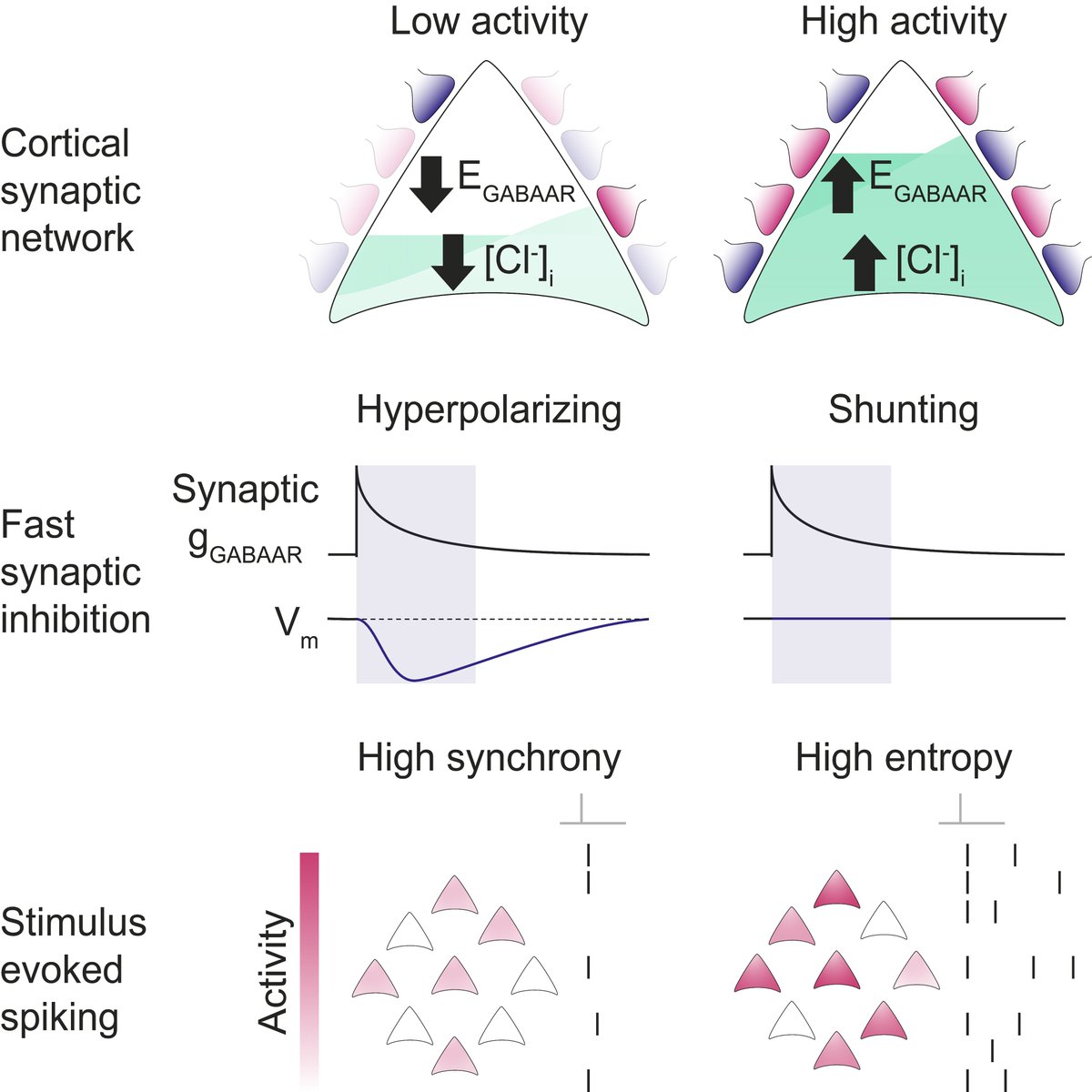
Thrilled to announce the release of our new preprint. Here we show how fast synaptic inhibition adapts to the level of cortical activity and demonstrate why this could be an important feature of how cortical networks process information. https://t.co/xw0eWFofx3
Ever wanted to explore the driving forces underlying inhibitory neuronal signalling? We did! So, for my MSc in @JosephRaimondo lab, we developed the all-optical approach ORCHID - all-Optical Reporting of CHloride Ion Driving force. Now out in @NatureComms https://t.co/kJGv5mZkpg
Our human connectome project is now published; https://t.co/JNaFmbCGbm. Thanks to all contibutors, esp @michalj, D.Berger, @stardazed0 and J.Lichtman.
As Cajal said; “The brain is a world consisting of a number of unexplored continents and great stretches of unknown territory".
Thrilled to announce the release of our new preprint. Here we show how fast synaptic inhibition adapts to the level of cortical activity and demonstrate why this could be an important feature of how cortical networks process information. https://t.co/xw0eWFofx3
Congratulations to @JosephRaimondo and his incredible team @UCT_NI for pioneering this exciting new frontier for studying neuronal ion dynamics. Happy to have played a small part in this adventure. @PharmOxford Please do check out their awesome preprint 👇🏻
We are excited to present ORCHID, a new tool for all-Optical Reporting of Chloride Ion Driving force. https://t.co/HdKWAazf31 In the brain, inhibition is mediated by Cl- permeable receptors. ORCHID can therefore be used to quantify the driving force across inhibitory receptors.
Please do check out our latest preprint which looks how we can study the mechanisms underlying benzodiazepine resistance in children with prolonged seizures 👇🏻 @NDCNOxford@KispiZuerich@KingsCollegeNHS
Seizures that won't stop - status epilepticus - are a medical emergency. We have some good treatments available, but for some patients these don't work.
Here's Tommaso Fedele and @RichBur trying to figure out why some treatments fail for some patients.
https://t.co/qRuvl7mCEN
A small subset of meningiomas metastasise extracranially. The outcomes for these patients are poor and there are no effective management options at present.
We present a case series and systematic review of the literature to describe their features.
https://t.co/xnmglAJlTi
A small subset of meningiomas metastasise extracranially. The outcomes for these patients are poor and there are no effective management options at present.
We present a case series and systematic review of the literature to describe their features.
https://t.co/xnmglAJlTi
Another elegant piece of work from @hannah showing how diurnal fluctuations in synaptic inhibition affect plasticity mechanisms. Check out the preprint now on bioRxiv 👇
Following up on our discovery that cortical intracellular chloride changes with wakefulness, we now look into how this dynamic affects synaptic plasticity mechanism.
Metaplasticity of cortical glutamatergic LTP by diurnal intracellular chloride dynamics https://t.co/QiMM3yZkyZ
Here we extend the brilliant work of @M__Mahn and @OferYizhar to show how their stGtACR2 provides an efficient optical tool for studying chloride dynamics across brain preparations and neuronal cell types.
📢Interested in a new approach to measuring intraneuronal chloride dynamics? Check out our new preprint which demonstrates a new optogenetic strategy that offers many advantages over the traditional agonist-dependent approaches. 👇 https://t.co/DjzDkFZihq
Thrilled to announce the release of our new preprint. Here we show how fast synaptic inhibition adapts to the level of cortical activity and demonstrate why this could be an important feature of how cortical networks process information. https://t.co/xw0eWFofx3