Some big personal news - I'm stepping up as Technical Lead for the @Livepeer Foundation!
After nearly 2 years contributing to the Livepeer community as an open-source developer and leading my own AI-focused group to spearhead AI jobs on the network, I'm thrilled to announce that I'm starting a new role as Technical Director.
We're building something meaningful - here's what we're working on and why now 🧵
1/ 🚀 Today we’re excited to introduce the Livepeer Foundation: a new, neutral entity stewarding the next phase of growth, decentralization, and ecosystem coordination across the Livepeer network.
Livepeer 2.0 Litepaper drops next Wednesday! 🚀
Join Doug on X Spaces to break down the proposed protocol changes and what they mean for LPT holders, Orchestrators, and builders.
https://t.co/3pO4tnes32
Anthropic and OpenAI can slow down their progress if they want to, but their agenda is to slow down open source by placing their cronies to control AI.
This is the same regulatory playbook rail road companies used during the gilded era.
@PessimistsArc Right. Dario was already claiming that GPT2 was too dangerous to open source back in 2019.
I made fun of them then.
Everyone should make fun of them now.
At some point, developers are going to abstract away their relationship with the programming language entirely. Many already have.
You pick the one that gives the best feedback to the model and produces the fewest surprises in production. This is why Rust is rising.
The developers now excited about Rust would never have learned it themselves. It's a pain in the ass to write and takes forever to master. Now that LLMs write it well, the calculus changes. Better type feedback, fewer bugs, faster runtime - what's not to like?
If you're not really reading the code anyway, who cares what language it's written in?
AI is becoming a new computing model for media and entertainment.
At the 2026 Runway AI Summit, NVIDIA’s Richard Kerris explored how real-time generative AI can make creative production a live, artist-controlled process. Powered by NVIDIA Vera Rubin, Runway brought Gen-4.5 to its platform in one day, helping close the gap between imagining a scene and bringing it to life.
.@openrouter is the only thing that comes closest to a free market for AI inference.
Inference providers compete to deliver the best quality service while consumers enjoy uninterrupted AI and the lowest price.
A remarkable creation by @alexatallah
Composable Subgraphs let one Subgraph consume another's entities as a data source.
kind: subgraph, specVersion 1.3.0 or later.
Stop re-indexing the same protocol five times across five teams. Index it once, build on top of it.
LIP-118 has passed the governance vote and is now deployed.
Orchestrators can authorize a separate low-privilege wallet to call rewards, keeping the main wallet cold and enabling multisig orchestrators. Thanks to everyone who voted and discussed it!
More on the forum: https://t.co/BfOJUnqVBN
LIP-118 is now live on-chain and open for voting.
It improves orchestrator security and enables multisig orchestrators. Please cast your vote, the poll runs for another 6 days. Thanks!
https://t.co/0er4yxgz1T
A proposed upgrade to the Livepeer protocol for Livepeer 2.0: Burn Mint Equilibrium.
Here's the idea in 20 seconds. Join the discussion on the forum (link below).
Ethereum's Glamsterdam hard fork is targeting end of August.
It's the biggest L1 upgrade since The Merge. Here's what's actually changing:
- Parallel transaction processing (EIP-7928).
Enables raising the gas limit from 60M to 200M — 3.3x more throughput
- Block building moves into the protocol (EIP-7732).
No more reliance on third-party relays like MEV-Boost
- Max smart contract size doubles from 24KB to 64KB. devs can deploy richer contracts without proxy workarounds
- ETH transfers from smart contract wallets finally get logged properly (EIP-7708). exchanges and wallets can track deposits from contract wallets without custom
integrations
The two big ones are BALs and ePBS. together they redesign how ethereum builds and executes blocks — the deepest infrastructure change since The Merge.
Timeline: Q3-Q4 2026. ETH is at $1,917. this isn't getting the attention it deserves.
@Linda3945345875@Livepeer You should check out https://t.co/Lb8qAQidWP. It explores a new burn-mint equilibrium model and other protocol upgrades designed to address that issue.
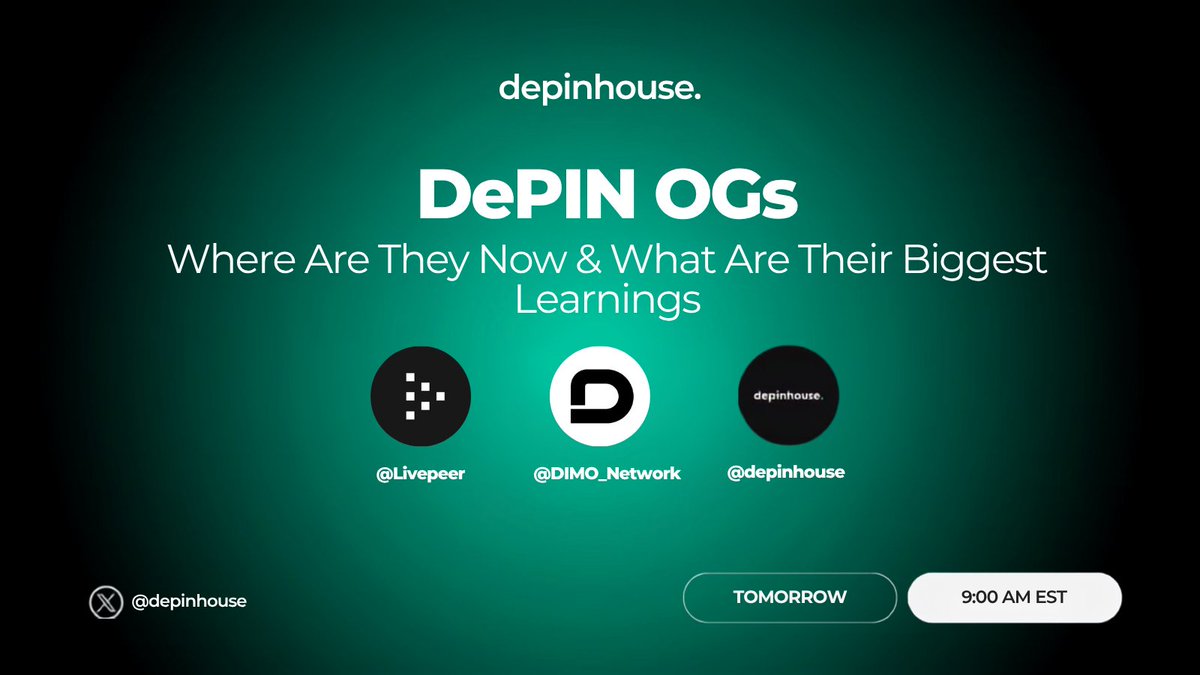
Building physical networks in Web3 isn't easy and the early builders had to figure out hardware, token models, and real-world adoption the hard way.
Join us TOMORROW (Thursday, July 30) at 9:00 AM EST for The Early Builders of DePIN: What They Learned & What They’re Building Now.
We’re sitting down with two OG DePIN pioneers:
🎥 @Livepeer Decentralized video & AI compute infrastructure
🚗 @DIMO_Network Open connected-vehicle data network
Expect an honest breakdown on hardware logistics, community scaling, and the future of decentralized physical infrastructure.
💬 Got questions for the guests? Drop them in our Q&A form: https://t.co/iqTlbOeKnm
🔔 Set your Space reminder now: https://t.co/9FvZZJvOQ6