r3 v1.2 just released (https://t.co/NsipZpn1R1). r3 is like Claude Artifacts but runs locally for any agent. The latest version adds support for images in the feedback and replies.
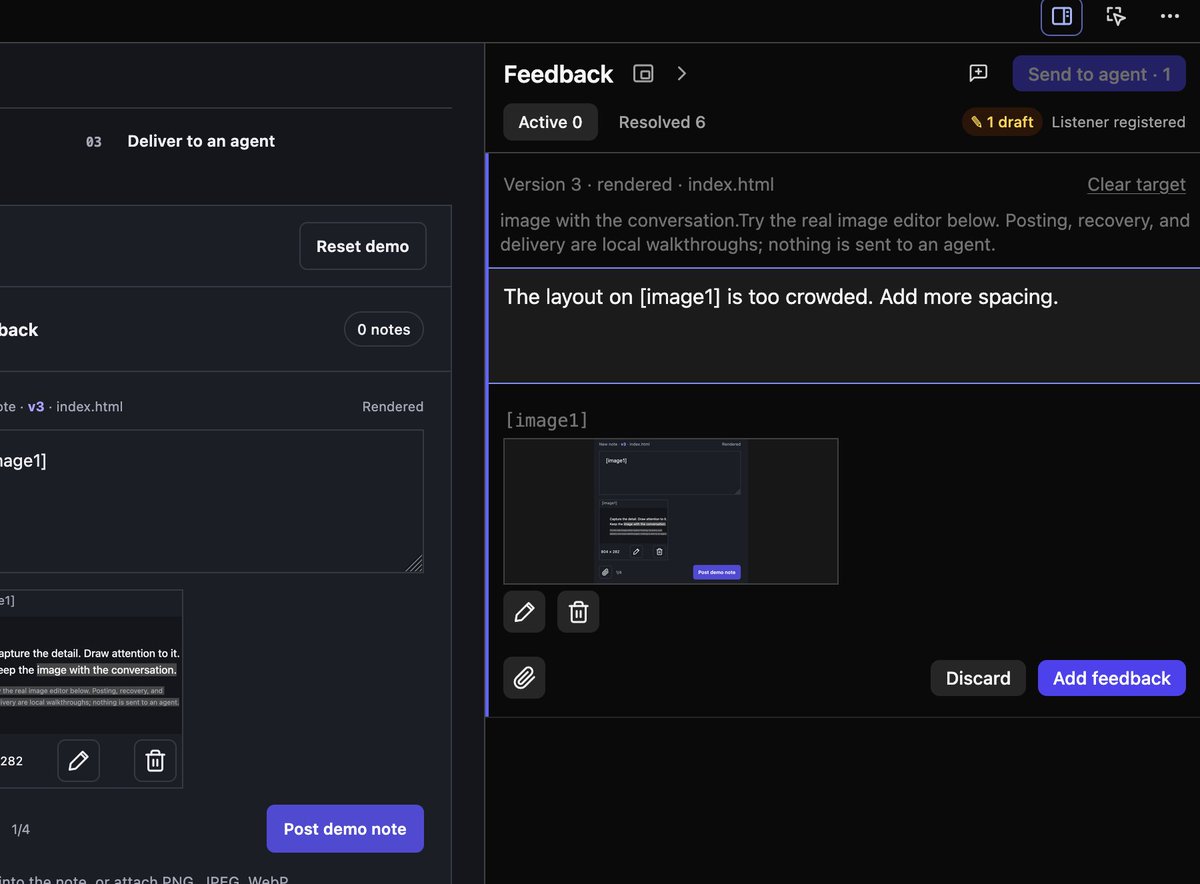
Pasting images into the text input will upload it and leave a placeholder in the text, just like what you are used to in TUI coding agents. You can further annotate or crop it to make the intention clearer to the agent.
It's super handy for giving feedback to visual artifacts, like UI design mockup or scene rendering comparison. Try it out!
r3: like Claude Artifacts, for any agent. Open source. Runs fully locally.
You can:
- 🎨 Compare UI designs and pin feedback to HTML elements
- 📄 Review richly formatted design docs
- 🧪 Learn how things work via interactive demos
https://t.co/XaQSthHpwb
#AIAgents#codex
I still love TUI coding agents for its simplicity but I can see where it comes short. I build two tools to fill the gap.
https://t.co/hFgLIi52fa as a mission control. It removes the mental burden of managing multiple terminal tabs. Remote sessions are supported too.
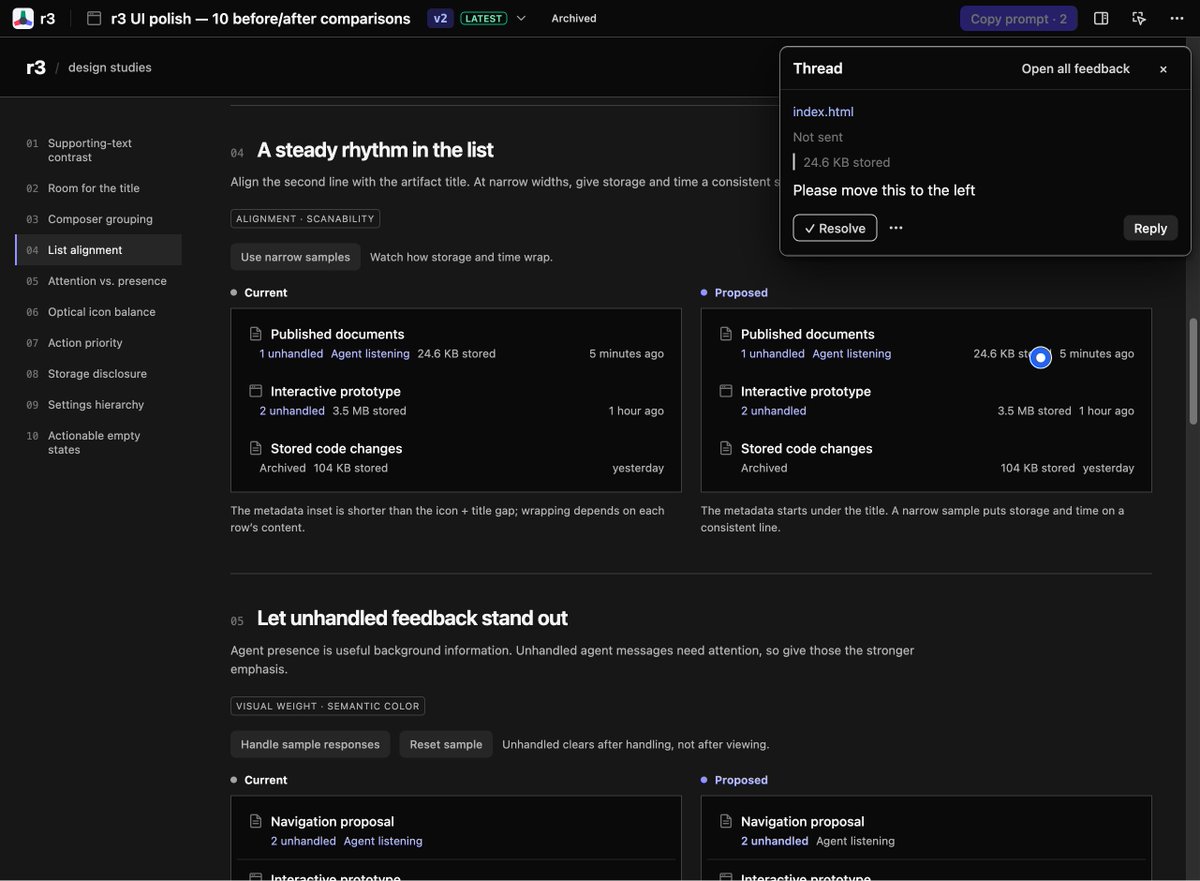
https://t.co/NsipZpn1R1 to host html artifacts (design doc, explainer, etc.). It lets user provide feedback pinned to the exact positions on the page.
@karpathy I've been using html design doc and explainer for a while. The efficiency can be felt instantly.
I also made a local tool (https://t.co/XaQSthHpwb) for commenting directly on the html elements. It feels so smooth to communicate with LLM in this way!
https://t.co/U999UAL5oh
r3 v1.2 just released (https://t.co/NsipZpn1R1). r3 is like Claude Artifacts but runs locally for any agent. The latest version adds support for images in the feedback and replies.
Pasting images into the text input will upload it and leave a placeholder in the text, just like what you are used to in TUI coding agents. You can further annotate or crop it to make the intention clearer to the agent.
It's super handy for giving feedback to visual artifacts, like UI design mockup or scene rendering comparison. Try it out!
My favorite part of building r3: shipping the full stack web app and cli as one executable, bundled by Bun.
It uses `https://t.co/2fk4GC2AS8()` with the `compile` option to bundle the React UI and its assets into the executable, together with the server, CLI, SQLite and Bun runtime. `Bun.serve()` serves the UI and HTTP API.
The end result? Users can simply download the executable from https://t.co/rsoY6r5bre and hand it over to the agent and start a claude artifacts equivalent that runs fully locally.
The only downside is the executable size, which is 80 MB for MacOS and 110 MB for Linux.
Thanks @bunjavascript for making this way of shipping local web apps possible!
r3 v1.2 just released (https://t.co/NsipZpn1R1). r3 is like Claude Artifacts but runs locally for any agent. The latest version adds support for images in the feedback and replies.
Pasting images into the text input will upload it and leave a placeholder in the text, just like what you are used to in TUI coding agents. You can further annotate or crop it to make the intention clearer to the agent.
It's super handy for giving feedback to visual artifacts, like UI design mockup or scene rendering comparison. Try it out!
@trq212 This looks cool! Although there are many cool new game demos made with opus 5.5 in one or few shots, tuning and polishing the feel of game mechanism are still something human need to play test and give feedback to AI. And that's the fun part of making games.
@999toba Looks like a distilled video gen that can get quality output with only few steps of denoising, paired with some duplex A2A model. Something like https://t.co/uwDuVPWBHS
Introducing LPM 1.0 — a video-based character performance model that speaks, sings, listens, reacts, and emotes in real time.
- Generating full-duplex conversation, identity-consistent infinite-length generation, and nuanced human-like performance.
- Building across a co-designed data pipeline, Base model, Online model, and streaming inference optimization.
- Key advantages over other video generation models: performance quality, emotional conversation, precise lip-sync, identity preservation, and lifelike naturalness.
Turning an image into a performance video, LPM 1.0 serves as a visual engine for conversational agents, live streaming characters, and game NPCs.
Page: https://t.co/Ve2c2YNuqj
Arxiv: https://t.co/cM54T3KSPs
Today we’re introducing Gemini 4 Argon.
It delivers frontier performance in complex workflows across real-world software engineering, knowledge work, and cybersecurity defense with an industry-leading 1M token output limit.
What happens when your gaming buddy becomes an in-game purchase? Tencent is testing an AI companion that watches your game play and talks with you as you play. Based on a screenshot, it uses usage-based pricing.
Tencent is no stranger to the freemium model. But on AI-heavy product, they are still not comfortable enough to do a freemium pricing. Charging per-minute price for a companion will certainly affect the user engagement. Not sure how this conflict can be resolved in the short term, assuming we won't have a significant drop on inference cost.
https://t.co/HZcRuETOkt
If a game lets you talk with an anime character the way you would on a video call, what would you want to play? I am thinking of a text adventure game where you experience the story by talking freely with different characters.
#AIVTuber#AIAvatar
@0xInk_ The art style looks beautiful! I used the same self-play simulation in my text adventure game too. As long as the game is turn-based, it's quite trivial to let AI self play and validate ideas.