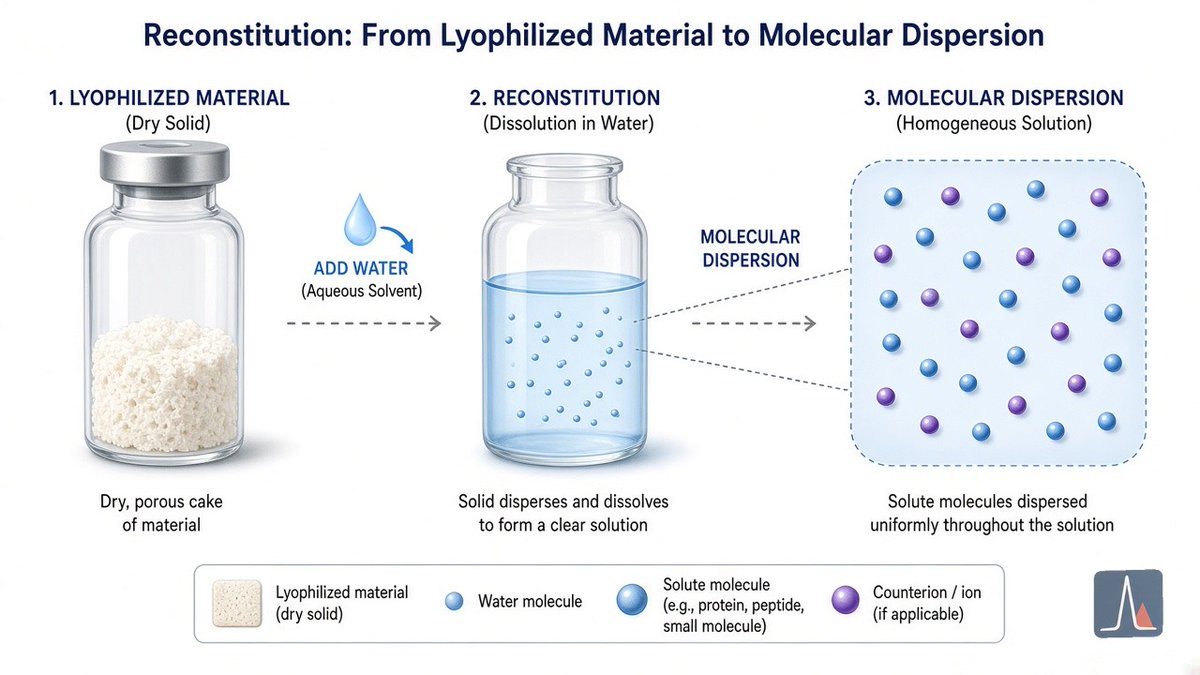
How to reconstitute a research peptide the right way: clean hands, clean stoppers, slow water, no shaking. 🧪
Step-by-step sterile bench guide. For laboratory research use only.
https://t.co/rqCXwEqV7H
@TheDrMAWZ Striking contrast with how much rodent work exists on tendon, gut and vascular models. Small uncontrolled human series can't tell us much either way, so a properly blinded RCT with imaging endpoints is what the field really needs next.
@tkebs2 Fully agree on lot match first. A COA for a different batch tells you nothing about the vial in front of you. Identity before purity makes sense too: 99% pure of the wrong sequence is still the wrong peptide.
Question for researchers: when you read a peptide paper or a COA, what do you check first: HPLC purity, mass-spec identity, or whether the tested lot matches the lot you have?
Updates on Telegram: https://t.co/HVVYsvlUr6
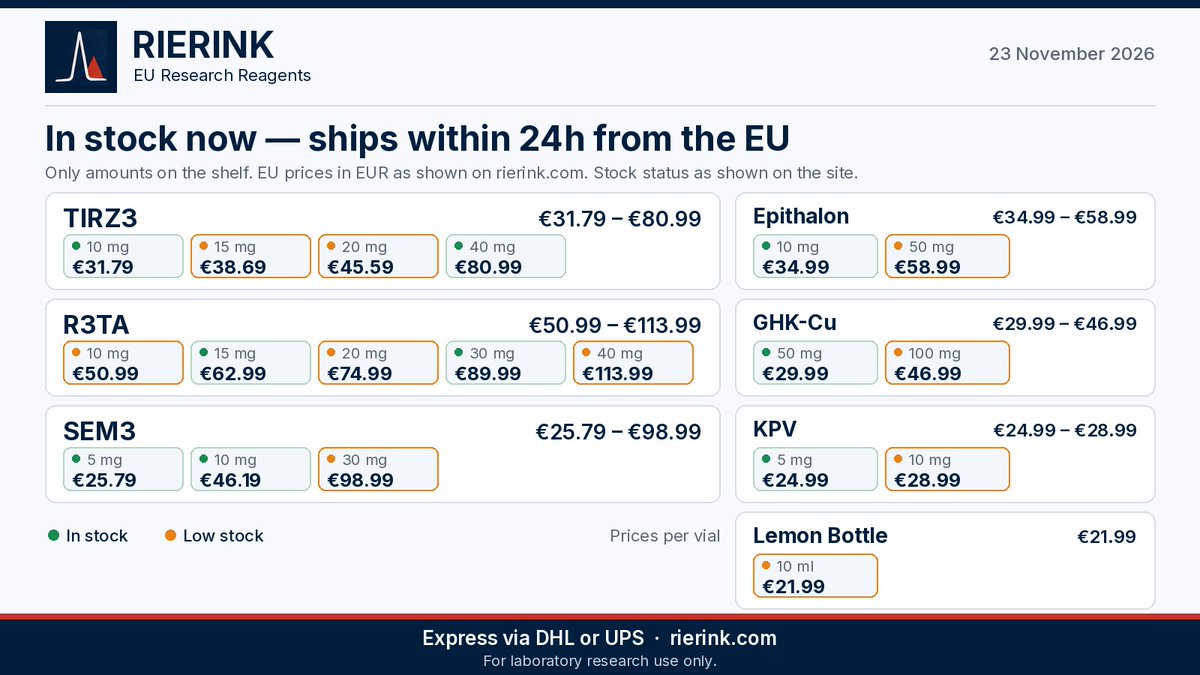
Today's EU shelf (23 Nov): ships within 24h.
TIRZ3 €31.79–€80.99; R3TA €50.99–€113.99; SEM3 €25.79–€98.99
Also: Epithalon, GHK-Cu, KPV, Lemon Bottle. Some sizes are marked low stock on the site.
Telegram: https://t.co/QdmYn9FUcj
https://t.co/Z1My3G9Ea0
For laboratory research use only.
@OSHOMAH01 The cardiolipin binding is the elegant bit: it stabilises cristae and the electron transport supercomplexes rather than just "boosting energy". Worth noting the FDA nod was accelerated approval for Barth syndrome, so kidney and other uses are still genuinely open questions.
@RosenelliEM The garetosmab arm is the fascinating part: more lean mass kept, but tolerability killed it. I'd love to see whether a lower dose or a later add-on could thread that needle, and whether the preserved mass shows up as real strength and function gains.
@brett_hudson22 The body-composition angle is what makes this interesting: same scale loss matters less than what it's made of. Blocking myostatin to protect muscle while incretins drive fat loss is a clever pairing. Keen to see longer trials with strength and function endpoints.
@Fran_Kilinski_ Fair poll. Worth framing the cancer point precisely though: it's a theoretical worry based on BPC-157's pro-angiogenic effects (VEGFR2 signalling) in animal and cell work, not something shown in people. Bigger issue is how little human data exists either way.
@PhysiocoachDBX GHK-Cu is such a fun research topic. One nuance: the 'third of human genes' figure comes from Broad Institute Connectivity Map data on cultured cell lines, so it's an expression signal in a dish rather than proof of the same effect in living tissue.
@BioDispatch Exactly. A purity and identity result tells you what was in that one vial at that moment, nothing more. Sterility, endotoxin, fill accuracy and the next batch are all separate questions. Good testing is a floor, not a safety stamp.
@peptidegrading Love seeing peptides used on the diagnostic side. RD1 makes sense as a source since that region (ESAT-6, CFP-10) is missing from BCG strains, which is what keeps IGRAs specific. 12 of 12 is a tiny n, but a neat proof of concept worth scaling up.
@nickhansonRN That's a fair bar. Most of the Epitalon telomere work traces back to Khavinson's group, largely cell and animal studies, so an independent placebo-controlled human trial with blood levels and objective sleep measures would settle a lot. Would love to see someone run it.
@PeakPeppers That per-protocol vs mITT gap is the classic sign that dropouts or adherence are muddying things, so the early p-tau181 separation may be the more telling signal. An oral all-D peptide moving a CSF biomarker by week 24 is genuinely exciting. Hoping the 2027 data holds up.
@vince_ceniceros Appreciate the honest take. GHK-Cu has the most human-adjacent data of the three, mostly topical skin and wound studies, while BPC-157 and TB-500 are still largely rodent and cell work. Data on the combo itself basically doesn't exist yet, which is the interesting gap.
Question for researchers: after reconstitution, which stability issue do you see reported most in papers: oxidation, deamidation or aggregation? And does pH guide your choice of vehicle?
Updates on Telegram: https://t.co/HVVYsvlmBy
Discussion: https://t.co/vGXL5Mr9PD
Paper note: a 20 Nov 2026 JAC-AMR study reports LL-37 sped up phage killing of two multidrug-resistant E. faecium isolates, alongside antibiotics. In vitro data on two isolates only; not tested in people.
For research purposes only. Not medical advice.
https://t.co/eN8I1NJEtR
Ready to ship from the EU within 24h (22 Nov).
TIRZ3 €31.79–€80.99; R3TA €50.99–€113.99; SEM3 €25.79–€98.99
Also: Epithalon, GHK-Cu, KPV, Lemon Bottle. Some sizes are marked low stock on the site.
https://t.co/rqCXwEqV7H
For laboratory research use only.
New research briefing: Glutathione: chemical identity and published assays.
It covers the Glu-Cys-Gly structure, its reactive thiol and GSH/GSSG redox pair, and how papers measure it; lab data only.
For research purposes only. Not medical advice.
https://t.co/Yi4I64hynH
New research briefing: Laboratory reconstitution of lyophilized research peptides.
It reviews published data on solvent choice and peptide stability in solution (oxidation, deamidation); not a protocol.
For research purposes only. Not medical advice.
https://t.co/2ZW6oCsSFe
@HealthyAlfred This is the Zagreb group's BPC 157 work, right? They frame acute alcohol damage as a vascular 'occlusion-like' syndrome, with the peptide rescuing collateral blood flow. Wild model and great results. Independent replication outside that lab is the next big step.