qed's head of us investing at money20/20: "every piece of friction is a new market that opens up. what rail, what payment, what shipment, who you're buying from, all that is back up for grabs with agents."
here's what that looks like in code. keeta.md, merged sunday: an agent asks the resolver for every route from the token it holds to the account it's paying. it gets back each provider, each fee, each minimum, in a json it can read before it sends. bivo's twelve rails are priced in it. layerzero's chains are listed in it. the agent picks.
"stripe is vulnerable. rigid, expensive, us-focused. ai is none of those things."
the rail isn't chosen by the merchant's checkout anymore. it's chosen per payment, by whatever is paying. @KeetaNetwork $KTA
Today we got the date. ATLAS goes live November 30!
Since August I’ve been saying that Keeta’s three-way announcement with LayerZero and BIVO back in July involving tokenized commercial bank money and stablecoins would eventually tie into a securities exchange launching on LayerZero.
This was before ATLAS was even announced.
At the time, I speculated that exchange could be connected to ICE, the parent company of the NYSE, and its plans to launch a tokenized securities venue.
Here’s my thinking.
Keeta, LayerZero and BIVO didn’t announce that partnership for no reason. There was clearly a purpose behind building infrastructure for tokenized commercial bank money and stablecoins.
Funny enough, ATLAS comes along and announces it will support over a dozen trading venues right out of the gate, with more coming before the end of the year. They’re also testing with institutions involved in markets that trade and clear over $1 trillion a day.
And what does every tokenized securities exchange need?
A cash settlement leg.
For the record, I still believe ICE’s planned tokenized securities venue could be part of this. However, since ATLAS was announced, my theory has evolved. I believe ICE’s planned venue could launch on top of ATLAS.
Here’s a simple example of how I believe this could work.
Imagine someone purchases $1,000 worth of tokenized stock through their brokerage. The order gets routed through a clearing broker to a securities trading venue connected to ATLAS.
ATLAS provides the infrastructure for the securities side, while Keeta could handle the cash side using tokenized commercial bank money or stablecoins, with LayerZero connecting the networks and helping coordinate settlement.
The buyer receives their shares, the seller receives their money, and both sides of the transaction settle.
But now imagine this happening across 20+ exchanges and trading venues like those being built on ATLAS.
Keeta, LayerZero and BIVO announced plans to build infrastructure for moving tokenized money between financial institutions and networks. Now we’re seeing infrastructure emerge that could potentially put that capability to use across multiple securities exchanges.
Keeta’s involvement in ATLAS settlement hasn’t been officially confirmed, and this remains my theory.
I believed there was a bigger purpose behind that three-way announcement back in July, and everything we’ve learned since has only strengthened my conviction as we continue to see these pieces come together.
@LayerZero_Core $ZRO 🤝 @KeetaNetwork $KTA
SPECULATION: COULD KEETA END UP SITTING NEXT TO CITADEL, DTCC AND ICE?
Here’s a dot worth connecting, not a confirmed fact, just a possibility worth thinking through.
Keeta and LayerZero already have a live partnership. Keeta Stablecoins, tokenized commercial bank money backed by deposits through Bivo, move across Keeta Network, Ethereum, Solana and Base using LayerZero’s OFT standard. LayerZero is also integrated as an anchor directly inside Keeta Network. That part is confirmed and already shipping.
Separately, LayerZero unveiled Zero earlier this year, its own institutional grade Layer 1, built for roughly 2 million transactions per second with a zero knowledge architecture splitting execution from verification. Citadel Securities took a strategic stake and is evaluating high throughput trading workflows on it. DTCC is exploring it for tokenization and collateral. ICE is looking at 24/7 trading and tokenized collateral. Google Cloud is exploring micropayments for AI agents on it. That is a different product, announced separately, with its own backers.
Here is the speculative part. LayerZero’s interoperability stack already connects over 165 chains through the same OFT standard Keeta already uses. If Zero plugs into that same framework the way every other LayerZero connected chain does, there is no structural reason Keeta Stablecoins could not eventually extend onto Zero exactly the way they already extend onto Ethereum, Solana and Base. If that happens, Keeta’s deposit backed rails would be sitting on the same chain that Citadel, DTCC and ICE are actively evaluating for trading, clearing and collateral.
To be clear, nobody has announced this. Keeta is not confirmed on Zero. This is purely reading the architecture and asking what becomes possible if the pieces LayerZero already built start talking to each other. But if you are mapping out where institutional money could eventually settle, this is the kind of quiet connection worth watching before it becomes a headline rather than after.
ANOTHER DOT WORTH ADDING: ATLAS.
LayerZero unveiled ATLAS in August, a headless trading, clearing and settlement engine built on Zero. It has no frontend, trading venues plug into it, market creators define what trades, and the listed asset types include perps, spot, stocks, commodities, bonds, memes and predictions. It comes in two versions, Open ATLAS for crypto native apps, and Institutional ATLAS, the same engine running 24/7 institutional markets under enforced rules.
Here is why that matters for KTA. Every trade on ATLAS still needs an actual cash leg to settle with once matching and clearing are done. That is precisely what Keeta Stablecoins are built to be, regulated, bank deposit backed money already moving across chains through the same LayerZero OFT standard ATLAS sits next to. If Keeta Stablecoins end up usable as settlement assets inside Institutional ATLAS, Keeta’s rails move from just payments to sitting underneath real trading volume.
The commodities angle makes this sharper. @askgroupae has already stated plans to build a commodities exchange on Keeta by 2027, oil, gold, silver, copper. ATLAS explicitly lists commodities as a supported market type for market creators. Put those next to each other and you get a plausible picture, a commodities venue built on ATLAS, settling in Keeta Stablecoins underneath it.
Nobody has confirmed any of this. ATLAS and Keeta have not been announced as linked. This is two real, separately announced pieces that happen to fit together, not a roadmap.
$KTA @KeetaNetwork@schenkty
the supplier doesn’t need a keeta wallet.
they give you an arbitrum address. you hold usdc on keeta. the newly documented route connects them through base and layerzero.
public checks confirm route discovery. a completed payment across all three networks still needs a public transaction trace.
but that’s the practical value here: choosing keeta for your treasury without asking every supplier to move with you. $KTA
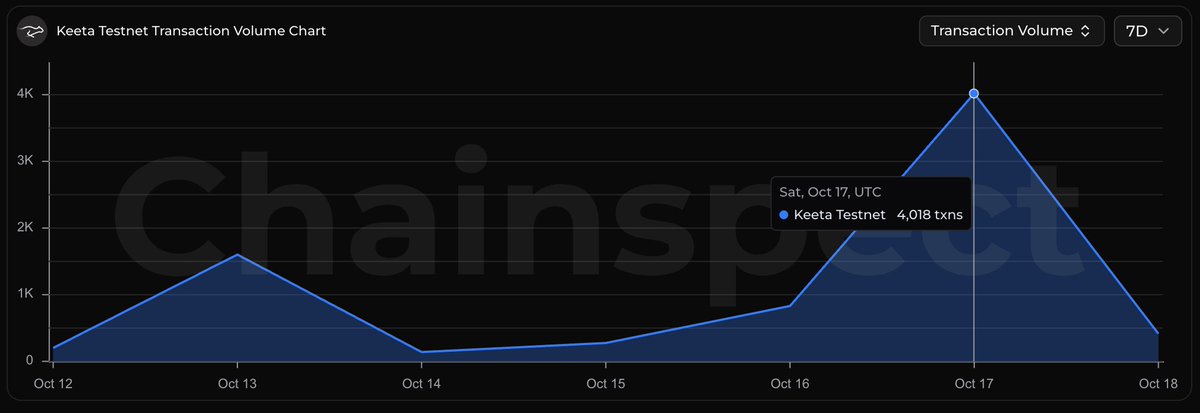
⚡ The @KeetaNetwork testnet processed 4,018 transactions on Saturday.
That was its busiest testnet day of the past 7 days.
Testnet builders worked the weekend.
📊 https://t.co/hyEmyUQREO
keeta's spanish account just posted a four-part statement of what keeta is. translated: "not a payments app. not a neobank. not another general-purpose crypto chain." a layer-1 "where traditional rails and modern blockchains settle together," with the goal "not to replace every bank or every chain" but "to clear between them without friction."
a month ago i called keeta a neobank factory, not a neobank. keeta's own copy now says the same, in its own words. so here's the statement checked against what the ledger did while they wrote it.
"a single place for currencies, tokenized deposits": nine bank-deposit currencies minted on mainnet october 7, kusd and keur cycling through mint and burn since.
"anchors connect external systems": a fifth node on the peer table since monday, a community resolver since october 4, a public listing address for new anchors.
"kyc anchors issue certificates": footprint certified amalfi october 6, keeta's own kyb anchor ca certified lrtech01 october 5, and 25 wallet certs landed in the hours after business accounts went live.
"assets carry compliance rules natively": the rules engine thread, same account, four days ago.
"settlement targets 400 ms": rosling's 90-day median is 0.9 s, p95 1.7 s. close, not there.
a positioning statement is a promise. this one is unusual in that most of its sentences already have a block hash.
@KeetaNetwork $KTA
I love it how Pavarotti really enjoys and appreciates Bryan's singing. He looks like a kid at Christmas.
Bryan Adams & Luciano Pavarotti - 'O Sole Mio
$KTA
Deutsche Bank is weeks from launching institutional crypto custody for Bitcoin, Ether, and stablecoins — with tokenized deposits and digital bonds planned next.
Eric Schmidt (former Google CEO) sits on Deutsche Bank’s Global Advisory Board. He’s also an investor in Keeta, the L1 purpose-built to connect traditional banking rails (Visa Direct, bank deposits, multi-currency fiat) with blockchain settlement — natively, with protocol-level compliance and extreme throughput.
Banks are building the custody and issuance layer.Keeta is building the network that sits between those banks, cards, stablecoins, and AI agents.
When the big institutions go live on the asset side, the infrastructure that already speaks both languages becomes the critical path.
That’s the setup.