@burgessev Under his proposed changes to the cloture rule (separately from the new procedures for bipartisan bills), senators wouldn’t have needed unanimous consent to offer amendments.
One of the greatest features of this proposal is “eliminating cloture” on amendments (i.e., limiting debate on them to one hour).
That would effectively kill the practice of filling the tree, because...
This approach of just jamming more stuff into reconciliation bills is a lot worse then actually ending the filibuster, though, because it deprives you of the possibility of writing concise, clear, focused single-subject bills that voters have a shot at understanding.
Or… hear me out… get rid of the filibuster given you already have 56 seats and fire the Senate Parliamentarian, if need be, like the Republicans did back in 2001.
I have so many theories as to why this is.
1) A learned helplessness in the rank and file, instituted over the past two decades by a bipartisan leadership style that dictated to members in a top down manner what they were going to do and enforced it punitively using campaign cash, committee seats, etc, as leverage.
2) At least on the R side, we have reached a critical mass of senators who have never seen a functioning Senate. They have no idea how powerful they actually are or how the Senate operated in the Before Times (not even that long ago! Like in the 90s and early 2000s!).
Current senators either don’t want to know and outsource that knowledge to staff who are disinclined to do anything with it, or are gaslit into believing they require permission to use their considerable privileges. (The latter point drives me absolutely bananas. What’s the point of being a senator if you have to ask Mother May I every single time you want to BE A SENATOR. No wonder they’re all leaving for different jobs.)
3) The Senate has completely atrophied as a problem solving institution. Usually when things get stuck there are bipartisan “gangs” that form to solve the issue, lead negotiations, or walk the Senate back from the brink. This doesn’t happen anymore largely because senators don’t feel they have individual agency. See points 1 and 2.
4) Also per the last point, the committees are too large, and senators are on too many, to allow them to focus on two or three things and become The Guy about That Thing.
5) The committees are also deferential to leadership in a way they didn’t used to be, and that lack of independence dulls vital skill sets because it relies on other people to chew your food for you.
6) The modern Senate will do nothing unless they have a predetermined outcome. How many times has “we don’t have 60” been used as an excuse to do nothing? The Senate is a majestic institution precisely BECAUSE it is designed to leverage uncertainty into consensus. You never know how things will actually end until you fight them to the floor and give issues a political process, force a negotiation, and don’t give up until you’ve come to a solution. The greatest causes in American history didn’t *begin* with 60 or 67 (former cloture threshold) votes. They ended there after massive exertion and process. Modern Senates refuse to countenance a) the workload required and b) the uncertainty of the outcome.
(more below)
@GabeFleisher The other part of this story is that right after Schumer and Manchin announced their agreement on the reconciliation bill, Republicans suddenly decided to filibuster the PACT Act.
https://t.co/z5Vl8vZgWe
@ThorningMichael@KDbyProxy@joshchafetz Nvm, apparently the revenge is happening right now – it seems that the corrected PACT Act is going to be filibustered...
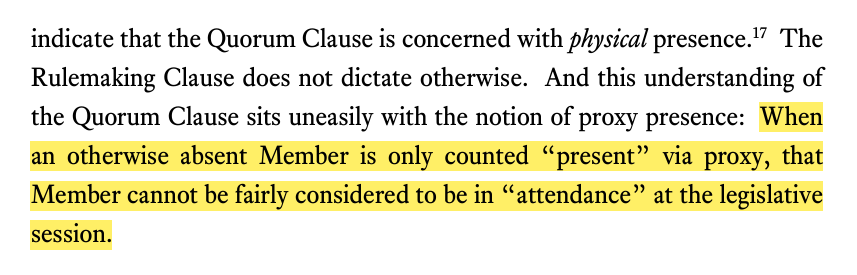
@danielp_reid@AskThePatrick@tc1415@legalstyleblog And it’s unfortunate that the government did not contest that issue. There is no way to tell from the Record or the Journal whether the members who voted by proxy were physically present or not.
https://t.co/6q3QLOxRBT
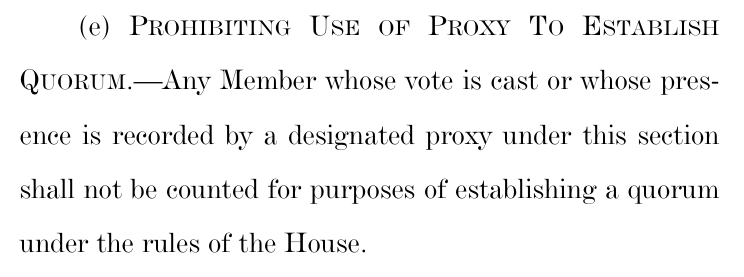
And the bipartisan proposal to allow proxy voting for new parents, which is probably going to be adopted in the next Congress, would not allow proxies to count towards a quorum:
@MattGlassman312 On the philosophical question, it’s quite beautiful that the Senate really leans into the whole continuing-body thing and does not require a quorum call at the beginning of each Congress. It is customary to have one, but it happens at the initiative of a senator.
This is one of my favourite clips in my archives, mostly because of Hoyer’s wonderful rhythm, but also because it’s a great illustration of the principle that voting and being present are two different things.
“Is 175 a quorum?”
“The chair cannot force everybody to stand...”
The problem is that a quorum is not determined by the number of members voting, but by the number of members present. The House found that a majority of members were present.
Indeed, the fact that a member voted by proxy does not necessarily mean that they were absent... ↘️
Back when Congress was more afraid of pocket vetoes than of recess appointments, it used to include a note in adjournment resolutions, patiently explaining its rules to any potentially overzealous judges.
To sum up: all of the opinions in this case perfectly illustrate why the courts should stay out of Congress’s internal procedures.
Come back in two years for my thorough scrutiny of the Supreme Court’s decision.
And the bipartisan proposal to allow proxy voting for new parents, which is probably going to be adopted in the next Congress, would not allow proxies to count towards a quorum:
NB: The holding is not that proxy voting is unconstitutional, just that proxies may not be used to establish a quorum. The day of these events was the *only* time proxies made the difference in establishing a quorum.