Two math olympiad champions wrote a training manual in 1993 on two old Macintosh computers, and every American kid who has won a major math competition in the last decade learned to think from it.
Their names are Sandor Lehoczky and Richard Rusczyk. The book is called The Art of Problem Solving. Most people in math know it as AoPS.
Since 2015, every single member of the US International Math Olympiad team has been an AoPS student. Not most of them. Every one.
That statistic sounds impossible until you understand what the book actually does.
Lehoczky and Rusczyk were not professors. They were competitors. Lehoczky earned the sole perfect AIME score in 1990 and led the national first place team. Rusczyk was a USA Mathematical Olympiad winner and a perfect AIME scorer in 1989. They had both survived the same brutal selection process the book was designed to train students for.
And the first thing they decided was that almost every existing math textbook was teaching the wrong thing.
School math gives you formulas. You memorize them. You apply them. You pass the test. Then you sit down in front of a real competition problem and the formula does not apply, and you have nothing underneath it.
That is the gap. The gap is not knowledge. It is thinking.
The entire premise of AoPS is that problem-solving is a transferable skill, not a bag of memorized tricks. A student who genuinely understands why a technique works can adapt it, combine it with something else, and deploy it in a context they have never seen before. A student who only memorized the technique freezes the moment the problem looks different.
The book teaches the difference between a formula and a method.
A formula tells you what to compute. A method tells you how to see. The students who win olympiads are not the ones who know more formulas. They are the ones who have trained themselves to look at an unfamiliar problem and recognize its structure. To see that this problem is secretly asking the same question as a problem they solved three weeks ago, just dressed differently.
Rusczyk calls this "learning to read the problem." Not reading the words. Reading what the problem is actually asking underneath the words.
The second thing they built into the book is tolerance for being stuck.
Most students treat confusion as a signal to stop. The book treats confusion as the starting point. Every chapter pushes students past the point where the obvious approach runs out. That moment of running out is not failure. That is where the actual thinking begins.
Lehoczky once described it this way. If you can solve a problem quickly, you are not learning. You are performing. Learning only happens when you are past the edge of what you already know.
The book was written on old Macintosh computers in 1993. Rusczyk launched the AoPS website in 2003. Today the community has over one million users. Thousands of students enroll in AoPS online courses every year. Most winners of every major American math competition are AoPS alumni.
A platform built by two kids who were good at math competitions has become the infrastructure that produces the next generation of mathematicians, engineers, and scientists who are good at thinking.
The formulas you memorized in school will eventually be obsolete.
The thinking you trained will not.
What is one problem in your life right now that you have been avoiding because you do not yet know the right formula to solve it?
I just spent months handwriting a 200 page guide on the entirety of ML foundations and math from scratch.
The guide features:
- Neural Nets (Backprop, Adam, SGD, Batch Norm)
- ML Algorithms (SVM, Grad Boosting, K-means, PCA)
- Hardware (Tensor Cores, Systolic Arrays, CUDA)
- Transformers (Multi-Head Attn, KV Cache, LoRA)
- Vision (ViT, Convolutions, MAE, IoU, NMS, VLM)
- Agents (OpenClaw, ReAct, Memory, Orchestration)
Everything I wish I had years ago, for free.
McKinsey just mapped the supply chain bottlenecks for humanoid robotics and everyone is focused on the wrong thing.
The real story is not that actuators and sensors are the bottleneck, that is obvious. The real story is what happens next.
🧵 Some thoughts and keys:
1. NdFeB magnets (neodymium iron boron) are in every single rotary actuator inside these robots. China controls ~90% of global rare earth processing. This means Beijing has a kill switch on the entire Western humanoid robotics industry before it even starts. The next chip war is not chips. It is magnets.
2. Harmonic drives and cycloidal gearboxes are precision components with maybe 3 serious manufacturers globally. Harmonic Drive Systems (Japan) has near monopoly status. One earthquake, one export restriction, and the entire sector stalls. Nobody is pricing this risk.
3. The EV industry already burned through this playbook. Battery bottlenecks, magnet shortages, supply chain concentration in China. Robotics is about to replay the exact same movie 5 years later and most investors are acting like it is a new plot.
4. Here is my contrarian take: the winners will not be the robot companies. The Teslas and Figures of the world will compress margins fighting each other on the finished product. The real margin will sit with component monopolists nobody has heard of yet. Just like $TSM prints while phone brands race to the bottom.
5. Sensing and perception is labeled "high risk" but I think this is where AI flips the script. Software defined sensing (using cheaper cameras + AI models instead of expensive LiDAR arrays) could collapse this bottleneck faster than anyone expects. Whoever cracks that eats the entire sensor supply chain.
6. One more: if humanoid robots scale to millions of units, NdFeB magnet demand will compete directly with EV motors and wind turbines for the same limited supply. Three industries fighting over one material. That is not a bottleneck, that is a price explosion waiting to happen.
7. The picks and shovels play for robotics is not even public yet. Most of these companies are Japanese, German, or Chinese industrials trading at 12x earnings while "AI" stocks trade at 50x.
The asymmetry is insane.
Personal update: I've joined Anthropic. I think the next few years at the frontier of LLMs will be especially formative. I am very excited to join the team here and get back to R&D. I remain deeply passionate about education and plan to resume my work on it in time.
Kimi is forced to do this cuz they don't have access to 500MW-1GW DCs
They are basically connecting a bunch of smaller DCs (50MW-200MW)
Waste of their outstanding talent
SAD
I’ve wanted to do this for a decade.
But I never did - I refuse to give any company my DNA.
It is me.
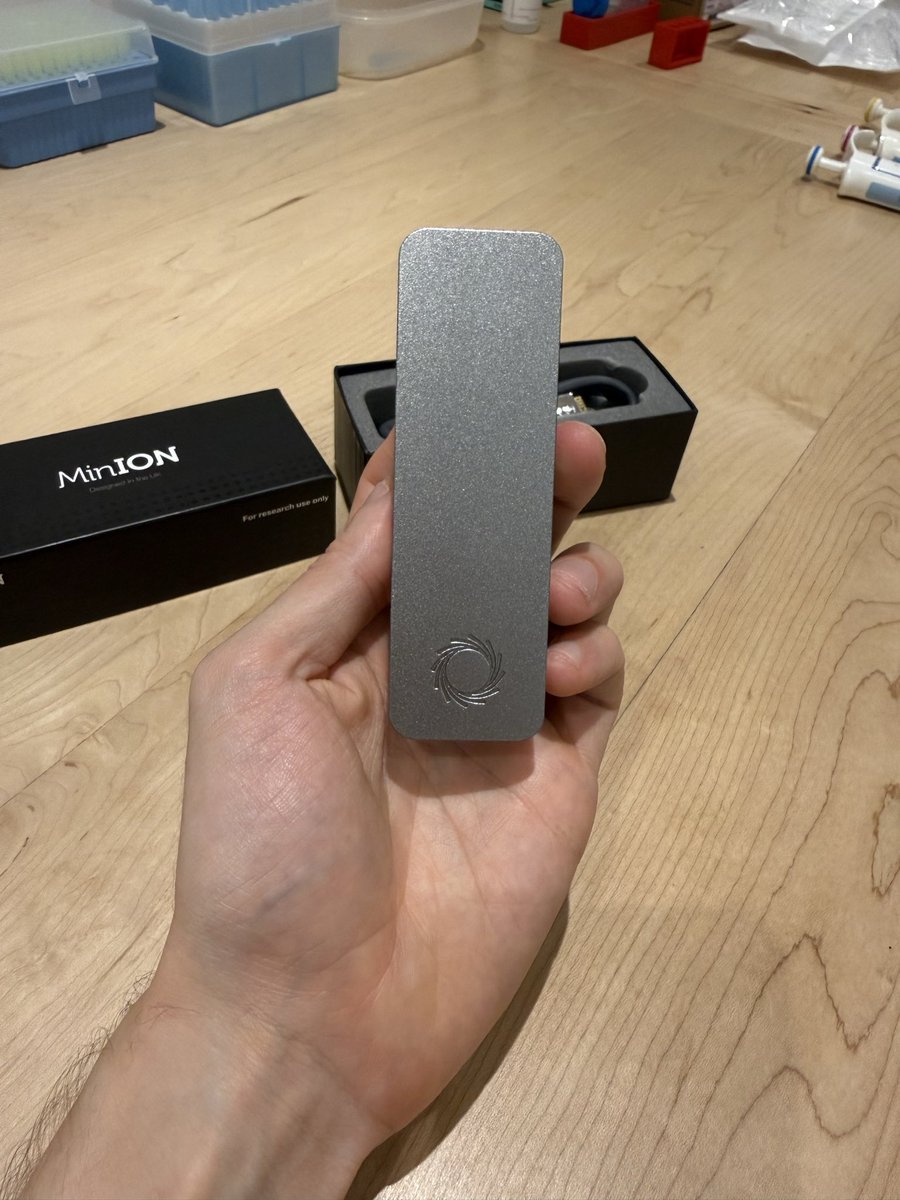
So this week I sequenced my genome entirely at home. Literally on my kitchen table.
I never exposed my DNA sequence to the internet. Not at any point.
I used a MinION to do the sequencing (it’s smaller + weighs less than an iPhone).
I used open-source DNA models for the analysis (Evo2 and AlphaGenome) running locally on a DGX Spark and Mac Studio.
I traced mechanisms behind my family’s multigenerational autoimmune conditions that no clinician has been able to understand.
When I set out to do this I didn’t know if it would actually work. It does.
Your genome is the most private data you will ever have. You probably shouldn’t let it leave your house.
🚨 BREAKING:
Scientists just learned how to control magnetism at the atomic level.
Not materials.
Not circuits.
Individual spin patterns.
Read that again.
Instead of using electric charge…
they’re using the spin of electrons to store and process data.
And it gets crazier:
They can create tiny magnetic whirlpools
called skyrmions…
that move with almost no energy
and can store massive amounts of data
This means:
Faster computers
Lower power usage
Ultra-dense memory
But the real shift is this:
We’re not just building electronics anymore…
we’re engineering structure at the smallest possible scale.
So the real question is:
If information can be stored in spin itself…
what limits computation?
Follow me I’m tracking where physics becomes technology.