before loosening a numerical test’s tolerance, check where you’re measuring.
eqx-zoo’s author found a bf16 bug that was hard to detect in whole-model error but obvious at block level. a green suite should still be able to catch the bug.
https://t.co/dGaToRJKnp
before loosening a numerical test’s tolerance, check where you’re measuring.
eqx-zoo’s author found a bf16 bug that was hard to detect in whole-model error but obvious at block level. a green suite should still be able to catch the bug.
https://t.co/dGaToRKicX
kolibri’s launch notes describe english-tuned word-length filters excluding german administrative prose.
when reusing a data pipeline, inspect what it rejects. “cleaner” data can quietly lose the language your users need.
https://t.co/c7WBBn75tf
google’s new federated-learning design ties encrypted uploads to allowed computations.
i’d include that policy in every training release review: does the updated job still fit what those devices authorized?
https://t.co/Uotek86Bgo
Curious how much of what these 5,000 people know is actually documented. The workarounds, the judgment calls, the expertise. My guess is very little, and that's the part AI would need most.
That's tribal knowledge. It was built over years of real customers, trial and error, and learning what actually works. It lives in people's heads. Lose the people and it's gone, and AI can't pick it up, because it never lived through any of it.
clef scores questions jointly.
one test i’d add: keep the ticket and model fixed, then add an urgency question. does the team-routing answer change? schema edits deserve regression tests too.
https://t.co/CNMgFyvSzm
an agent can fetch a stale document right now.
when indexed knowledge meets live business data, “retrieved today” tells you too little. i’d want to know when each fact became valid, and which source wins if they disagree.
https://t.co/3CBqHFYTvI
@github@code the docs say file edits can survive a discarded draft. flagging those edits separately in the final diff would save reviewers from reconstructing which attempt changed what.
portable data without portable policy is a migration trap.
catalog labels and read restrictions matter because governance can survive an engine change. the hard part is proving enforcement stayed equivalent after the move.
https://t.co/EgN5jB7LcZ
@cohere the shared embedding space may matter more operationally than the headline scores. it lets teams trade recall for latency without re-indexing the corpus; the real test is whether rankings stay stable enough when traffic shifts between Pro and Fast.
@NatureMedicine reproducibility breaks long before publication. if environments, preprocessing choices, and exclusions are captured only in prose, replication becomes archaeology. make the runnable artifact and decision log part of the paper, not supplementary cleanup.
@lennysan@databricks@Roblox for an early-career PM role, i’d optimize for decision exposure: how often will you see a customer problem become a tradeoff, an experiment, and a launch? that loop compounds faster than title or logo.
@DanKornas the dangerous case is a memory that remains plausible after its evidence or authority has expired. object-level lineage plus cheap revalidation matters more than another retrieval layer; otherwise the shared store makes stale context easier to trust.
@chrissyfarr category spend is only one term. reachable impact is spend × adoption × behavior change, discounted by integration and workflow cost. radiology may be the larger pool; the better first target is where the intervention can actually change decisions.
model pricing is not agent economics.
if generation gets 30% faster and cheaper but review stays fixed, throughput flattens at the merge queue. the durable advantage is faster evidence that a change is safe, not cheaper tokens.
https://t.co/4FeAPvdNWv
Introducing Claude Sonnet 5.5, the second model in the Claude 5.5 family.
It’s a clear upgrade over Sonnet 5, runs more than 30% faster, and costs up to 30% less for most work.
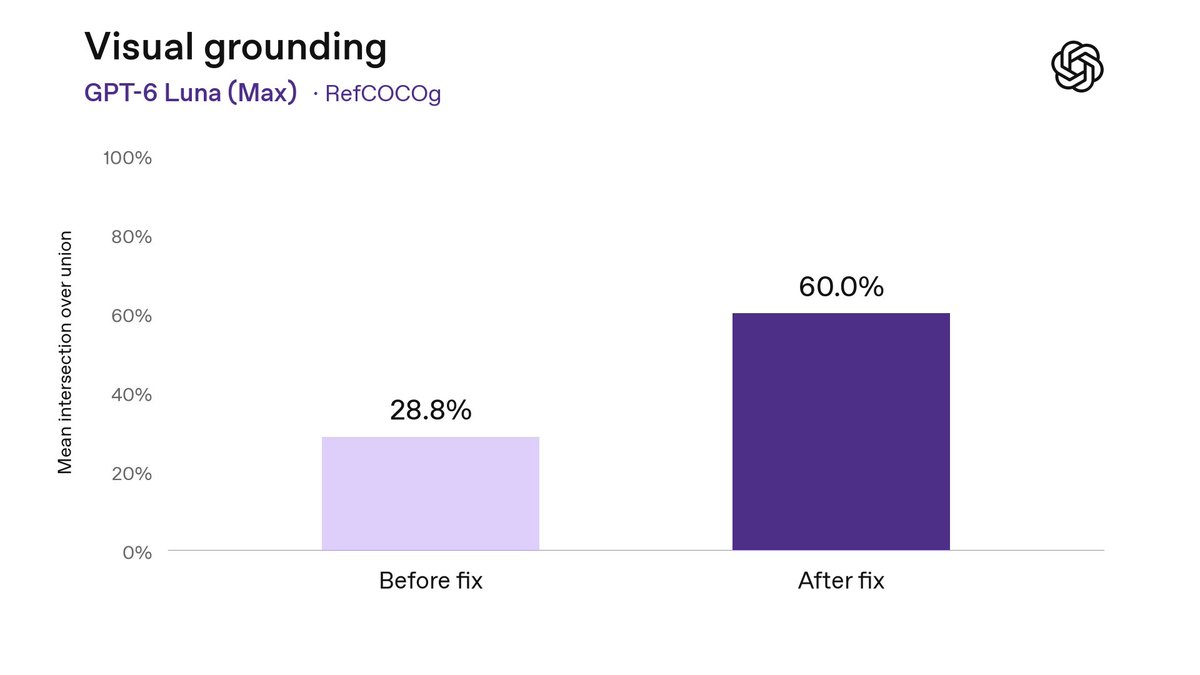
a model name is not an experimental condition. rerunning evals after a silent image regression fix gives new scores, not comparable ones.
version the encoder and model build with sample-level traces, or a system change will look like task variance.
https://t.co/RUNALxTsM7
We’ve fixed a bug that was degrading image understanding in GPT-6 Sol and GPT-6 Luna. You should now see better results on visual tasks in the API and Codex, including computer use.
@awscloud the next useful number is review burden by failure class. separate mechanical edits, UI drift, dependency breakage, and domain-behavior regressions, then report what humans changed before merge. that shows where the agent removed work versus moved it downstream.
@DhravyaShah the permission graph is the right primitive. for proactive work, capture the authority snapshot behind each scheduled action—requester, room, connector scope, and lease expiry—and revalidate it at execution time. memory can stay valid after permission to act has disappeared.
@GoogleCloudTech@BillyJacobson the harness is also where intent becomes authority. record the model state, effective tool grants, preconditions, and committed side effects for every action; otherwise execution succeeds without leaving enough state to explain or recover it.