I built backend for a fintech app that gives students their first credit card - so they can build credit before they even graduate.
Also won ETH India AND ETH Singapore, and built one of the fastest token snipers on Solana. (0-2 blocks)
Now I'm open to new opportunities 🧵👇
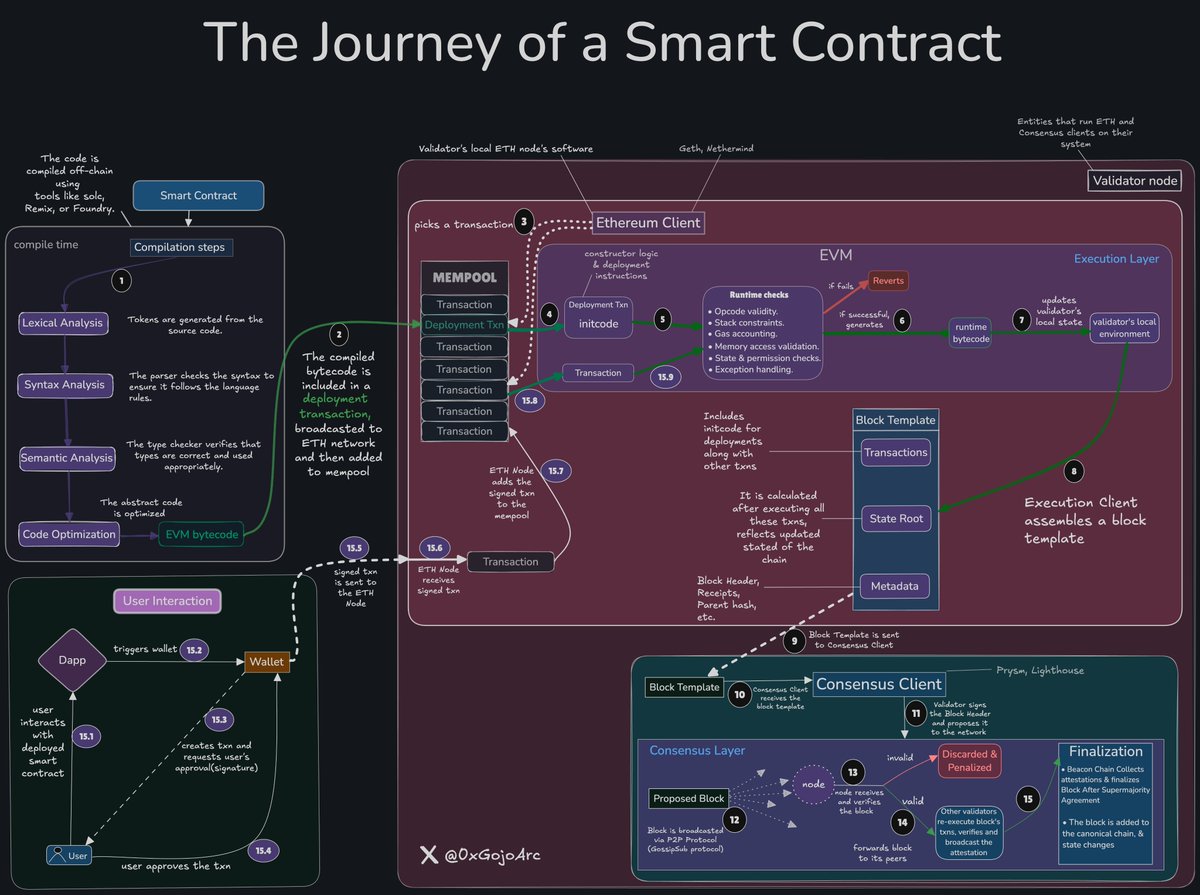
This is the most detailed journey of a smart contract you'll ever find!
Finally, it's done, this took way longer than expected to finish.
If this gets 100 likes, I'll make more! 😎
Can be done in parallel. Do some learnings on the side while doing your normal job.
But I would say the highest priorities are:
- everyone should program in assembly and/or C at some point. Programmers must grapple with pointers and the difference between stack and heap. This will also teach you about computer architectures.
- big-O analysis should be second nature. No need for esoteric data structures, but trees, lists, queues, heaps, hashmaps, etc should be second nature. Ideally build them from scratch at some point. Basic recursion should feel natural (yes, you should invert a binary tree because it’s one of the simplest recursive algorithms out there). If you don’t have an instinct for “how fast is this operation” you can’t design anything consequential.
- actually learn how binary arithmetic works. I’ve seen developers who can’t understand a bitmap because of this.
- know the basics of networking and cryptography. No need to go super deep, but they can’t be complete black boxes. I’ve found a lot of programmers have a weak understanding of probabilities and don’t recognize when they can make massive efficiency gains by using randomness properly.
- in an ideal world, build a compiler (this requires more commitment, but will teach you a lot)
- the highest impact thing (but also the hardest) is modifying an operating system. This gets your hands dirty with a big codebase and teaches you want the computer is doing to your programs behind the scenes. It will also teach you parallel programming and hardware optimizations.
It’s really depressing to see posts like this.
We as an industry have pushed under the rug calldata verification because “we just want to get people on the door”.
But that needs to end now.
You either understand your transactions, or you use a wallet that will help you understand.
Using a wallet that doesn’t help you understand should soon be considered as worthless as using a wallet that exposes your private key.
Dropping some thoughts as this concerns me a lot lately:
- What happens when a DPRK-backed persona slips into Ledger, Trezor, MetaMask, etc.?
- What happens when client teams get compromised from within, turning trusted core devs into silent attack vectors?
- What happens if the Kim boys start tampering with the cryptographic libraries we all rely on?
(we don't know if this already happened btw...)
So far, the attacks have targeted individual projects. The next phase? My guess is a full-scale takeover of the infra that holds our ecosystem together.
Look, it's pretty simple: the threat model isn't just shifting—it's escalating. Every move you make without paranoia is an opening for state-sponsored actors to dig in deeper. If you're not fucking questioning everything, you're already playing their game.
This industry's long-term survival depends on its foundational pillars operating in a constant state of paranoia. Like it or not.