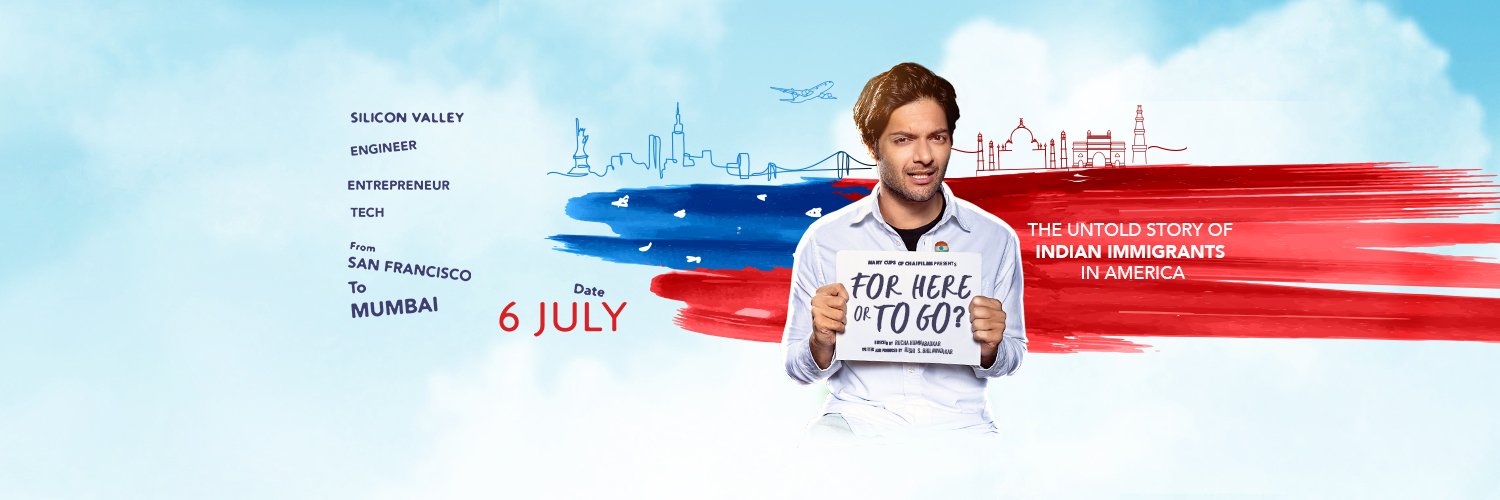
In 2017, I released "For Here or To Go?" – a feature film about legal Indian immigrants.
It was mischaracterized by Breitbart as a “cheap labor lobby funded H-1B movie.”
The same flawed arguments are making the rounds today.
Here’s why they’re wrong 🧵
introducing @inflight
the missing feedback layer for prototypes
⇢ works with any agent
⇢ supports pinned comments + video
⇢ turns feedback into next steps for Claude
There are now only two class of problems that will be worth solving- extremely hard ones no one attempts and extremely personal ones only you can attempt
Mr. Musk, yes, no billionaire should dictate a nation’s policy - Indian or American.
India must welcome competition in satellite internet, from Indian and global providers, whoever offers the most practical and affordable last-mile solution for those in remote regions. In countries with lower per-capita incomes, satellite internet must be affordable too. High subscription fees and equipment costs risk putting it beyond the reach of ordinary households. Connectivity must bridge the digital divide, not create a new one.
India knows our networks and spectrum are strategic infrastructure, not merely commercial assets. India’s national security safeguards are non-negotiable.
Every country makes choices based on its own interests. Those in the West cannot preach free markets while practicing protectionism at home. USA imposed 100% tariffs on Chinese EVs to protect its domestic industry, just as India takes measures to protect its own domestic manufacturers. Both India and the US have restricted Huawei over security concerns. One cannot demand a level playing field from others only when it suits its own agenda.
Indians will internally debate, question and address our strengths and shortcomings as a democratic country.
Take BharatNet, India’s programme to bring broadband to village-level local bodies. We will question why, as the CAG’s 2026 audit report found, the programme is struggling to meet its original objectives. Why were only 33.2% of service-ready Gram Panchayats operational, despite ₹39,888 crore being spent? At the same time, we know to appreciate our telecom sector and regulations, which has made internet data among the world’s most affordable, bringing millions online.
India is a democracy, not a colony. We welcome the world, but we, the Indian people, will decide our own future - not Western vested interests, their double standards or any billionaire - Indian or American.
As metaphor, yes. In practice. Architecture’s product is the thought, the function, the material, and the interface at once. There is no separate mediator. Software splits those layers on purpose: the same system architecture can support many different interfaces, and changing the interface does not require changing the underlying architecture
i was in a random bookstore & came across a book that described achieving moksha as achieving “super intelligence”.
the hindu religion figured it out a while ago.
"User interfaces are largely going to go away.
Because the agents speak English, or other languages. You can talk to them. You can say what you want. The UI can be generated.
So I can say, generate me a set of buttons that allows me to solve this problem, and it's generated for you."
- Eric Schmidt is the former CEO of Google.
Today’s websites are designed for humans, with carefully crafted UIs.
But we are probably moving towards UI-less web.
automated bot traffic has already surpassed human activity on the web. with AI agents, this number will explode.
In near future its very plausible that 90% or more of web traffic will be non-human.
Imagine a web with no websites. All your favorite apps are now just databases, queried for information by agents that zip around on your behest.
In a world primarily composed of bots, what happens to websites? Do agents learn to navigate them like a human? Do they go away entirely? 🤔
---
Video from 'Peter H. Diamandis' YT channel
@zoink@rabi_guha Good counterpoint. UI as verification and audit surface will exist, no so much action surface. Only if user opts to engage like for games will the ui be an active engagement surface.
@aakashgupta Made one film, put it on Netflix. Now on Prime.
Yes, that entire industry makes it very difficult to be and remain authentic. Which is ironically the main reason to make art. Selling art of course is the layer that few can adapt well to.
Part of taste is what not to do.
What matters more than your taste is effectiveness of your solution. The design has to support the effectiveness.
That effectiveness is not just about users doing tasks successfully, it also includes internal persuasion, timeliness, feasibility, viability, desirability and brand fidelity.
The ability to design for that effectiveness should be the hiring bar.
And a lot of times actively not introducing your taste filter gets you to be most effective.
Design has obsessed over craft and forgotten to evaluate and hire for effectiveness. As a result, the core UX is owned by other functions.
The vast majority of large companies survive purely by launching things and discovering what works by Process of Elimination.
There is no rhyme or reason -- or conviction -- in anything they do.