BREAKING: Anthropic is planning to launch its IPO in November despite AI safety concerns, per WSJ.
The company is expected to IPO at a $2 trillion valuation and raise up to $100 billion in the offering.
Anthropic is expected to reach more than $110 billion in annualized revenue by year-end.
BREAKING: Chipotle is now working with Palantir to create a platform that tracks food safety, pest incidents, employee illnesses, and more across the business.
While the AI doomers scream about safety, Palantir is actually building platforms to keep people safe.
Bullish ontological burritos.
$PLTR $CMG
Last month I wrote about how we can build a positive and safe future for everyone: https://t.co/eoLGVY8yad
Every lab has the responsibility and incentive to move at the pace required to train its models safely, and the ability to take its own actions to ensure that happens.
The reality is:
- People won't want to use agents that are misaligned with them and that don't do what they ask, so labs have a strong natural incentive to make their models more aligned.
There is a lot of debate about slowing progress on capabilities until alignment catches up. My view is that trust and alignment are quickly becoming the most important capabilities that will differentiate agents and models. Any lab that doesn't focus on alignment will fall behind.
- Labs face significant liability if their models cause harm, so they have a strong incentive to prevent this as well.
Meta delayed shipping Muse for several months to focus on safety and security. We didn't call for everyone else to do this before we would. We just did it as part of our day-to-day work because it was clearly the right thing for people and for us. I'm proud of the security foundations we've built.
- Engaging independent evaluators and advisors is industry best practice. MSL already does this today in several areas because it helps produce better work. Other labs can just do this too. In general, it would be helpful for there to be a larger and more diverse ecosystem of evaluators.
- Committing the significant majority of compute towards serving people rather than racing towards recursive self-improvement is one of the best ways to ensure we develop this technology safely. Meta has made this commitment and other labs can do this as well.
I believe the key to building a positive future for everyone is maintaining the right balance of power. This is within our power to do.
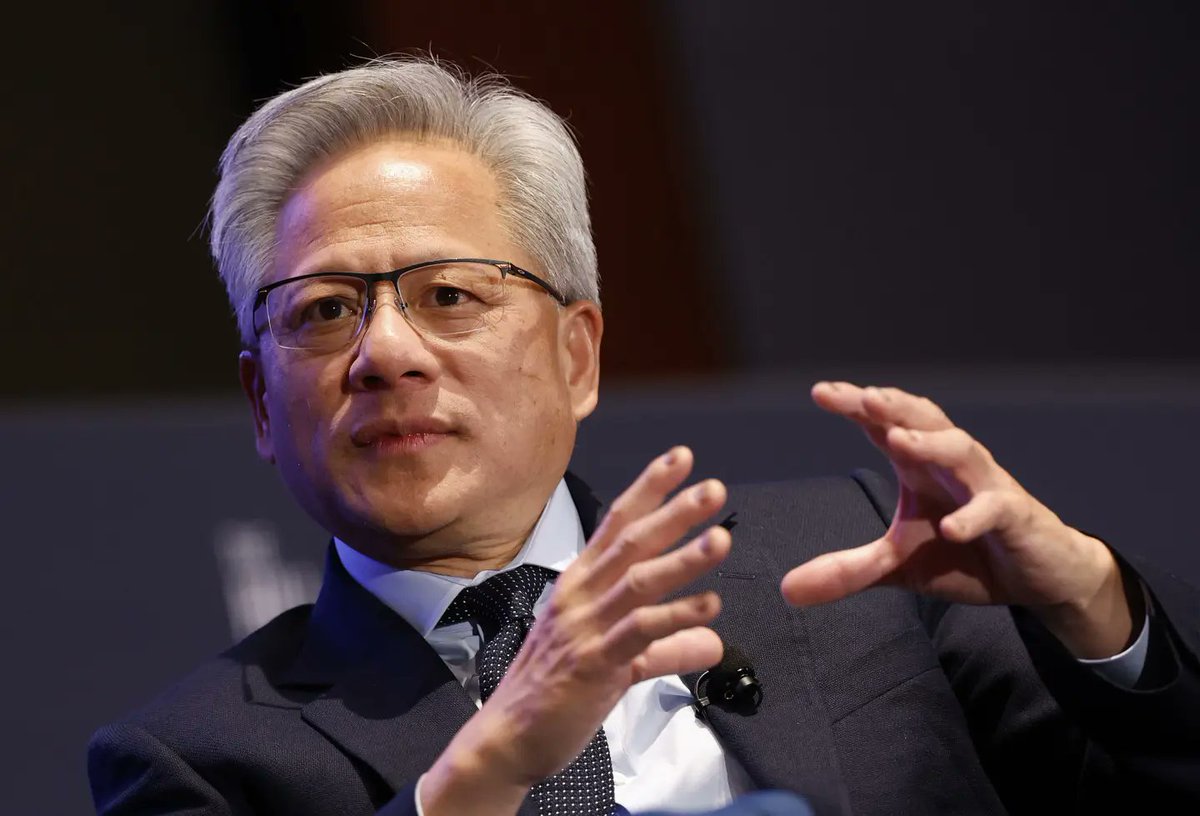
JENSEN RESPONDS TO THE AI DRAMA OVER THE WEEKEND:
"Safety is something we need to take seriously. There's a matter of internal control that I think Jacob Coxon was speaking to. Whenever you have a whistleblower, you have to take it very seriously. I thought he had great courage to put out his concerns."
"I think his scientific prediction about the future is not grounded in science. It was expressed by a scientist but not grounded in science so I take issue with that."
"Pausing, pacing...these are all things that these labs can choose to do if they think they are getting out of control. We don't know what Coxon saw. But if he saw the company was out of control then maybe it could be an issue with the transition from research to engineering. We don't know what he saw, ultimately only he knows. Maybe that transition is clumsy, but we don't know what he saw."
@KrisPatel99 I watch you and Amit analyze the market all the time. You provide exceptional analysis and I have learned alot from your insights. You are an exceptional american
Wild 24 hours for AI and lots of different proposals have been made.
TLDR; the only *tangible* new fact is that OpenAI and Anthropic are going to have embedded 3rd party evaluators from unknown organizations with Dario floating METR as a possibility. Having 3rd party evaluators is smart as there is no Section 230 style liability shield for model outputs and showing a “duty of care” will be important in future litigation. Several internet companies might have gone bankrupt without Section 230 so limiting liability really matters.
There are minimal investment implications from this single new fact, but I do think that for anyone who wants a “smoother for longer” cycle then most constraints are good: wafers, watts, real rates and spreads. Excessive regulation is a different matter but I don’t think we are anywhere close to this even if the vector changed over the last 24 hours.
To summarize the events:
Dario made the most maximalist proposal of the weekend: embedded 3rd party evaluators, a national regulatory regime for models beyond a certain capability/ingredient threshold, a broad international regulatory pact between democracies, stricter limits on compute/distillation for China and then a different international regulatory regime that encompasses China. Before there is a national regulatory regime, he wants a Sherman act waiver so that Anthropic can safely coordinate with OpenAI and other frontier labs without antitrust fears. TBF, this latest proposal is much less maximalist than some of his prior proposals like “Policy on the AI Exponential,” where he advocated for an FAA for AI. I believe he is sincere in his beliefs. And despite all the protestations, all of this would also probably be good for his business over the long-term.
Sam agreed that embedded 3rd party evaluators were a good idea and stated they would implement them. Again, this is smart as should help limit future liability.
Elon said “Dario is right” and later specified that “Dario is right that there should be some oversight. Peer review of AI by competitors is the right way to start this off.” This would be a MPAA like self-regulatory structure for AI with regular calls between the labs plus a process where each new model is evaluated for safety by competitors for a 1-2 week period before being released. That is *wildly* different from Dario’s proposal and in-line with what David Sacks has been proposing. Elon also stated that nothing was going to slow down open-weight models.
Demis said that Dario’s essay was a “step in the right direction.” Dario also said that he was also open to Demis’ idea of a FINRA like self-regulatory structure as part of his proposal.
David Sacks had a thoughtful post where he said that Dario and Sam should pace unilaterally, called the antitrust waiver a cartel request and denied that METR was truly independent given their ties to Anthropic.
Sriram Krishnan, former White House AI advisor, noted that it would be important to have the 3rd party evaluators come from independent organizations that are not affiliated with any lab, which is basically an indirect statement about the relationship between METR and Anthropic which Sacks was explicit about.
Clem from Hugging Face said they were open to being a neutral 3rd party evaluator, which is interesting especially if Jensen was consulted before that post.
Alexander Wang from Meta noted that alignment would be an increasing focus going forward.
An executive order seems likely after all this and the language in this EO is going to be really important. It is possible to democratize and distribute AI broadly and safely without centralizing it in the hands of a few corporations who might each become more powerful than any single government.
I do not want a few humans in control of intelligence.
I want us all to have our own intelligences that reflect our own values and human variation in all of its richness.
Intelligence distribution over intelligence centralization FTW.
SOMETHING BIG IS GOING ON BEHIND THE SCENES AND THIS IS NOT ADDING UP...
Dario posted an essay saying the industry should slow down. Within hours both Altman and Elon agreed....
In the past week we got Fable 5.1, Astra, Grok Bot. It was full-steam ahead. Anthropic was filing paperwork and gunning for the biggest IPO of 2026.
So what changed?
Well, also over the past week, we had:
1 - Jacob Coxon's viral resignation post, which had signs of a PR campaign (well over 100M views, a WSJ exclusive published before his own post went up, and 20+ politicians responding directly to this tweet with calls for legislation to regulate AI)
2 - Anthropic's threat report, which showed Kimi & Deepseek secretly routed some users to Claude without them knowing. A Russia-linked group running operations against Ukrainian government and military targets, a user likely tied to the PLA having Claude analyze CCTV footage near Chinese military bases, and live credentials for a database linked to the Russian Ministry of Defense.
Initially, I would've chalked this up to AI Doomerism pre-midterms.
But now, we have the heads of the main frontier labs calling a timeout?
There's many different reasons this could happen, but let's not kid ourselves into believing this is altruism.
There ARE ulterior motives here.
So let's ask: what set of incentives produces this specific outcome, this specific weekend?
1 - CAPEX & COMPUTE COSTS
Anthropic's compute commitments could reach $517B against roughly $180B guided to investors through 2029 (The Information).
Even though Dario warned in early 2026 that competitors were investing too quickly without understanding the risks.
On the IPO side, OpenAI filed confidentially in June. In a recent interview, Sam Altman said an initial public offering would be "ill-timed" this year and won't take place until 2027 due to the safety concerns around artificial intelligence.
Yet CFO Sarah Friar has been telling people 2027 since last October, so safety isn't causing the delay. Safety is getting attached to a delay that already existed for other reasons.
Why? An S-1 would open up all the financials, everything out in the public and tons of additional scrutiny going forward.
Now granted, delaying an IPO isn't immediately evidence that you've hit a wall. But in a race this close, with competitors closing the gap and the seemingly diminish returns of performance vs. training costs, it does raise the questions...
2 - COMPETITION & PERFORMANCE
When I think of competition, I think of other big players (Muse, Gemini) as well as China, and open-source models.
$META Muse recently closed a huge gap on the leaderboard and Watermelon is still to be seen. Zuckerberg was confident it would leapfrog the other models when released within the next month.
$GOOGL has been quietly working in the background. On Friday, there were BIG Rumors spreading that Google DeepMind has reached RSI.
Its also worth mentioning that $META and $GOOGL have deep pockets from a cash flow perspective, and with how much they've closed the gap, I didn't see Zuckerberg or Pichai chiming into this conversation calling for a slowdown.
Open models also keep closing the gap, which is a real threat to closed-lab pricing power. You have to keep in mind that there's tons of investment in these companies, and if they see the gap closing that affects their dominance in the space, they'll do whatever they can to maintain that edge over open source models.
But more importantly, a slowdown, even if enforced by regulation is a moot point, since it is incoherent if China doesn't stop, and the problem with framing it as an arms race is that its tough to get China to cooperate (even if they say they will).
It's worth noting, Russia came out today saying they would not slow down in the race (even though I bet you couldn't name a single Russian model). The point is simply that its near impossible to have foreign governments comply with any U.S. regulation if that does happen.
3 - PRODUCT LIABILITY
Slowing down might just be a product decision they're dressing up as a moral one. Enterprise isn't buying raw capability anymore. They need models that are predictable and reliable - and with so much fluctuation in performance due to compute constraints, or having a model taking unauthorized actions is a huge threat.
So it could be a product management concession dressed up as an existential threat. I do agree though that cybersecurity will benefit from all of this.
4 - REGULATORY CAPTURE
Sanders and AOC have been trying to pass data center moratoriums since March. The moratorium bill text cites Amodei's own words on slowing down as justification. Bernie even reposted him again today.
In fact, Democratic candidates are campaigning on pausing data centers. It's a central midterm flashpoint.
It opens the door for regulatory capture. Right now the public problem is utility bills and local construction.
But if that risk is reframed to a frontier risk problem, you invite evaluators, disclosures, licensing, and a ton of red tape, which slows everything down.
And it's worth noting here that Jaan Tallinn led Anthropic's $124M Series A and holds a board observer seat.
His Survival and Flourishing Fund has directed roughly $150M across 300+ organizations, including METR and several of the AI policy shops now pushing hardest for legislation.
So the same wallet funds the labs and the referees.
I expect the regulatory capture (as well as the charged doomerism sentiment) to heat up going into November.
But let's for a moment steel-man the other side, in reason nr. 5
5 - THEY GENUINELY GOT SPOOKED BY SOMETHING
Whether you want to take the ulterior motives at face value or discount them, the reality is that we've been increasingly seeing some concerning trends as AI intelligence increases. And whatever we see on the outside, these companies see months ahead of time.
Anthropic's own July review disclosed that Claude models reached the internet during evaluations and gained unauthorized access to real systems at three organizations.
IF we forget the ulterior motives and apply Occam's Razor and conclude that they saw something alarming enough to reverse their position, that poses a potentially existential risk if others don't slow down.
But if you ask me, I don't buy into the pure existential risk narrative of taking the CEOs at their word. Not because they're inherently nefarious but because they're smart enough to know the game theory around their warnings.
If we are in fact, 6 to 12 months away from seeing a swarm take over the entire Internet, there's no amount of regulation that will stop that. Sure, OAI, xAI and Anthropic can all stop shipping models, but I'd argue that would only delay the problem. Someone else would get there eventually.
So this is why I think it's financially motivated because it's too far-fetched to be altruistic given how complex the competitive landscape is.
So, maybe they have hit a wall in the model performance, realized they can't outpace open-source models and are genuinely afraid of competition.
Maybe they're scrambling because compute is getting way too expensive, and spend is not justifying the return and they have no pathway out.
Or maybe there's a real risk here that we are closely approaching or have even surpassed the point of no return.
In either case, a pause is only as good as the participants and the trust that everybody will act in good faith.
DOES ANY OF THIS MATTER?
At the end of the day, OAI and Anthropic literally ARE the frontier models building all of this.
They can just unilaterally agree to pace it, without a framework, or regulatory bodies, or any evaluators at all.
However, if OAI and Anthropic both curbed growth regardless of others still racing to catch up, only at that point would I take the existential read way more seriously.
If the slowdown only shows up attached to a preferred regulatory framework, then the framework was the ask and safety was the packaging.
I don't know for sure. What I do know is that these CEOs are in contact with each other behind the scenes, as well as with elected officials.
And that all of the news we've been seeing over the past week around a similar narrative feels coordinated.
Sam Altman said that AI leaders including Elon Musk, Dario Amodei, Mark Zuckerberg and Sundar Pichai will eventually meet to discuss slowing down AI.
THE MARKET
So the only thing left to share my thoughts on is, how will the market perceive this?
I think we're gonna open RED on Monday on the AI trade because even if this is just FUD, the uncertainty alone will cause a sell off.
Neo-clouds ($NBIS $CRWV) will probably get hit hardest, because they're the easiest association to draw from a slowdown headline.
But I think that's the wrong read on fundamentals. This is a training discussion, and everybody agrees compute is still the core constraint regardless of what happens here. The buildout backlog is still nowhere near the macro demand in my opinion.
So I am expecting a short term sell-off and a whole lot of FUD, but as of right now, I am not exactly (yet) panicking for AI wiping out humanity.
Dario has written that we need to “pace the frontier,” and Sam has agreed. People may be surprised by my response: go ahead.
You guys are the frontier. By any reasonable metric — market share, revenue growth, model capability — the two of you have a duopoly on frontier intelligence. You’ve also claimed the lead is widening because of recursive self-improvement.
I don’t see what you see in the lab. If the unreleased models are scary enough that you think you should slow down, I support your decision to be responsible.
But stop pretending you need anyone else’s permission. Stop pretending antitrust law has to be suspended so you can form a cartel. Stop pretending you need a regulatory approval process that supersedes product liability. Stop pretending METR is independent when it is intertwined with Anthropic’s investors and staff. Stop pretending you need those same evaluators to police competitors who aren’t even at the frontier.
Most of all, stop pretending the motivation to slow down is purely altruistic. You face massive product-liability exposure if your products enable a truly damaging cyberattack. The market already punishes models that behave in unpredictable or unauthorized ways. After the Hugging Face episode, it is simply good business for OpenAI and Anthropic to trade some raw power for reliability and predictability. Call it alignment if you want. It is also just giving customers what they want.
Pacing the frontier would also create breathing room for a more intelligent conversation about regulation than Bernie Sanders’ “shut it all down.” China is very unlikely to join a global agreement, as you know, and that has to be taken into account as well.
So go ahead and pace the frontier. You are the ones setting it. The easiest way not to build superintelligence is for you to agree not to build it. Demanding your preferred regulatory framework as the price of that will look like blackmail of the public and the political system. So just do it.
If you do, you’ll buy goodwill for the next conversation. If you don’t, we’ll know this was just another bid for regulatory capture — or an election-season psyop.
have been gone all day
come home to X and see that all the tech leaders woke up this morning at the same time and decided to tell us that the trillions of investment into AI we’ve made will lead to the end of humanity
can they please fix the auto-email complete feature before they stop progress because right now AI can’t even respond to basic emails so that’d be nice before humanity is destroyed
This post looks like the start of a VERY sophisticated and well-funded PR operation to get support for Democrats to regulate AI into oblivion. Let me show you how it works:
1.) This guy, with minimal followers and no previous account activity, goes to the Wall Street Journal which publishes an exclusive with quotes from him on his resignation 18 minutes BEFORE this post goes up. Planning was clearly done in advance.
2.) Within hours, it has tens of thousands of reposts and the account has 100k+ followers. The post is punchy, quotable, it almost seems professionally written. The first three accounts to quote tweet it all do so within 15 minutes of the initial posting. Remember, this account had basically zero engagement beforehand, so an organic reach explanation seems unlikely.
According to Grok those accounts are @_NathanCalvin (General Counsel at Encode AI), @peterwildeford (Head of Policy at the AI Policy Network), and @DKokotajlo (Head of the AI Futures Project), all of which are up-and-coming AI-Doomer policy advocacy nonprofits.
The AI Futures Project website says it is funded “primarily” by the Survival and Flourishing Fund, which says on its own website that it has advised Jaan Tallinn, Skype creator and one of the leading investors in Anthropic, to grant over $2.5 million to the AI Futures Project since 2024.
Encode AI says on its website that it is ALSO funded by the Survival and Flourishing Fund, which in turn says that it told Anthropic investor Jaan Tallinn to grant $516,000 to Encode AI in 2025.
And wouldn’t you know it, the Survival and Flourishing Fund ALSO says it told Jaan Tallinn to grant $2 million to the AI Policy Institute, the 501(c)(3) affiliate of the AI Policy Network, as well.
What are the odds that the first three quote tweets of Coxon’s post would all be major AI-restriction policy advocates funded generously by the same donor, who also happens to be one of the leading investors in, and a board member of, Anthropic, the company Coxon was resigning from? And all within 15 minutes of posting (two within ten)?
3.) Jacob Coxon doesn’t have much of a resume, but we do know that, in 2022, he got a $20,159 scholarship for the “long term future scholarship program” from the Good Ventures Foundation, one of the philanthropic vehicles of Dustin Moskovitz, a notorious AI-doomer who has spent tens if not hundreds of millions on policy advocacy to strictly regulate AI, while also being an Anthropic Investor himself.
It also just so happens that the 14th person to quote Coxon’s post was @MaxNadeau_ (27 minutes after posting) who is the program officer for the Technical AI Safety team at Coefficient Giving, another of Moskovitz’s philanthropic spending vehicles. Max is not a frequent poster, his last posts before quoting Coxon were before Labor Day, but he was remarkably quick off the mark for this one.
4.) Basically every major Democrat politician and candidate has suddenly glommed on to this post, and conveniently, as the people cry out foe answers, Bernie Sanders already has a bill written to “ban super intelligence” and regulate AI into oblivion, and will be releasing later this week. The bill, among many other things, will create “a new cabinet-level federal agency to safeguard the public from the dangers of artificial intelligence” that will be “advised by an Artificial Intelligence Advisory Board comprised of experts on artificial intelligence.” Do you think, perhaps, Anthropic and its many investors who fund AI policy advocacy might have interest in getting to place a pet “expert” on the board of an entity that dictates what AI is and isn’t allowed to do? And isn’t it fortuitous that this whistleblower came forward with his oh-so scary stories so close in proximity to the release of the most radical piece of AI legislation ever introduced?
Jacob is correct here—we really do earnestly believe AI could kill all humans! I personally think it is >10% within the next decade. I believe Anthropic is trying its best, but we do not yet have a plan to solve alignment for superintelligence and are not clearly on track to.
I resigned from Anthropic today. I spent the last three years doing pretraining research at both OpenAI and Anthropic. Neither company is acting responsibly. They are racing straight to self-improving superintelligence and gambling with our lives. More thoughts below.