@GeoffNorcott@veezugroup I don't use them that much but have never had any issues with advance bookings, whether a few days in advance for very early morning rides to the station or with an hours notice on the return journey on leaving London on a weekday evening.
Complaining about nightlife when you *checks notes* choose to live in Soho is like living in South Kensington and complaining about the museums. Or moving to Hackney and grumbling about creatives. Living in Richmond and hating green space. It's all getting a bit silly, isn't it?
THEY ARE BASTARDS!
We just got an email sent to MSE. The spelling was awful, and it was quite tough to understand. Lower down, the writer later explained she was 78 and her disability had stopped her being able to spell. So perhaps it is a stroke, or something similar.
I've tidied it and summarised below, changing some identifying details. In a nutshell, it was this...
"I invested, Martin, with Quotum when you first announced it on TV. What an opportunity for me to buy my own flat. My manager there passed me through to a nice man who asked me for £350 more. He showed me it was growing. I did what he told me to do."
She then goes on to explain how she really wanted her flat and she gave more and more money. And she has nothing left to help with her disability.
I'm honestly in tears typing this. These types of scam ads have now been going on for a decade. I have spent my career trying to help people with their finances. It feels visceral to get this, and to feel that this reputation has been perverted by criminals to steal from someone who is clearly so vulnerable leaves me feeling nauseous.
So many people, both vulnerable and not, lose money and see their lives and wellbeing destroyed. It's now seven years since I sued Facebook. And yet still nothing is being done.
Big tech makes £3bn a year from these scammers. We have a law in place to make them responsible for these ads they're paid to publish, yet it isn't implemented. How many more of these do I have to receive - and far worse, how many more people have to go through this?
This is relentless. It is wrong. Government has to take action! I wrote to the PM just two weeks ago on this very issue. I've not heard back yet.
(We are, of course, going to try and point her in the right direction to get help, but that will be stressful for her too)
On point & timely from @RowanPelling given my chat with Francisco Campis. Mown down by 3 teenage motorcylists. He was on a bicycle but once he shared his story, dozens shared their own tales of being hit while walking in Cambridge. You need eyes in the back AND sides of your head
My cat Louis needs daily medication.
He will not take a pill. Not hidden in food. Not crushed. Not wrapped in anything. We tried everything.
Then we discovered the system.
Step one. Take the packet out of the cupboard very slowly.
Step two. Hold it up. Make surprised faces.
Us: Oh. OH. What's this. What IS this. Is this a TREAT? A TREAT FOR LOUIS?
Louis: (ears up)
Louis: (suspicious but interested)
Step three. Offer him the pill.
Step four. Before he can sniff it — pull it back. Wag a finger. Return it to the packet like it's something precious we almost gave away by accident.
Louis: (more interested now)
Louis: (what was that)
We repeat this four or five times. Each time getting him more confused. More convinced this is something he desperately needs to know about.
By the end he's so wound up by the mystery that when we offer the pill again he eats it as fast as possible.
Just to find out what it is before we can take it away.
Then.
The realisation.
Louis: (sits perfectly still)
Louis: (expression changes completely)
Louis: (the look of a creature who has been betrayed at the deepest level)
Louis: (stares at us)
Us: (staring back)
Louis: (walks away slowly)
Louis: (with whatever dignity he has left)
Me: (same thing tomorrow)
Me: (works every time)
Me: (he never learns)
Me: (we never get tired of it)
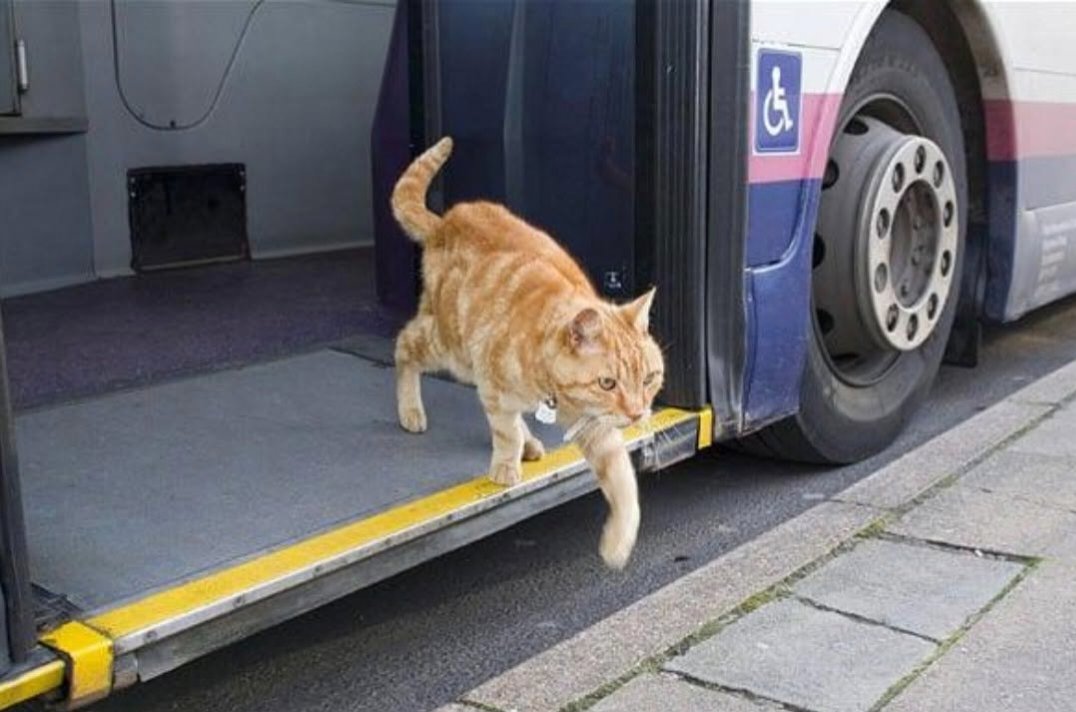
Dodger, a clever ginger Cat from England
He became a local celebrity after his owner discovered he had been regularly riding public buses on his own sometimes even taking a 10 mile round trip. Drivers began recognizing him, offering him food, and even knowing exactly which stop to let him off at, while passengers happily let him curl up on their laps like a seasoned commuter
The Black Death arrived in England in 1348. Within two years, somewhere between a third and a half of the population was dead.
The peasants who survived noticed something within a generation.
There was nobody left to work the fields. The labour shortage was so severe that landlords, for the first time in English history, had to bid for workers. The peasants, suddenly possessed of leverage, demanded payment partly in meat. Beef, mutton, and bacon began appearing in the manorial accounts of agricultural labourers' wages.
Skeletal records from English burials in the late 1300s and 1400s, set against pre-plague remains, show measurable increases in average adult height. Bone density improves. Dental health improves. Iron-deficiency markers decline.
The peasants got taller. The peasants got stronger. The peasants started causing political problems on a scale they had previously been too undernourished to attempt.
In 1351 Parliament passed the Statute of Labourers, attempting to cap wages back at pre-plague levels. The peasants noticed. In 1381, well-fed, the same peasants marched on London in the largest popular uprising in medieval English history.
The nobility, in the centuries that followed, expanded the Forest Laws. Killing a deer in a royal forest was a capital offence. The Game Laws of the 1600s and 1700s extended the principle. Meat available to the peasant shrank back toward what it had been before the plague.
By 1850, the average British army recruit from the industrial slums was so short and so undernourished that the height minimum for enlistment had to be lowered repeatedly to keep the regiments staffed.
The single greatest improvement in working-class height and health in English history was caused by a plague that made meat affordable for two generations.
The single greatest decline was caused, in significant part, by a political decision to make it expensive again.
You can see the whole sequence in the skeletons.
The skeletons are in the museums. Go and look.
Hocus Pocus. 1973. The Midnight Special. Here's the story:
The TV producers told the band they only had 5 minutes left & couldn’t play the 7-minute “Focus,” but the band’s response? ‘Hell no, we’ll just play it faster.’ And so they turned it into a full-blown exorcism ✞
He came in when they were at rock bottom. He turned them around. He delivered an enormous victory. But they’ve grown tired of the boring playing style so they’re going to get rid of him. It doesn’t always work out for the best…
The press pack outside No10 starved of BREAKING NEWS CRISIS DOWNING STREET CHAOS LATEST for 20min turn on each other instead with Beth Rigby demanding Chris Mason resign after he loses the confidence of Robert Peston
Westminster may finally be about to have the argument it has spent 40 years avoiding.
If Andy Burnham returns to Parliament, the political class will know how to cover it. A leadership drama. Who is up, who is down, whether Keir Starmer can survive, whether Labour is once again turning inward. The familiar machinery of Westminster psychodrama will whirr into life.
That framing misses the larger point. Burnham’s possible return matters not because of what it says about Labour’s leadership, but because of what it reveals about the British state: what it can still do, what it has forgotten how to do, and what kind of country it must become if it is serious about resilience.
Britain is finally having a more serious conversation about national security. The Strategic Defence Review, the pivot back towards Europe, the recognition that hybrid warfare turns citizens, infrastructure and civic institutions into part of the front line: all of it marks a real shift in how the state thinks about its own survival.
But at the centre of that conversation lies a question that the defence establishment, and most of Westminster, still does not want to answer. What kind of society do you need to be before resilience is possible?
Finland is now the model everyone cites. Comprehensive security. Whole-of-society defence. Civilian preparedness woven into military planning. British strategists admire the Finnish system and ask how it might be copied. But the admiration stops short of the uncomfortable question: why does it work there?
The answer is not geography or history or some mysterious quality of Finnish national character. It is structural. Nearly 80% of Finns say they would defend their country if attacked. In Britain, the figure is closer to 33%. That gap is not an accident. It exists because Finland has spent decades building a society in which people have a genuine stake in what they are being asked to defend. Energy is affordable. Housing is available. Public services function. Institutions command trust. The Nordic welfare state is not a sentimental add-on to Finnish security policy. It is the foundation of it. You cannot ask people to defend a country that does not work for them.
Britain has spent 40 years building the opposite. The privatisation of essentials – energy, water, transport, housing – transferred wealth upwards from households to shareholders while making the basics of everyday life more expensive. The state, stripped of the tools to control costs at source, has been reduced to compensating after the fact.
Out of every pound the Government spends on housing, 88p goes to subsidising private rents. Just 12p goes to building homes. When energy prices spiked in 2022, the Government spent £40bn in a single winter cushioning the blow, not because it had a resilient energy system but because it lacked one. Debt interest now consumes more than £100bn a year. Britain has the highest debt servicing costs in the G7: the compounding price of financing failure rather than eliminating it at source.
This is what bond market dependency actually looks like. It is not an abstract fiscal condition. It is the consequence of a state that has been stripped of the supply-side tools that would let it cure the problems it now pays, indefinitely, to manage. And here is the paradox the Treasury refuses to confront. The countries that borrow most cheaply are often those that have retained the public investment model Britain abandoned. The spread between UK and Dutch borrowing costs has widened sharply not because markets fear public investment, but because they have lost confidence in a model that borrows to subsidise private failure while never addressing its causes.
This is the connection Britain’s defence debate is missing. The familiar framing, that social spending is what must be sacrificed to meet the NATO target, is not merely politically toxic. It is strategically illiterate. Cutting the foundations of social cohesion to fund the hardware of national defence is self-defeating. You end up with planes and no pilots, submarines and no crew, an army that cannot recruit because the society it is meant to protect has stopped believing in itself.
I think Burnham understands this. That is why his programme is more interesting than the leadership gossip suggests. What he has been building in Greater Manchester – public control of transport, expanded social housing, investment in the productive foundations of the city economy – is not a nostalgic rerun of postwar nationalisation. It is a proof of concept for a different kind of state.
The Bee Network is the most visible example, but the argument behind it travels. A state that can shape markets is not condemned to subsidise their failures. A state that produces affordable energy through public generation does not need to spend tens of billions cushioning every price shock. A state with a serious public housebuilding programme does not need housing benefit to rise endlessly in line with private rents. A state that builds institutions people can see, use and trust begins to restore the civic confidence on which resilience depends.
The real constraint on Britain is not money. It is capacity: the workers, institutions, supply chains and public purpose needed to turn national will into national renewal. Britain’s tragedy is not that it has run out of money. It is that after 40 years of hollowing out the state, it has made itself less able to act.
Burnham’s critics will reach for the familiar warning. Borrow more, spend more, spook the gilt markets, repeat the Truss disaster. But this misunderstands both the problem and the opportunity.
Bond markets do not have ideological preferences. They have functional ones. They prefer clarity, credible revenue streams, productive investment, and a state with a plan. What they punish is not public ambition but incoherence. A properly designed productive state programme would not be a leap into fiscal fantasy. It would be an attempt to end the much costlier fantasy that Britain can keep borrowing to compensate for broken markets while refusing to repair them.
The defence conversation and the economic conversation need to become the same conversation. Finland did not build national resilience by choosing between welfare and security. It built resilience by understanding that they are inseparable: that a country in which the basics work, where people trust one another and the institutions around them, is one that can face danger with something more than anxiety.
That is the deeper argument Burnham represents. Westminster will be tempted to treat him as a leadership story. It should resist the temptation. The question is not whether Burnham can return to parliament. It is whether Britain can return to the idea that the state should make life work. Because a country that cannot command the confidence of its people cannot truly defend itself.
🚄💨 An open window on a train is pure magic! 🌬️✨
Our inaugural Snälltåget from Hamburg to Stockholm is soaring across the mighty Great Belt Bridge in Denmark. Full trip report: https://t.co/4DIJrTdvYu