Everyone believes CUDA is NVIDIA's moat, the reason we've maintained our dominance in the AI era. I've never believed that.
NVIDIA has only one true moat: its people. And the most important of them is Jensen Huang.
I've worked on CUDA compilers, libraries, and DSLs for eight years, from Volta to Rubin. I think I've earned the right to share my perspective on what NVIDIA's moat really is. I hope you'll bear with me.
1. What is CUDA?
Many people think CUDA is just a programming language and its compiler, and that NVIDIA's moat comes from the massive amount of software written in CUDA, making it impossible for developers to leave NVIDIA GPUs.
This is completely wrong. It's an incredibly naive understanding of CUDA.
To me, CUDA is everything NVIDIA does.
CUDA isn't just a language, software, or hardware architecture. It's a product defined by a unique customer experience.
When you find GPU programming too difficult, CUDA gives you an easier way. When your GPU code isn't fast enough, NVIDIA engineers respond and help you solve it. When a handful of GPUs can no longer push your technology forward, NVIDIA has already scaled its computing platform from desktops to massive data centers. When you need more data centers than anyone else can supply, NVIDIA has already secured wafer and HBM capacity years in advance to meet your demand.
That experience is CUDA.
It's made possible by the relentless, day-to-day work of everyone at NVIDIA. And the person who brings all these people together, who gives them a shared vision and purpose, is Jensen Huang.
2. What made CUDA possible?
Patience. Perseverance. An unwavering commitment to a vision.
Around 2006, NVIDIA bet that the future would demand far more computing power, and began transforming GPUs from graphics processors into a platform for general-purpose computing. Initially, it was a commercial disaster. The added costs hurt margins, the market wasn't ready, and the strategy faced enormous skepticism and pressure, including questions from the board.
But Jensen persisted.
For roughly a decade, NVIDIA kept investing in CUDA, building its hardware, software, and developer ecosystem long before the commercial payoff became clear.
Eventually, deep learning arrived. And NVIDIA was ready.
Today, this sounds like an inspiring story. But for those who lived through it, it meant a decade of perseverance, doubt, and being misunderstood.
Looking back at the history of technology, how many people could have done the same?
This is what I've always loved most about NVIDIA.
And now, Jensen has been pushed out.
This won't kill NVIDIA. The company can still create tremendous commercial value. But it has killed NVIDIA's soul. And how far can a body go without its soul?
If this is how Jensen Huang is treated today, how will those of us who built CUDA be treated tomorrow?
I love NVIDIA deeply, but I have to say it: NVIDIA is dead.
Dylan Patel reveals SemiAnalysis has had to email Jensen Huang directly to get Nvidia to fix open source software, and says that was the only way it got solved
“If there’s any manufacturing issues with Rubin, people are distracted and Jensen’s not there. Things get solved slower. Things get solved by committees. Things don’t get escalated up.”
“I don’t know how many times at SemiAnalysis we’ve emailed Jensen for a thing to get solved. Like, what the fuck? Why are we emailing Jensen to fix something on some open source software? And yet that’s the only way we get it solved. And we’re irrelevant, compared to actual companies in the space.”
“How often is it Jensen going out there and solving a problem? From what I’ve heard from everyone around the ecosystem, it’s a lot. How many times is it like Elon tells Jensen something, Jensen goes and tells his team, and the team fixes it, because the team was trying to work with the team and it doesn’t work out.”
There were many forces that potentially would like to see @JensenHuang removed as CEO of @nvidia $NVDA
- China hawks
- frontier labs
- NVDA competitors
- China maybe
- anti-AI people
- short sellers
Would be a powerful (and shocking) redemption story if he could be reinstated as CEO
$NVDA @JensenHuang See you later.. Best of luck
Fix your problems and we will root for you when you return to amaze us once again
It's been quite the ride so far
@optionscjp $NVDA This is one of these situations you never expect.
It's caught a lot of investors off guard
I am just holding for now and observing the situation
Valuation was already too cheap
There is still too much uncertainty IMO
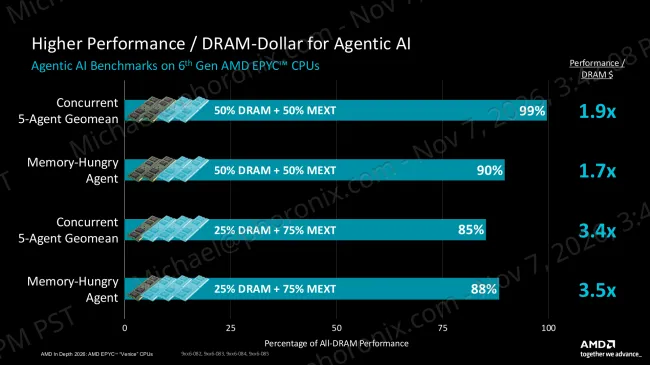
Read up on @AMD MEXT, it's really interesting. In a nutshell, it makes flash memory such as NVMe SSDs behave more like DRAM. More here 👇
https://t.co/vrps2PxXZ9
@optionscjp $NVDA This is one of these situations you never expect.
It's caught a lot of investors off guard
I am just holding for now and observing the situation
Valuation was already too cheap
There is still too much uncertainty IMO
@optionscjp $NVDA This is one of these situations you never expect.
It's caught a lot of investors off guard
I am just holding for now and observing the situation
Valuation was already too cheap
There is still too much uncertainty IMO
BREAKING: Nvidia, $NVDA, CEO Jensen Huang's relationship with an alleged Chinese spy facilitated at least $7.5 billion in Nvidia chip shipments, per The Information.
The relationship reportedly dates back to 2023.
RE: The claim that TSMC will enter memory and disrupt the big three memory makers
This doesn't make sense. As far as I know, TSMC has been working on this project for more than five years, but it would be a mistake to assume what they're building is commodity DRAM. TSMC has no DRAM IP, no DRAM patents, and none of the relevant technology.
I think the term "3D DRAM" is what's causing the misunderstanding.
After talking with industry experts, I believe this is the correct way to read the reports of TSMC entering DRAM.
TSMC's earlier published research gives a good sense of the direction.
At the 2025 VLSI Symposium, TSMC presented a memory technology based on oxide semiconductors, using a cell made of one transistor and one capacitor (1T1C). The goal was to integrate this memory into advanced logic chips and give processors a cache with low power and low latency.
The key feature of the design is that the memory array is built directly into the back end of line (BEOL) interconnect layers of the logic chip. Conventional DRAM is manufactured as a separate chip.
To build the memory array in the interconnect layers of an advanced logic chip, TSMC used select transistors with an oxide semiconductor channel and capacitors fabricated with a low temperature process.
According to TSMC, the test chip, which integrates memory and logic on a single die, operated at 0.75V. Data retention exceeded 128ms, random read/write cycle time was under 8ns, and endurance was above 10¹⁴ cycles. TSMC positioned the technology as a processor cache that offers higher density than SRAM while keeping power consumption and latency low.
So TSMC would be producing 3D DRAM as a next generation technology to replace SRAM. And not in large volumes, either.
Anyone saying TSMC will make DDR or LPDDR has no idea what they're talking about.
Intel $INTC CEO Lip-Bu Tan:
“Applying even conservative estimates to the total number of digital agents, and agents serviced per CPU, it is easy to anticipate a massive dollar and unit TAM for CPUs over the coming 5 years.
By our estimates, server CPU TAM, largely driven by agentic workloads, could increase as much as 5x from where it is today, from $40 billion to more than $200 billion over 5 years.”
$AMD $ARM $NVDA