Operator. Builder. Addict. I run multiple addiction treatment facilities in Maryland & build the tech to fix a broken system. Real takes on BH & healthcare AI.
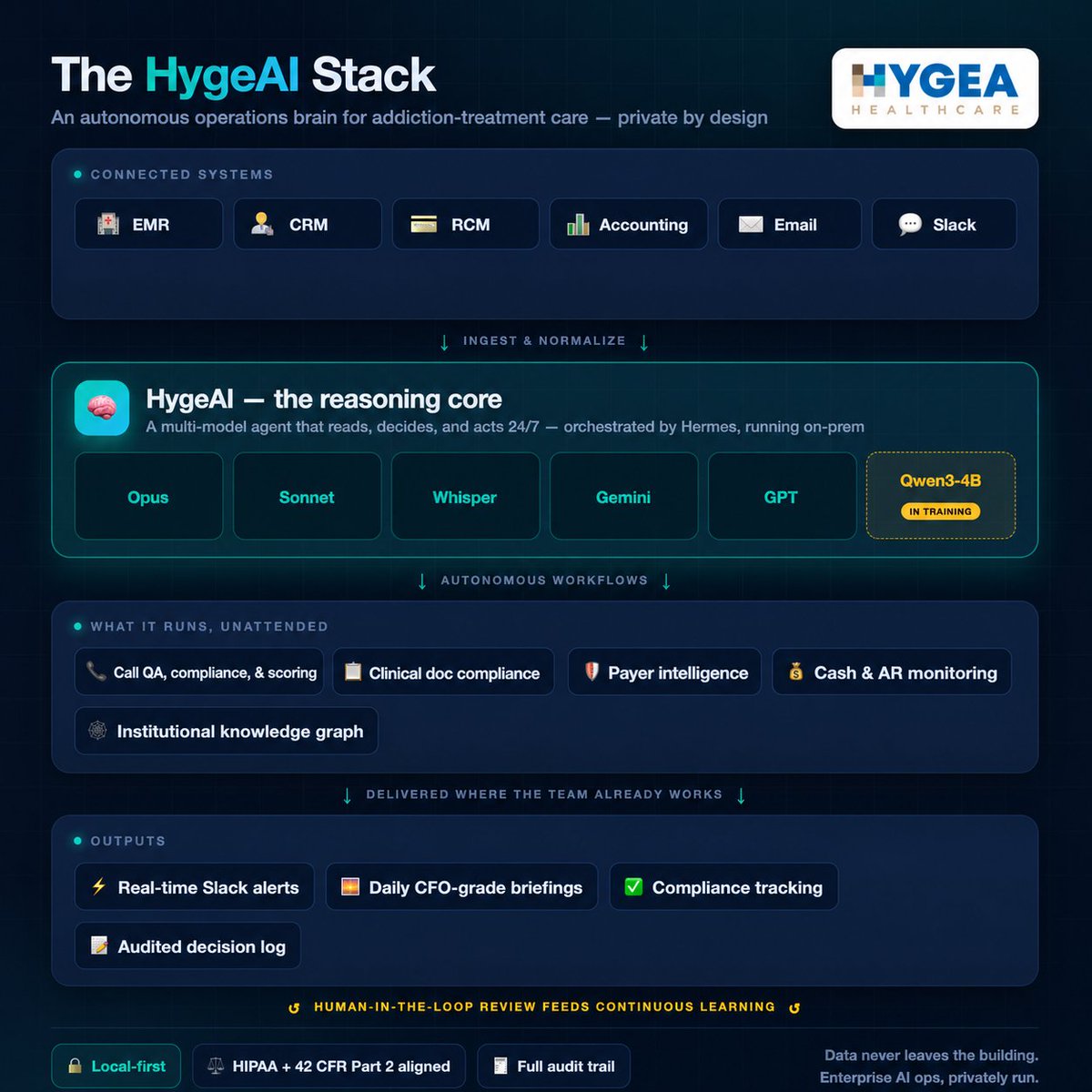
I showed the AI stack I built for Hygea; the feedback was awesome, so I’m sharing it.
HygeAI is an on-prem brain for addiction treatment: QA, compliance, payer intelligence, AR, and decision support.
Private. Auditable. Human-reviewed.
Questions welcome.
I installed @dhh’s Omarchy on an old laptop and I’m completely mindblown 🤯.
I think this is a complete game changer and 1 of these moments in time we’re going to look back on as a MAJOR inflection point. The possibilities are endless. Having control at this level has never been possiblr before.
I haven’t had this feeling and this much fun using a computer since Windows 3.1 which was the OS I used after DOS.
The @grok@bot is amazing. Makes it simple for the everyday person to use multi-agents. There are still uses for Hermes and OpenClaw but I’ve found using Grokbot on certain portions of projects and workflows to be extremely useful and simple.
I bet @elonmusk and @SpaceX will win the AI wars. No one has the complete infrastructure he does.
The advance in Grok 4.6 way surpassed what I was expecting. The gap between Grok and OpenAI/Anthropic latest LLM’s just got WAY smaller.
I’ve been following the Lindsay Clancy trail and if this doesn’t wake us up to how broken our behavorial health system is in America then I don’t know what will. This is obviously a woman that was dealing with severe mental health issues and the system failed her and her family tremendously.
I understand why the defense is hyper focused on telehealth as one of the main issues but I strongly disagree. Telehealth is a good thing. The continuity of care is the issue. I think she saw at least 4 different providers in over a 4+ month period and most of them didn’t review the other’s notes and records and the providers never spoke with each other.
This was a really nice pick-me-up today that was much needed. Thank you @RicMetzgar for the accolade. I’m humbled and honored to work with a group of such amazing people. This makes all the pain, negativity, late nights, and mental health struggles feel like they’re worth it.
At least once a week I listen to this speech, https://t.co/nBEYn7ZbYN It helps me put things in perspective, especially when I'm feeling down.
I have extremely bad depression and anxiety at times. It's something I’ve dealt with my entire life and I used to be ashamed to admit, but it's part of me and who I am, so I'm learning to accept it and do the best I can.
When I'm feeling bad, I'm an isolator. Mental health is a real thing, and the stigma around it has made me feel weak, ashamed, embarrassed, inadequate, like a failure, and so on…
Even writing this isn't easy. But if you can relate in any way, I'd love to hear from you. I believe the opposite of addiction is connection.
This is good to hear but the more important issue is social media and holding those companies accountable.
Facebook has published research that shows mental health and suicide rates have exponentially increased particularly with female youth because of their algorithms but have they changed anything?!? NOPE.
I wonder why that is… WU Tang said it the best… C.R.E.A.M.
Washington policymakers, youth advocates and mental health leaders gathered this week on Capitol Hill to discuss new research that adds to the growing chorus of concerns over teenagers' use of artificial intelligence. https://t.co/CDSPa1zTtQ
@FOXBaltimore Teen AI use is too broad a category. Homework help and treating a chatbot like a confidant create different risks. Did the research measure emotional reliance, secrecy from adults, or displacement of human support, or just mainly frequency of use?
@OpenAI At 300 million health questions a week, separate clinical questions from access questions. People also use AI to decode denials, bills, records, or referrals. Are you measuring whether ChatGPT resolves the administrative problem, or only whether the answer is medically sound?
@FierceHealth Rebates shift more than timing. A provider may front the drug cost, prove eligibility, then wait to recover the discount. Did the court address that operating burden, or only whether manufacturers need HHS approval?
How can Medicaid provider’s survive operating like this?
The Carelon issues we’re dealing with in Maryland are ridiculous and something has to change.
I currently have clients in 1 of my facility’s with their auth still pending since the beginning to middle of June… not denied… PENDING!!!
And the excuse we’re told is we’re extremely behind. Can you imagine if on payday I said to my employees, “Sorry, we’re extremely behind and you won’t be paid for another couple of weeks.” Would that be sufficient?
@MDHealthDept
@chrissyfarr@Use_Bridge@keatonbedell Clinic count is a weak proxy for opportunity. Behavioral health looks crowded until you segment by acuity, payer, state licensure, and time to first appointment. Did the report compare volume with reimbursement and clinician supply, or only demand?
@FierceHealth Connecting ChatGPT to records is the easy demo. In addiction treatment, consent can change and 42 CFR Part 2 can restrict what follows the patient. How does Health in ChatGPT handle revoked consent and data that was already pulled into the conversation?
@KeithNHumphreys@sfchronicle A 27% drop in six months is real progress, but the supply shock makes the lesson harder. Treatment systems cannot assume weaker fentanyl will last. Which local metric would tell you San Francisco is safer even if fentanyl purity rises again?
@FierceHealth IDR can fail both sides. A provider delivers care, submits the dispute, and carries payroll while payment sits unresolved. Did UnitedHealthcare propose a deadline with automatic payment consequences, or mainly a new process for reviewing disputes?
Behavioral health facilities finance the payer's delay.
Payroll runs every two weeks.
Rent is due monthly.
A clean claim can still sit unpaid while the payer asks for another record.
The provider carries the cost of care while the insurer controls the clock.
And then the payer can make a sudden change which is catastrophic to cashflow especially as a primary medicaid provider where our margins are already paper thin.
We experienced this recently in Maryland.
At 1 of our inpatient locations an outpatient provider was illegally billing for the same dates of service that the patient was under our care.
What do you think the payer did?!? DENIED our claims even-though the client was physically at my location. Eventually they fixed everything but cashflow-wise it crippled us in the short term.
@morgancheatham@NYSE That last mile is where health AI meets the payer. A benchmark can improve while the product still cannot produce evidence that fits coverage policy, coding, and utilization review. Which proof point kills more pilots now: clinical validity, workflow impact, or budget impact?
New criteria create an immediate operating problem when providers update before payers do. The clinical team documents to one standard while utilization review is judged against another. Like in Maryland we are still using the 3rd edition but my in-network contracts with majors are based off the 4th edition. It makes it extremely challenging to treat Medicaid and Commercially insured patients. Are major payers committing to an adoption date for Volume 2?