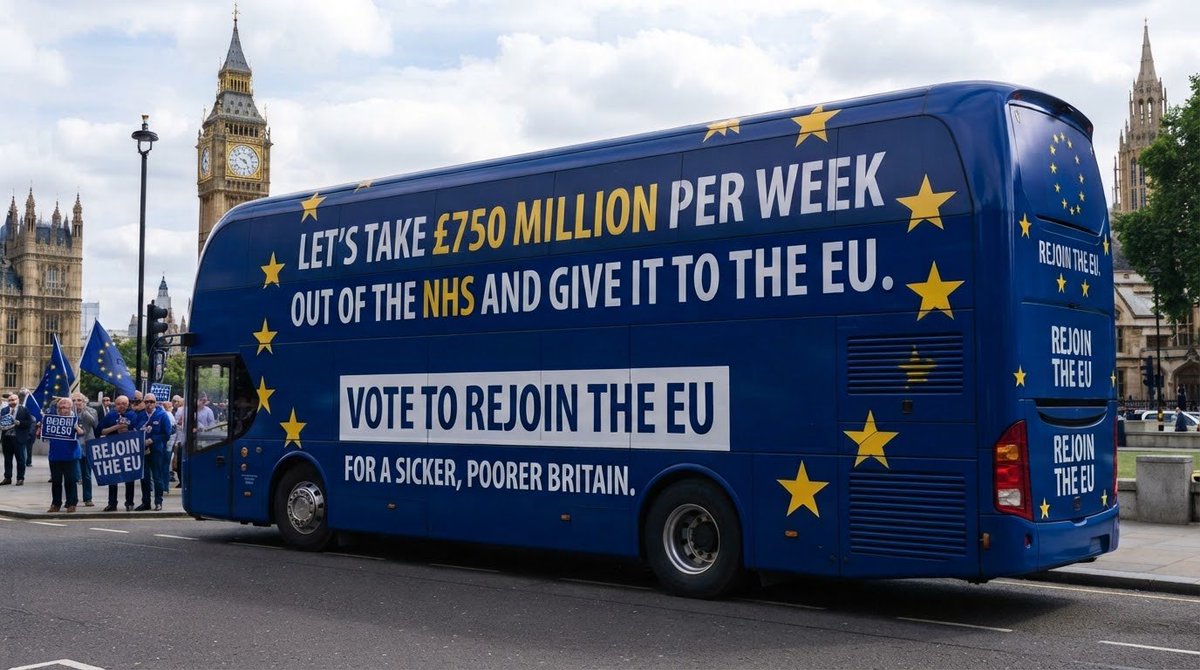
Understand how serious this is … Britain is already owed £6 BILLION in student loans from EU students.
£360 MILLION is in arrears because 43,700 EU students living overseas have made NO repayments in the last year.
The EU is demanding, UK taxpayers spend up to £450 MILLION A YEAR to give EU students cheaper university tuition fees instead of paying international student fees, with no cap on numbers!
That’s on top of £570 MILLION the government already agreed for rejoining Erasmus+ for 2027.
And not one person in the UK has been asked.
Haka gives ABs unfair psychological advantage. It gives an opportunity to lay down a challenge which the opposition is unable to confront w/o criticism.If the RFU does nothing to provide backdrop, then the crowd has every right to respond as it sees fit. https://t.co/nVKOR3M9iY
This is an excellent article from @FSI_Europe, listing just eight of the many things that have changed with the EU since the UK left it in 2020.
If you're not already following FSI, then you should do! Well worth your time.
https://t.co/EVPY3MPn0Q
🚨 FOOD PRICES UP 38%. IS BREXIT REALLY TO BLAME?
I joined @MartinDaubney on @GBNEWS to look at the UK vs EU figures 👇
🛒 UK food prices up 𝟯𝟴.𝟰% since Dec 2019. EU average? Up 𝟯𝟴.𝟴%
🇩🇪 Germany up over 40%. Spain up more than us too
🌾 The real drivers: war in Ukraine, fertiliser and energy costs
📈 GDP since the 2016 vote: UK +14.7%, ahead of France, Italy and Germany
🚢 Before Brexit 46% of our goods exports went to the EU. In 2025? Still 𝟰𝟲%
The common factor is energy, not Brexit.
👉 Watch:
https://t.co/SPVzIOBsge
@JohnCotton@EULondonMark@pescottfrost Yes that was the point I was making. His ilk wet the bed when Trump used tariffs , yet crack one off at the thought of the eu doing the same
@JohnCotton@EULondonMark@pescottfrost And also explain which FTAs the uk will have to walk away from and how much this would cost us when the EU erects its trade barriers
The orange has more top 100 universities than the blue combined.
And I'm meant to believe subsiding the "blue" areas to come here so we can get access to them is a good deal?
Frédéric Bastiat gave economics its most useful diagnostic tool in 1850, and most people in government today have never applied it; in fact, they avoid it like the plague.
The tool is simple: when you evaluate any policy, law, or intervention, you must account not only for what you can see, but for what that intervention could destroy before it could exist.
A shopkeeper's son smashes a window. The glazier gets paid. The crowd watching decides this is good for the economy because money circulates. What they cannot see is the suit the shopkeeper planned to buy, the tailor who goes without a sale, the capital that evaporates into replacement rather than expansion. Destruction consumed resources. Nothing was created. This is the broken window fallacy.
Governments run this logic on a civilizational scale.
The 2009 Cash for Clunkers program destroyed 690,000 working vehicles, most of them affordable transportation for lower-income buyers, in exchange for a brief sales spike at GM and Ford. Congress saw the spike; nobody in the Congressional Budget Office modeled the used-car market that you, specifically, lost access to when supply collapsed and prices jumped. The program cost $3 billion, and you paid for it, then you paid again at the used lot.
Minimum wage laws work exactly this way. The politician sees the worker earning $17 an hour instead of $14. The camera follows that worker. The teenager never got hired because the entry-level position was automated or simply eliminated when the math stopped working for the employer. That teenager's first job, his first reference, his first skill set, disappears into the unseen and nobody holds a press conference about it.
Trade tariffs are perhaps the most dishonest application of the seen-and-unseen problem. The steel mill in Pennsylvania stays open. Those workers are visible, photographed, quoted in dispatches. Invisible are the downstream manufacturers, the auto plants, the appliance makers, the construction firms who now buy steel at artificially inflated prices and either raise their prices or cut their own payrolls. The 2018 Section 232 tariffs saved 8,700 steel jobs by one Federal Reserve estimate, while raising costs across steel-consuming industries that employed 6.5 million workers.
Every resource a government spends was first extracted from somewhere else. Every job a subsidy preserves is set against jobs the private sector never created because capital was redirected by force. The seen is always photogenic. The unseen never gets a ribbon-cutting ceremony, which is precisely why politicians ignore it, and you keep paying the difference.
I feel this somewhat confounds the 18-year property cycle. It's actually a theory I have a lot of time for (and if 2027/28 ends up being the nominal bottom it wouldn't surprise me) but we're already in a real-terms crash
This guy runs one of the biggest recruitment companies in the UK.
He’s clear: rejoining the EU would not help young people in the jobs market.
One by one the Rejoin lies are being shot down.
This guy looks like he’s on the verge of a coronary. And he lies whilst saying we were lied to, and then when confronted with reality (fyi the 350m was a suggestion by people not in government in any case), he just keeps on saying “Fact”. The guy is thick as mince
Zohran Mamdani finally got confronted on his city-owned grocery store grift and his response is pure slop.
"This is an industry that has typically a margin between 1% and 4% and your plan is to sell products at a 30% discount..."
Trump tells Canada that the US must have a veto over parts of its trade policy. Sensible progressives call him a madman and a megalomaniac.
The EU makes an almost exactly analogous demand of Britain. The same people whoop and cheer and talk about "repairing relations".