This is what will matter 1000 years from now.
Not your politics. Not your stupid tantrums about who platformed who on some website. Not your incomprehensible desire to send NASA's entire budget to the third world.
This guy reignited the Space Age.
He spent his own money, hired a bunch of dudes, and reignited the Space Age. And together, they underbid and outdid NASA and its pet dinosaur corporations on every conceivable level.
This is history happening before you.
If you are a puddlefish, if you think this is a wasteful showpiece or science project, then you don't understand physics, economics, astronomy, or in fact the basic layout of the universe you live in.
We live in a tiny puddle at the bottom of a well.
Out there is an entire universe, full not only of stuff to explore, but full of stuff to build things out of.
Big things. Wonderful things. Things that are going to make all of the cool stuff you have today, all of human civilization to date look like early Assyrians writing stuff down on wet clay with a reed.
Infinite resources. Infinite energy. Infinite space.
Instead of fighting over little patches of land, we will have an infinite 3d volume. Enclose it in steel, pump it full of air, spin it, and it's a habitat.
Instead of scratching tiny scraps of metal out of the crust of one planet, we will break down entire asteroids and smelt them.
Instead of drilling for hydrocarbons and turning water wheels, we will harness entire suns, split the atom, and eventually draw our fuel from the substance that makes up 99% of the entire universe.
None of your local, temporal Earth politics matter compared to this. This is more important than pride parades and abortions, more important than tribal conflicts in eastern Europe and southwest Asia, more important than tensions with Russia and China.
More important, in the long run, than the United States of America.
America's most important function, its one most vital purpose, is to serve as an incubator for this.
Because this changes everything.
All of our arguments about conditions on this planet become obsolete, because the whole planet becomes just one suburban neighborhood.
All of our wars over resources and territory become obsolete, because no one has time to brawl when we're all sitting on top of a dragon horde with sacks and shovels.
Everyone who was alive at the time remembers where they were when Kennedy died in Dallas. When the towers fell. When the Eagle landed. When the Wall came down.
But this... this is the real moment, one of the first of many. They are what every child will know about a thousand years from now, even if they have four arms and are genetically engineered for zero-g, or are sentient blocks of code running on a sphere of computronium enclosing an entire star.
You may not live to see that, depending on what we do or don't invent, and when.
But it will happen, and you will live to see wonderful things.
If the puddlefish don't get in the way.
Don't be a puddlefish.
Billions of years from now, the universe will die.
The last star in the last galaxy will fuse its last atom.
Entropy will overtake everything as we return to a state of absolute zero.
And then IBM will buy it.
Multi-agent collaboration has emerged as a key AI agentic design pattern. Given a complex task like writing software, a multi-agent approach would break down the task into subtasks to be executed by different roles -- such as a software engineer, product manager, designer, QA (quality assurance) engineer, and so on -- and have different agents accomplish different subtasks.
Different agents might be built by prompting one LLM (or, if you prefer, different LLMs) to carry out different tasks. For example, to build a software engineer agent, we might prompt the LLM: "You are an expert in writing clear, efficient code. Write code to perform the task …".
It might seem counterintuitive that, although we are making multiple calls to the same LLM, we apply the programming abstraction of using multiple agents. I'd like to offer a few reasons:
- It works! Many teams are getting good results with this method, and there's nothing like results! Further, ablation studies (for example, in the AutoGen paper cited below) show that multiple agents give superior performance to a single agent.
- Even though some LLMs today can accept very long input contexts (for instance, Gemini 1.5 Pro accepts 1 million tokens), their ability to truly understand long, complex inputs is mixed. An agentic workflow in which the LLM is prompted to focus on one thing at a time can give better performance. By telling it when it should play software engineer, we can also specify what is important in that subtask: For example, the prompt above emphasized clear, efficient code as opposed to, say, scalable and highly secure code. By decomposing the overall task into subtasks, we can optimize the subtasks better.
- Perhaps most important, the multi-agent design pattern gives us, as developers, a framework for breaking down complex tasks into subtasks. When writing code to run on a single CPU, we often break our program up into different processes or threads. This is a useful abstraction that lets us decompose a task -- like implementing a web browser -- into subtasks that are easier to code. I find thinking through multi-agents roles to be a useful abstraction.
In many companies, managers routinely decide what roles to hire, and then how to split complex projects -- like writing a large piece of software or preparing a research report -- into smaller tasks to assign to employees with different specialties. Using multiple agents is analogous. Each agent implements its own workflow, has its own memory (itself a rapidly evolving area in agentic technologies -- how can an agent remember enough of its past interactions to perform better on upcoming ones?), and may ask other agents for help. Agents themselves can also engage in Planning and Tool Use. This results in a cacophony of LLM calls and message passing between agents that can result in very complex workflows.
While managing people is hard, it's a sufficiently familiar idea that it gives us a mental framework for how to "hire" and assign tasks to our AI agents. Fortunately, the damage from mismanaging an AI agent is much lower than that from mismanaging humans!
Emerging frameworks like AutoGen, Crew AI, and LangGraph, provide rich ways to build multi-agent solutions to problems. If you're interested in playing with a fun multi-agent system, also check out ChatDev, an open source implementation of a set of agents that run a virtual software company. I encourage you to check out their github repo and perhaps even clone the repo and run the system yourself. While it may not always produce what you want, you might be amazed at how well it does!
Like the design pattern of Planning, I find the output quality of multi-agent collaboration hard to predict. The more mature patterns of Reflection and Tool use are more reliable. I hope you enjoy playing with these agentic design patterns and that they produce amazing results for you!
If you're interested in learning more, I recommend:
- Communicative Agents for Software Development, Qian et al. (2023) (the ChatDev paper)
- AutoGen: Enabling Next-Gen LLM Applications via Multi-Agent Conversation, Wu et al. (2023)
- MetaGPT: Meta Programming for A Multi-Agent Collaborative Framework, Hong et al. (2023)
[Original text: https://t.co/4gTbcQfikx ]
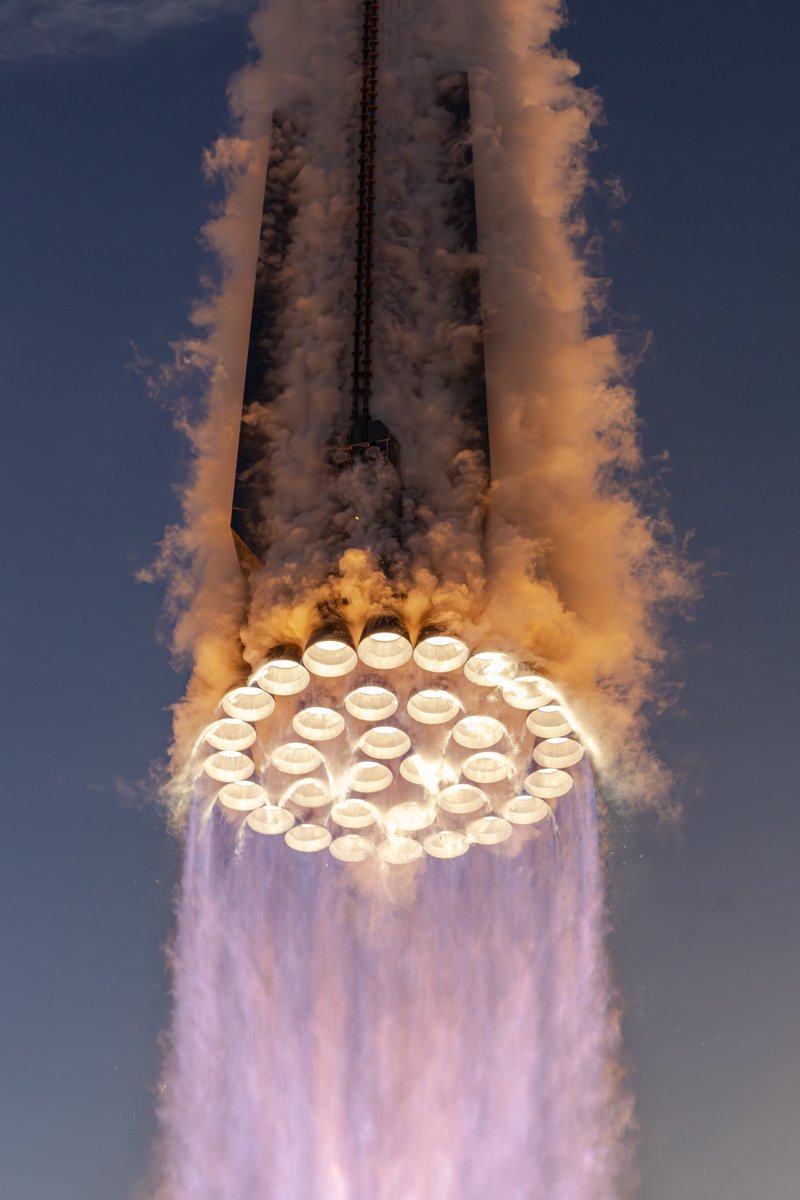
This stunning video of the @SpaceX Inspiration4 mission launch was made of multiple telescope tracking shots and composed in a neverending loop.
[🎞️ MarsScientific]
Some Paradoxes of Modern Life
1. The paradox of reading: The books you read will profoundly change you even though you’ll forget the vast majority of what you read.
2. The paradox of writing: Great writing looks effortless. But because the ideas are so clear, casual readers don't appreciate how much time it took to refine them.
3. The paradox of creativity: Your work is done when it looks so simple that the consumer thinks they could've done it, which means they won't appreciate how hard you worked.
4. The paradox of decision making: It’s better to choose, commit, and get started instead of waiting for the best possible option, so the correct decisions are actually suboptimal.
5. The paradox of originality: Many of history's greatest artists have found their voice by copying others. We discover who we are by imitating others and watching our uniqueness emerge over time.
6. The paradox of news: By telling us to care about everything, the news leads to apathy instead of action.
7. The Productivity Paradox: We keep inventing things that save us time, but it feels like we have less time than ever before.
8. The Paradox of Strategy: The same things that help you achieve outlier success also increase your chances of outlandish failure. For example, investing with leverage increases your chances of risk and reward.
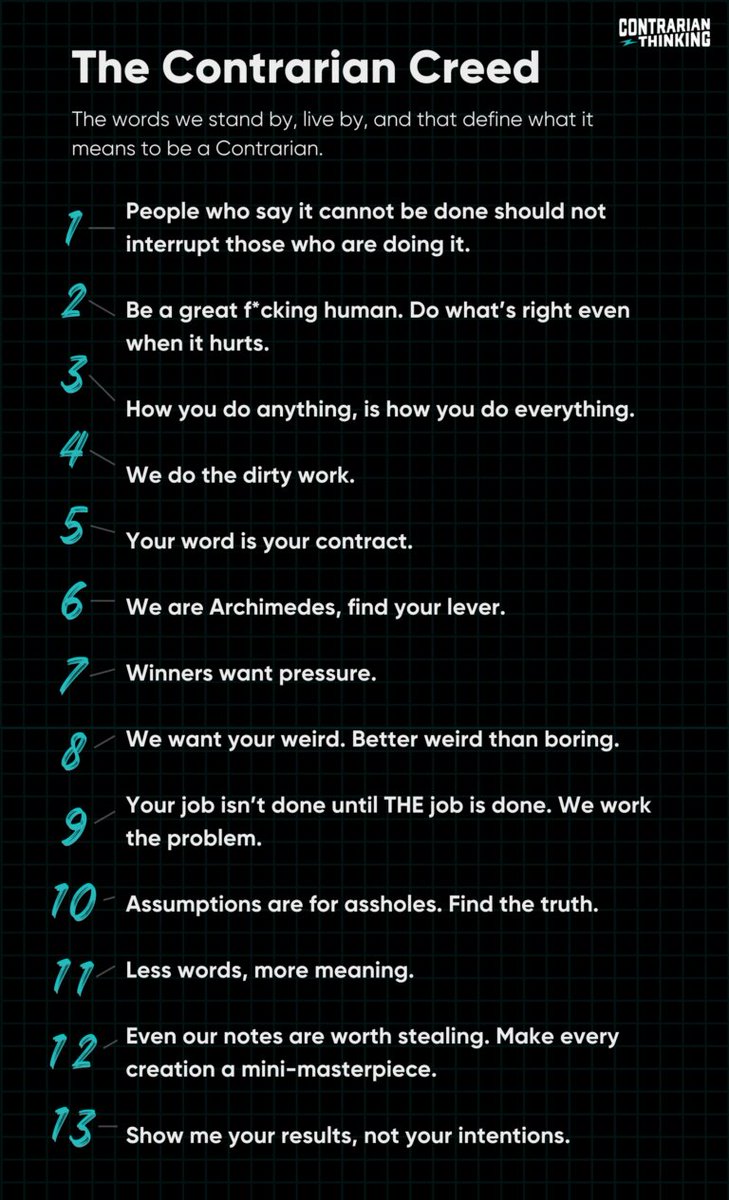
So, we created the Contrarian Creed.
These are the words we stand by.
Writing these out in stone helps us attract and cultivate people who embody them.
Our list of 13 values:
Hear me out.
A new university called: STEM.
Building cracked builders. No grades. No BS. Project based. Accelerated 2 yr education. Strong relationships with the best startups and tech companies in the world for hiring.