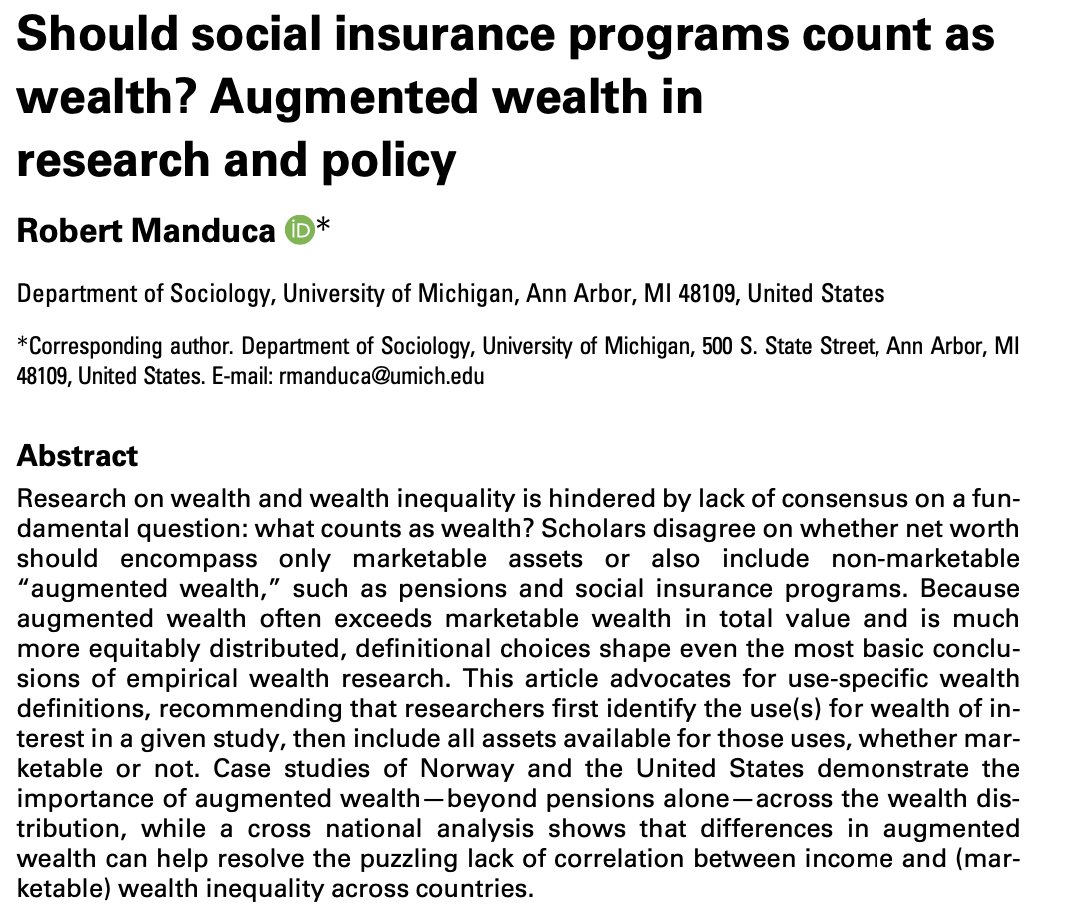
I have a new paper out! "Should Social Insurance Programs Count as Wealth? Augmented Wealth in Research and Policy." Published yesterday in Socio-Economic Review @SASE_Meeting https://t.co/puC0CtasSd
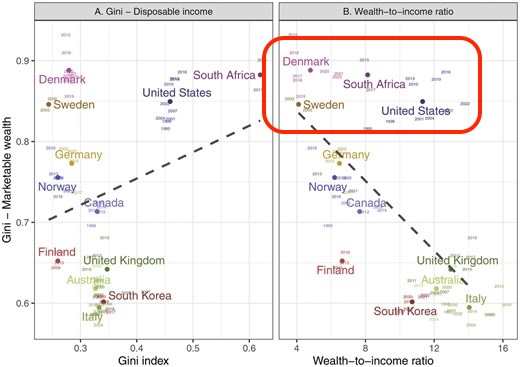
Very valuable paper by the terrific @robertmanduca on the how to think about different wealth definitions, specifically the distinction between personal "market" or tangible wealth and claims to pensions and social insurance, arguing that there is no correct answer, but rather that the choice of what to include in wealth should be dictated what substantive socioeconomic question is under consideration. The paper shows how apparent wealth versus income inequality paradoxes may depend on measurement choice.
Two comments to add. First, human capital is still and elephant in the room when considering the narrow versus augmented measures. Second, Manduca's arguments about difficulties in comparing countries apply a fortiori to comparisons of wealth inequality for a given country at different points in time, an issue that Larry Blume and I discuss in our JPE review essay on Capital in the Twenty-First Century.
@sndurlauf Thanks for the kind words! Great point regarding inter-temporal comparisons--certainly all these programs will change over time within countries. Human capital is always tricky, but can def make sense to include in some cases (esp for people with job security)
@surlygopher@MattBruenig@sc_cath@mattyglesias The key with Sweden + Nordics is they just have way less private wealth per capita than we do: 4x GDP versus 11x for the US. So the same wealth Gini doesn't hit the way it does here - most people rely on the welfare state not savings
@mattyglesias Here's an attempt to work through when you should and shouldn't include social insurance as wealth--for some purposes you really should, and for others you really shouldn't https://t.co/hOm1dYgkqi
@BrankoMilan Here's an attempt to come up with some rigorous ways to decide when social insurance should vs shouldn't be included - if you start counting it, it opens up a lot of very lefty "wealth creation" policy options https://t.co/hOm1dYgkqi
We conceptualize ‘tax base fragmentation’: the spatial concentration (within a metro area) of property wealth in particular wealthy municipalities. The concept is intuitive—but not captured by existing measures of segregation & jurisdictional fragmentation https://t.co/WAIwqoPeQI
🚨We analyzed 138 million geocoded property tax records to quantify how municipal boundaries spatially overlap onto economic segregation in every US metro area—creating disparities in localities’ ability to fund public goods. And we made an interactive map of our results! [1/16]
#UmichSoc Prof. Robert Manduca (@robertmanduca) explains the local impact of cuts to programs like Medicaid & SNAP in recent @USAtoday article. 📉
Read more: https://t.co/1xE3TNlkLp
In @MarketWatch@robertmanduca helps break down what's at stake for local communities as a result of #Medicaid cuts in the One Big Beautiful Bill—on average these safety-net programs account for 40 percent of money flowing into local communities.
https://t.co/sBvGAhghvW
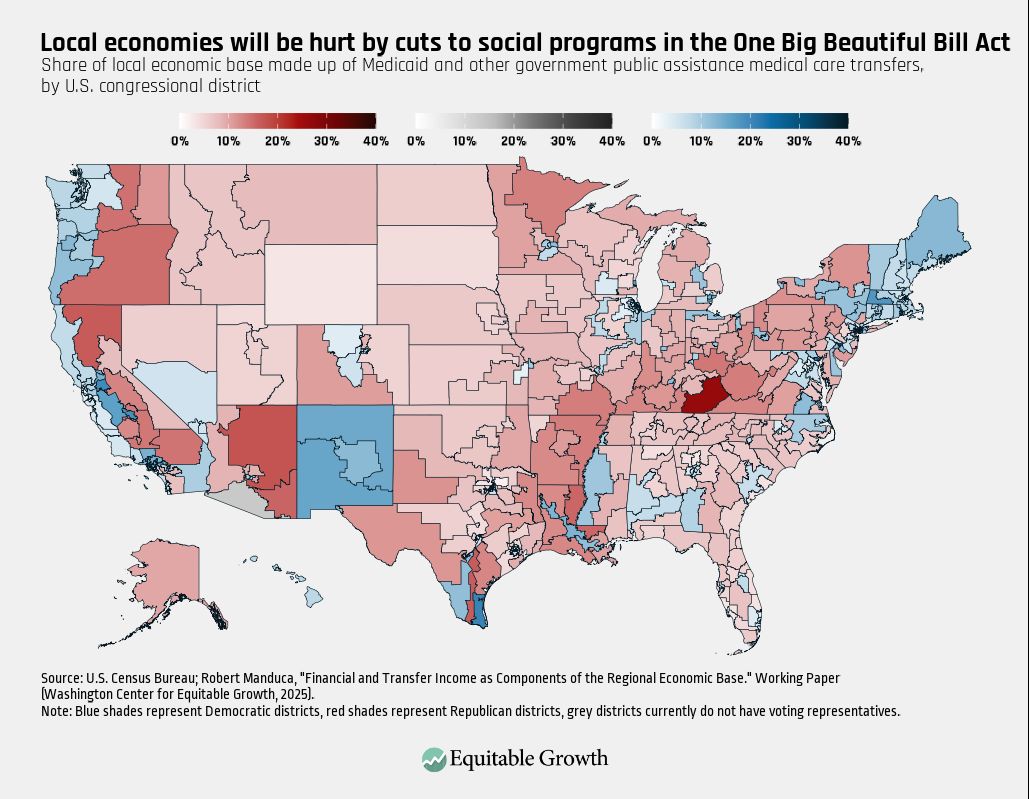
"Cuts to social programs will have a major impact on local economic activity." Social programs are a key part of the regional economic base.
@robertmanduca on how Medicaid and SNAP cuts in the #ReconciliationBill will negatively impact local economies:
https://t.co/dRJHOKprBD
Appreciate the engagement from @oren_cass -- sounds like we agree on the extent to which many communities depend economically on Medicaid, SNAP, and other transfer programs. The question is how to move forward
This is the inevitable endpoint of an economic model that concentrates gains in a narrow set of sector and geographies and then promises that the "winners can compensate the losers." Huge swathes of the country literally become "exporters of need," depending upon their eligibility for government transfers to keep their economies going.
Economists will score this as successful -- look, consumption went up! But it is totally unsustainable, economically and politically. That's not an argument against a strong safety net, it's an argument against a politics that treats a strong safety net as somehow the equivalent of, or a plausible alternative to, an economy that spreads investment and production widely.
Local economies across the U.S. may face significant economic fallout from the #ReconciliationBill.
This impact is expected to be severe in areas where programs like Medicaid and other federal transfers form a larger portion of the local economic base.
https://t.co/dRJHOKprBD
New working paper alert! Posted at @equitablegrowth, it investigates the economic geography of social transfer programs and financial income--with implications for the Medicaid and SNAP cuts proposed in the reconciliation bill 👀
https://t.co/ZCHVsi7B9U








![bd_highsmith's tweet photo. 🚨We analyzed 138 million geocoded property tax records to quantify how municipal boundaries spatially overlap onto economic segregation in every US metro area—creating disparities in localities’ ability to fund public goods. And we made an interactive map of our results! [1/16] https://t.co/sp3ahac7Jm](https://pbs.twimg.com/media/G6iDwaPXoAAI-WC.png)