I read this post and found myself thinking about how absurd the entire premise of a race war really is.
You see, I’m both.
I carry Nigerian ancestry. I carry European ancestry. The same DNA that some people demand I celebrate is intertwined with the DNA they tell me I should be suspicious of. The same bloodline that produced Africans also produced Irishmen, Scandinavians, Sicilians, and others who all converge in me.
So when people start talking about racial conflict, I have to ask a simple question:
Which half of myself am I supposed to hate?
Am I supposed to reject my father’s lineage while embracing my mother’s?
Am I supposed to condemn one set of ancestors while celebrating another?
Am I supposed to look in the mirror and declare that half of my own existence is somehow the enemy?
The entire idea collapses under the weight of its own stupidity.
Over the course of my life, I have met wonderful white people and terrible white people. I have met wonderful black people and terrible black people. I have met honorable men and women of every background imaginable, from all over the earth. I have met fools, criminals, liars, and opportunists from every corner of humanity.
Character never asked permission from skin color.
Neither did evil.
What concerns me is that there are people who profit from keeping Americans focused on race. Every election cycle, every social controversy, every national tragedy somehow gets filtered through the same tired lens.
Divide. Categorize. Agitate. Repeat.
Meanwhile, ordinary Americans are working, raising children, caring for aging parents, paying bills, building businesses, serving in churches, coaching little league teams, and trying to leave their communities better than they found them.
Those people are not enemies.
The real battle has never been black versus white.
The real battle is truth versus lies. This is the war I wage.
Responsibility versus excuses.
Wisdom versus foolishness.
Good versus evil.
And every race, every nation, every tribe, and every family contains examples of both.
As a man who is both Nigerian and European, I refuse to participate in a conflict that requires me to hate my own heritage. I refuse to judge people by categories. I refuse to surrender my ability to evaluate people as individuals.
Judge a man by his conduct.
Judge a woman by her character.
Judge all people by the same standard.
That is the only standard that has ever made sense to me.
#AStoneGroove #SilentMajoritySpeaks
“Then I heard the voice of the Lord saying, ‘Whom shall I send? And who will go for us?’ And I said, “Here am I. Send me!”
~ Isaiah 6:8
Tonight, let’s remember the brave men and women who answered that same call. I wore this scripture on a chain around my neck for 20 years.
They heard the voice of duty — of God and country — and said, “Send me.” They left homes, families, and futures behind to defend liberty on distant battlefields.
Some never returned. Their sacrifice was total. Their “Here am I” became eternal.
Today we honor their courage, their faith, and the freedom they secured for us. We owe them a debt we can never fully repay — only remember and live worthy of.
To every Gold Star family, every veteran who carried the weight: Thank you.
May we never forget those who said “Send me”… and meant it with their lives.🙏✝️
Goodnight, ya’ll.
You may have stepped on one, sprayed one, or crushed one this morning without realizing it was helping your garden. 🌿🐞
One of the biggest mistakes gardeners make is assuming that every unfamiliar insect is a pest. In reality, many of the creatures crawling through your flower beds and vegetable patches are working around the clock to control the insects that actually cause damage.
Here are a few garden allies worth protecting:
🐞 **Ladybugs**
Both adults and larvae are relentless aphid hunters. In fact, the strange-looking larvae often consume more aphids than the familiar red adults. If you spot a dark, spotted larva among an aphid colony, leave it right where it is.
🦟 **Green Lacewings**
These delicate insects with transparent wings and golden eyes are among the most valuable predators in the garden. Their larvae feed on aphids, thrips, scale insects, and other common pests.
🪰 **Hoverflies**
Often mistaken for wasps because of their yellow-and-black coloring, hoverflies are harmless pollinators. Their larvae are equally impressive, feeding heavily on aphid colonies and helping keep outbreaks under control.
🪲 **Fiery Searcher Beetles**
These striking metallic blue-green beetles patrol gardens at night, hunting caterpillars, slugs, snails, and other plant-damaging pests.
Some beneficial insects can look intimidating:
🔍 Ladybug larvae resemble tiny alligators more than ladybugs.
🔍 Hoverfly larvae look like small translucent worms hiding among aphids.
🔍 Earwigs may appear threatening because of their pincers, but they often feed on pests and decaying plant material.
🔍 Rove beetles raise their abdomen when disturbed, giving them a fierce appearance despite being valuable predators.
🔍 Ground beetle larvae hide beneath mulch and stones, feeding on cutworms, slug eggs, and other soil pests.
A healthy garden isn't free of insects—it's full of the right insects.
Before reaching for a shoe, spray bottle, or pesticide, take a closer look. The creature you think is causing the problem may actually be the one solving it. 🌼🐝🌱
You've seen the meme: don't mow, the dandelions are the bees' first meal of spring. It's a nice idea, but dandelions get oversold.
Bees absolutely use dandelions, but in much of North America, they're neither the first flowers nor the biggest spring food source.
Long before lawns turn yellow with dandelions, bees are working the trees.
Willows are among the earliest and best bee plants on the continent, flowering when little else is available and practically humming with native bees. Maples open early too, producing vast amounts of pollen and nectar. Alders, elms, and other wind-pollinated trees may look insignificant to us, but bees collect their pollen eagerly.
By the time dandelions appear, many bees have already been feeding for weeks.
There's no need to rip out your dandelions. They're useful, and bees will happily visit them. Just don't mistake a lawn full of them for peak pollinator habitat.
If you want to truly feed bees in spring, protect a willow, plant a native tree, and remember that some of the most important flowers of spring are hanging thirty feet above your head.
It's the middle of June. Is it too late to plant flowers? No. Not even close.
Here's the thing about perennials: the first season isn't about the show so much as it is about the roots. There's an old gardener's line for it: the first year they sleep, the second year they creep, the third year they leap.
A native perennial you put in the ground this week spends all summer and fall digging in, building a root system down where you can't see it, and comes back next spring stronger.
So plant the tough natives now. These shrug off heat and want full sun:
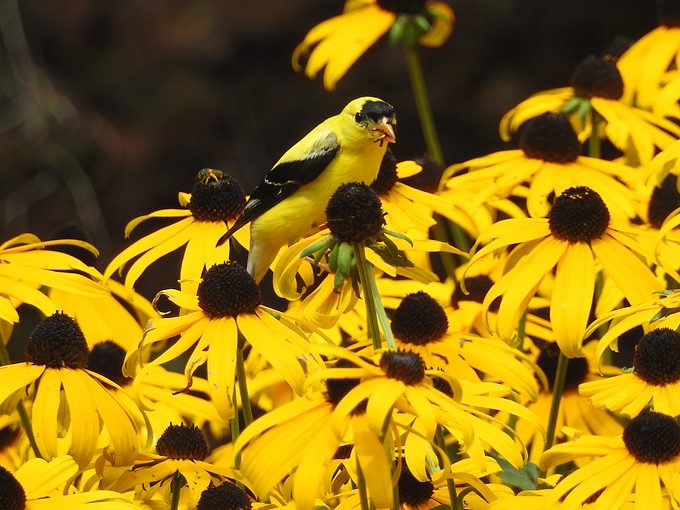
- Black-eyed Susan, which may even bloom for you this year.
- Purple coneflower, a pollinator magnet that feeds goldfinches all winter.
- Butterfly weed, the native milkweed monarchs actually need. It loves warm soil, so now is perfect.
- Bee balm, if you want hummingbirds.
- Blazing star and coreopsis, both tough as nails.
- Goldenrod and asters, which bloom in fall, so you might get color out of them this very season.
There's exactly one rule for planting in summer heat: water them plenty. This first season, while the roots are still shallow, give them a good soak a couple times a week through the hot stretches. Once they're rooted in, you can walk away and they'll fend for themselves for years.
So no, you're not too late. You're right on time for the plant that comes back.
A yellowjacket in June is a fairly docile pest controller. A yellowjacket in late August wants to fight you for a soda. Same insect, but the colony has changed.
All summer, the workers hunt protein. Caterpillars, flies, and other garden pests get chewed up and fed to the larvae back in the nest. In return, the larvae provide the adults with a sugary secretion that fuels the workers.
So all season those workers are out killing the bugs eating your tomatoes because that's how they feed the babies that feed them. A single colony removes thousands of pest insects.
Then late summer arrives. The colony reaches peak population. The queen shifts from producing mostly workers to producing males and next year's queens. Fewer larvae remain, and as those larvae pupate, the workers lose much of their built-in sugar supply.
Now you have a huge population of aging wasps searching for carbs wherever they can find them. Fallen fruit, hummingbird feeders, your picnic, your soda, anything sweet. They're not suddenly mean. They're just hungry, unemployed, and nearing the end of their lives.
You'd be itching to fight for a piece of candy too.
By winter, the old queen, workers, and males are dead. Only newly mated queens survive to start fresh colonies the following spring, and old nests are almost never reused.
A nest tucked away in a field corner or high in a tree is doing free pest control for a few more weeks, then it's gone.
The nests worth dealing with are the ones in doorways, walls, or places where people, especially anyone with a severe allergy, could be at risk.
Many people owe the 12 year old (now 13) Scottish girl an apology.
You first @PoliceScotland
And you @freddiesayers - you posh twat
And you #narinder-heres-my-flange
God bless those girls. And well done mum
This article was written by a 26 yr old college student by the name of Alyssa Ahlgren, who's in grad school for her MBA. What a GREAT perspecitve..👍🏽
My Generation Is Blind to the Prosperity Around Us!
I'm sitting in a small coffee shop near Nokomis (Florida) trying to think of what to write about. I scroll through my newsfeed on my phone looking at the latest headlines of presidential candidates calling for policies to "fix" the so-called injustices of capitalism. I put my phone down and continue to look around.
I see people talking freely, working on their MacBook's, ordering food they get in an instant, seeing cars go by outside, and it dawned on me. We live in the most privileged time in the most prosperous nation and we've become completely blind to it.
Vehicles, food, technology, freedom to associate with whom we choose.These things are so ingrained in our American way of life we don't give them a second thought.
We are so well off here in the United States that our poverty line begins 31 times above the global average. Thirty One Times!!!
Virtually no one in the United States is considered poor by global standards. Yet, in a time where we can order a product off Amazon with one click and have it at our doorstep the next day, we are unappreciative, unsatisfied, and ungrateful. ??
Our unappreciation is evident as the popularity of socialist policies among my generation continues to grow. Congresswoman Alexandria Ocasio-Cortez recently said to Newsweek talking about the millennial generation, "An entire generation, which is now becoming one of the largest electorates in America, came of age and never saw American prosperity."
Never saw American prosperity! Let that sink in.
When I first read that statement, I thought to myself, that was quite literally the most entitled and factually illiterate thing I've ever heard in my 26 years on this earth. Many young people agree with her, which is entirely misguided.
My generation is being indoctrinated by a mainstream narrative to actually believe we have never seen prosperity. I know this first hand, I went to college, let's just say I didn't have the popular opinion, but I digress.
Why then, with all of the overwhelming evidence around us, evidence that I can even see sitting at a coffee shop, do we not view this as prosperity? We have people who are dying to get into our country.
People around the world destitute and truly impoverished. Yet, we have a young generation convinced they've never seen prosperity, and as a result, we elect some politicians who are dead set on taking steps towards abolishing capitalism.
Why? The answer is this,?? my generation has only seen prosperity. We have no contrast. We didn't live in the great depression, or live through two world wars, the Korean War, The Vietnam War or we didn't see the rise and fall of socialism and communism.
We don't know what it's like to live without the internet, without cars, without smartphones. We don't have a lack of prosperity problem. We have an entitlement problem, an ungratefulness problem, and it's spreading like a plague."
In 2009, dozens of cedar waxwings dropped dead in a Georgia yard. A lab opened them up and found their stomachs packed with one thing: bright red berries picked off the shrub by the porch.
That shrub was nandina, sold all over the South as "heavenly bamboo."
It's not bamboo, but an Asian barberry relative, and its berries contain cyanide compounds. A bird that eats a few is usually fine. But cedar waxwings don't eat a few. They descend in flocks and strip plants bare, and in late winter, when those berries are one of the few foods left hanging, a whole flock can swallow a deadly dose in minutes.
The Georgia birds were found dead beneath the shrubs they had been feeding on. It's happened since, including more cedar waxwings found dead at UNC Chapel Hill.
The berries are also how the plant spreads. Birds eat the fruit and scatter the seeds. Nandina has escaped gardens into woods across much of the South, from Virginia to Texas.
It tolerates deep shade, which means it doesn't stop at the trail edge. It can establish in intact forests and crowd out native plants. State after state lists it as invasive. It's still sitting on the shelf at the big-box nursery.
It's easy to recognize. An upright evergreen shrub three to eight feet tall, with lacy leaves that turn red in cold weather, clusters of white flowers in spring, and bunches of glossy red berries that hang on all winter.
So yank it. Get the roots, because it resprouts. If you can't remove the whole thing this year, at least cut off every berry cluster before the birds find it.
Then plant something that actually feeds them: winterberry, American beautyberry, chokeberry, or native hollies.
The birds deserve better.
Back in Victorian days, it was considered quite fancy for gardeners to build something they called a stumpery.
It's a pile of dead stumps and logs, often stacked roots-up, arranged in a shady damp corner and left to rot on purpose. The Victorians built them to show off ferns, but they also turn out to be some of the best wildlife habitat you can make.
The first one went up in 1856 at Biddulph Grange in England, where a gardener took the stumps left from clearing land and stacked them ten feet high along a sunken path. The fern craze was at its peak, and the rotting wood made perfect planting pockets. King Charles has a famous modern stumpery at Highgrove built from sweet chestnut roots.
What the Victorians treated as decoration, nature treated as a feast. As the wood breaks down it feeds fungi, mosses, and beetles, including stag beetles whose grubs live in deadwood for years. Toads, salamanders, and small mammals move into the damp gaps. A single rotting log can support an astonishing variety of life.
To build one: find a shaded corner, stack stumps and logs with the roots facing up and out, leave plenty of gaps, and tuck ferns and moss around the base. Then walk away and let it rot.
You make a sculpture out of dead trees, and everything in the yard moves in.
Thank you to all who fought and sacrificed in freedoms defense all those years ago. Incredible footage here. Blessed that both my uncles survived and will never forget the over 400,000 who did not come home.
He wrote a six-and-a-half-minute song about twenty-nine drowned sailors. The record label told him to shorten it. Gordon Lightfoot refused. It became one of the most enduring songs in North American music history anyway.
November 10, 1975. A massive freighter called the SS Edmund Fitzgerald was crossing Lake Superior during a brutal storm. Winds reached sixty miles per hour. Waves climbed over thirty feet high. The crew radioed that the ship was taking on water. Then the radar signal disappeared. All twenty-nine crew members were lost. No survivors. No bodies recovered. Only silence where voices had been moments earlier.
When Gordon Lightfoot read about it in a magazine, the story stayed with him. But what haunted him most wasn't the spectacle of the storm. *It was the ordinary humanity of the men.* Twenty-nine people had simply gone to work one morning and never come home.
So he sat down and wrote a ballad. Not a dramatic anthem. Not a commercial radio single. A requiem. *The Wreck of the Edmund Fitzgerald* told the story slowly and carefully, almost like an old sea shanty passed down across generations. Every verse carried details from the disaster. Every line honoured the men who had vanished into Lake Superior.
The problem was length.
The song ran more than six minutes long. In the mid-1970s, radio hits were supposed to last around three minutes. Record executives worried stations would never play something so long and so sombre. They urged Lightfoot to trim verses, simplify the story, make it more commercial.
**He refused.**
The men deserved the full story. Not the shortened version. Not the radio-friendly version. *The truth in full.* So the label reluctantly released the song exactly as he wrote it.
And something remarkable happened. Radio stations played all six-and-a-half minutes. Listeners stayed with every verse. *The Wreck of the Edmund Fitzgerald* climbed to number two on the Billboard charts in 1976 and became one of the defining songs of his career.
Gordon Lightfoot was born in 1938 in Orillia, Ontario — a small Canadian town north of Toronto. He grew up singing in church choirs, learning discipline, harmony, and emotional restraint long before fame arrived. His voice was never flashy. *It was honest.* While much of the folk movement leaned toward protest music or psychedelic experimentation, Lightfoot built something quieter and more enduring — songs about weather, distance, labour, loneliness, roads, lakes, and ordinary people trying to endure difficult lives.
His songs sounded effortless. They were built with extraordinary precision. Every word mattered. Nothing was wasted.
*If You Could Read My Mind* became his breakthrough hit in 1970. *Sundown* reached number one in the United States in 1974. By the mid-1970s he had become one of the most respected songwriters in North America. Bob Dylan openly admired his writing. Johnny Cash recorded his songs. Elvis Presley covered his work. But Lightfoot never abandoned Canada for Nashville or Los Angeles. *"These are where the stories come from,"* he said about the landscapes of home.
Success did not protect him from struggle. For years he battled alcoholism, which affected his health, relationships, and performances. Eventually he confronted it and slowly rebuilt his life. Then in 2002 — he nearly died. An abdominal aortic aneurysm ruptured suddenly, forcing emergency surgery. Doctors believed he would not survive. He spent six weeks in a coma while his family prepared for the worst.
*But somehow, he came back.*
The recovery was slow and painful. His voice weakened. His stamina changed permanently. Still, he returned to the stage — not because touring was easy, but because the songs still mattered. For nearly two more decades, Lightfoot continued performing in smaller theatres across Canada and the northern United States. Older now. Frailer. Slower.
*But still singing. Still carrying the stories.*
**Gordon Lightfoot died in 2023 at the age of eighty-four.**
And after his death, people returned again to *The Wreck of the Edmund Fitzgerald.* Not simply because it was famous — because it *remembered.* Without his stubborn refusal to shorten the song, the story of those twenty-nine sailors might have faded more quickly into history. Instead, every time the song plays, the ship sails again across cold water. The storm returns. The men are remembered.
That was Gordon Lightfoot's gift. He turned ordinary lives into lasting memory. He made distance feel human. He made weather feel emotional. He made silence meaningful.
And he proved something rare in an industry built on compromise —
*Integrity is not the enemy of success. Sometimes it is the reason the work survives.*
Suficiente por hoy y traten de ser felices.
El amor incondicional no es un mito:
Lo puedes observar todos los días en las madres.
Ya sea por una cuestión biológica o cultural,
el amor de una madre realmente es incondicional...
NEW: Dan Bongino just eviscerated Seattle Mayor Katie Wilson for allowing the city's urban core to devolve into a hell hole.
And with a failing mainstream media unable to consistently hold elected officials accountable, he goes on to highlight the importance of independent journalism.
"The iPhone is the political colonoscopy of our time."🔥
Thank you for highlighting my work Dan.
@dbongino|@DiscoveryCWP