founders are unstoppable when they master:
distribution + AI/agents + business/field + sharp systems
gives you near total control over destiny
bootstrap vs backed becomes a scale decision
If you spend JUST one hour per day actually using AI to build something real, within 90 days you will be in the top 1% of people who understand what is happening. The bar is still shockingly low.
Unclear if a durable trend, but CEOs and CTOs are back to coding with a fury, thanks to coding agents.
I have public company CEOs sliding into my DMs (and “InMail”) telling me about falling in love with shipping software again thanks to Claude Code and Vercel.
“Dream accounts” that we always wanted to work with, where in the past the C-suite would hardly understand the infrastructure until much later in the game.
Coding agents are the ultimate PLG-fication of the enterprise. Bad, legacy software can’t hide anymore. The stack that works is self-evident to the entire organization, from intern to CEO.
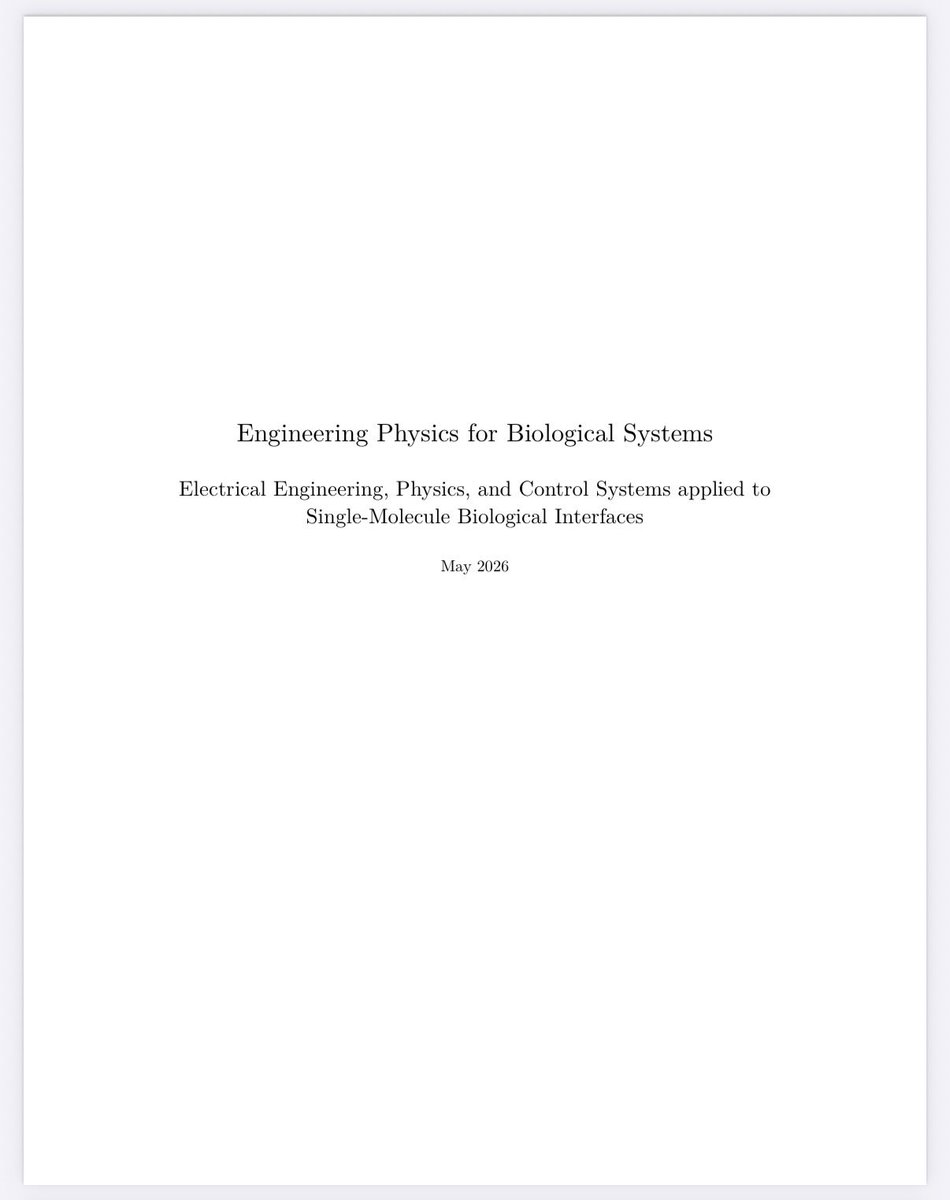
i come from a programming background, so i didn’t have strong physics/engineering mental models for biology
inspired by the Quant Bible from MIT, i created an equivalent for engineering in biology
it’s not deep but has been helpful for me
link: https://t.co/4mjghhW4xe
The thesis is simple: the future belongs to individuals who build compounding AI systems, not to individuals who use corporate-owned centralized AI tools.
I'm trying to build these in open source so you can have them for free. That's what GBrain is.
Two days ago I shipped the Action Building Cold Start Pack free.
Today I shipped the companion.
The Security Pack. 11 static checks. 3 skills. Free.
It caught 12 CRITICAL issues on my own product on the first run.
#AI#Claude#actionbuilding
You can download it at https://t.co/zWAFI8j6Ja
I've been creating a set of tools for non-technical builders in AI and today I'm making those available for the community for free.
It's called Action Building.
It's for founders who aren't engineers but are (or want to be) shipping real software with AI and keep hitting walls.
You can download a zip with case studies and a native plug-in for #claude
I hope this is helpful to folks. Its helped me wring out the sloppiness of coding.
https://t.co/zWAFI8j6Ja
Introducing Pods
Hyperspace Pods lets a small group of people - a family, a startup, a few friends, to pool their laptops and desktops into one AI cluster. Everyone installs the CLI, someone creates a pod, shares an invite link, and the machines form a mesh. Models like Qwen 3.5 32B or GLM-5 Turbo that need more memory than any single laptop has get automatically sharded across the group's devices - layers split proportionally, inference pipelined through the ring. From the outside it looks like one OpenAI-compatible API endpoint with a pk_* key that drops straight into your AI tools and products. No configuration beyond pasting the key and changing the base URL.
A team of five paying for cloud AI burns $500–2,000 a month on API calls. The same team's existing machines can serve Qwen 3.5 (competitive on SWE-bench) and GLM-5 Turbo (#1 on BrowseComp for tool-calling and web research) for free - the hardware is already on their desks. When a query genuinely needs a frontier model nobody has locally, the pod falls back to cloud at wholesale rates from a shared treasury. But for the daily work - code reviews, refactors, research, drafting - local models handle it and nobody gets billed. And when it is idle, you can rent out your pod on the compute marketplace, with fine-grained permissions for access management.
There's no central server involved in inference. Prompts go from your machine to your pod members' machines and back: all of this enabled by the fully peer-to-peer Hyperspace network. Pod state - who's a member, which API keys are valid, how much treasury is left - is replicated across members with consensus, so the whole thing works on a local network. Members behind home routers don't need port forwarding either. The practical setup for most pods is three models covering different jobs: Qwen 3.5 32B for code and reasoning, GLM-5 Turbo for browsing and research, Gemma 4 for fast lightweight tasks. All running on hardware you already own.
Pods ship today in Hyperspace v5.19. Model sharding, API keys, treasury, and Raft coordinator are all live.
What Makes This Different - No middleman. Your prompts travel from your IDE to your pod members' hardware and back. There is no server in between reading your data.
- No vendor lock-in. Pod membership, API keys, and treasury are replicated across your own machines using Raft consensus. If the internet goes down, your local network keeps working. There is no database in someone else's cloud that your pod depends on.
- Automatic sharding. You don't configure layer ranges or calculate VRAM budgets. Tell the pod which model you want. It figures out how to split it across whatever hardware is online.
- Real NAT traversal. Your friend behind a home router with a dynamic IP? Works. No VPN, no Tailscale, no port forwarding. The nodes handle it.
- Free when local. This is the part that matters most. Cloud AI bills scale with usage. Pod inference on local hardware scales with nothing. The marginal cost of your 10,000th prompt is the electricity your laptop was already using.
Coming soon:
- Pod federation: pods form alliances with other pods.
- Marketplace: pods with spare capacity can sell inference to other pods.
BREAKING: Scientists just injected a Parkinson's patient with neurons grown from their OWN skin cells.
No immune drugs. No donor. No rejection.
12 months later — the cells are ALIVE, producing dopamine, and patients are moving better.
This is a thread you need to read 🧵👇
🔗 SOURCE: Aspen Neuroscience Press Release — March 18, 2026
https://t.co/qbapgbvbwd
I've been building with AI tools for months and its amazing how its accelerated. I'll be posting more about how I do it in the upcoming days. Heres a fun example: https://t.co/0j8jjtG6ZP
and two images of Frankie my dog I used as my tester!
In a decade, we'll look back and miss the chaos, culture wars and shenanigans of the early gen AI days. This shit gets professionalized real' quick. Enjoy the mayhem while we have it. We're all lucky to be in the middle of it.
The founder of Niantic built Google Earth.
He has been building this for years.
I got a demo. It is stunning.
And is the platform that will bring us infinite realities.
I call it the Holodeck.