🚨 Another big milestone for the rental market: annual rent growth has finally, officially turned negative. (First time since 2020)
Our model observes same-unit repeat-rents, and tells us that new leases are 0.7% cheaper today than one year ago.
1/🧵
https://t.co/Me2I3QIIRd
Here's a link to the full report if you're interested.
We love this one – we’ve been writing it every year since 2018 and we're always excited to share the newest numbers! ✌️
https://t.co/EK4zwBYQ2b
Just published the newest edition of our Millennial Homeownership Report!
According to the latest data (2023), the millennial homeownership rate stands at 45%.
A 🧵with some highlights:
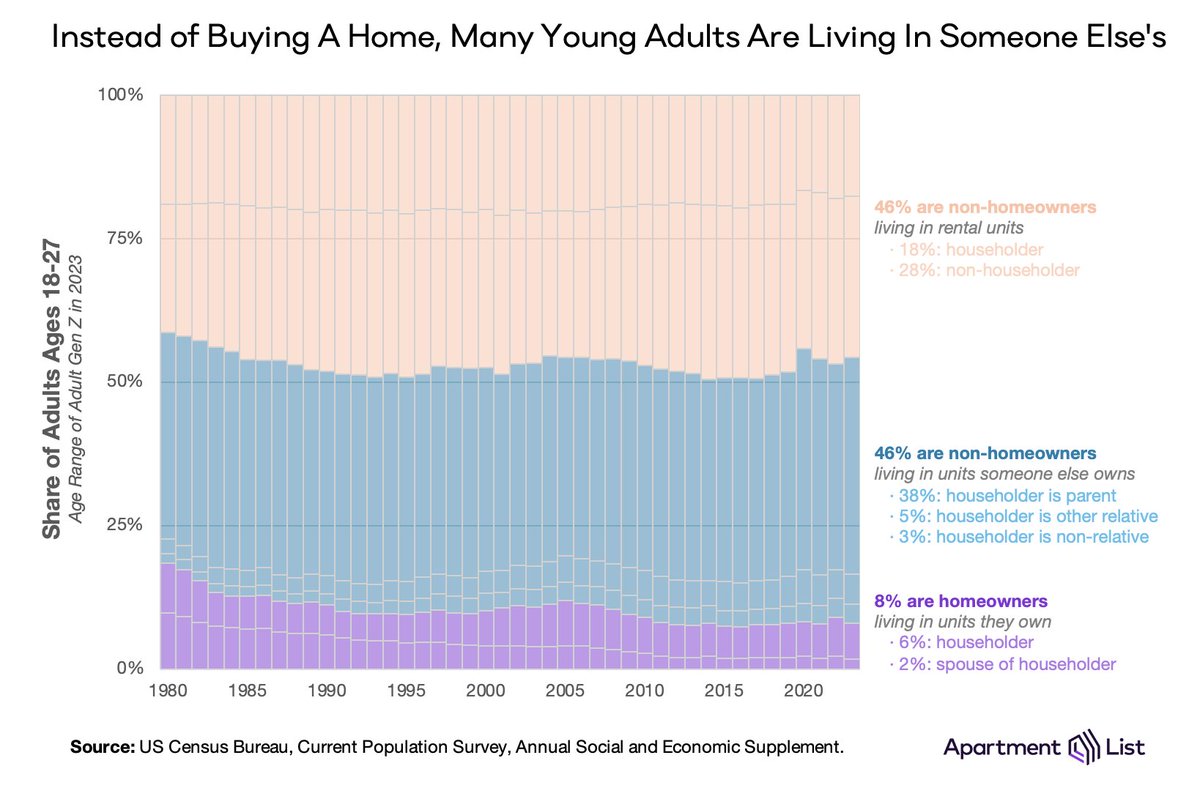
We’re finally getting some good data on Gen Z as well: today 8% are homeowners and they're pacing pretty similar to millennials through their mid-20s.
But this chart really stands out to me: at age 25, nearly 30% of Gen Z are still living with a parent.
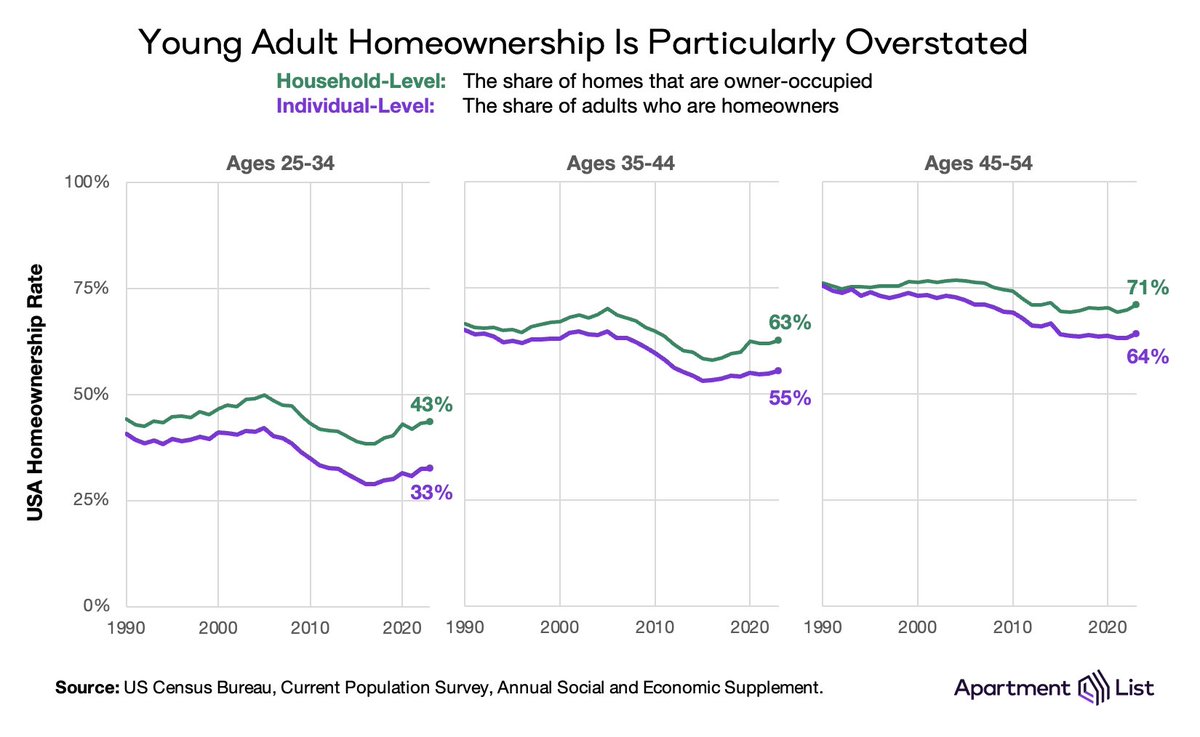
The gap exists because more people who don't own homes are living together. They're included in the denominator of the individual rate, but omitted from the denominator of the household rate.
With a smaller denominator, the household rate gets a boost -- hence the paradox.
The former is easy to calculate and compare over long periods of time.
The latter is fuzzier (it requires some data assumptions) but it responds more appropriately to shifts in household composition.
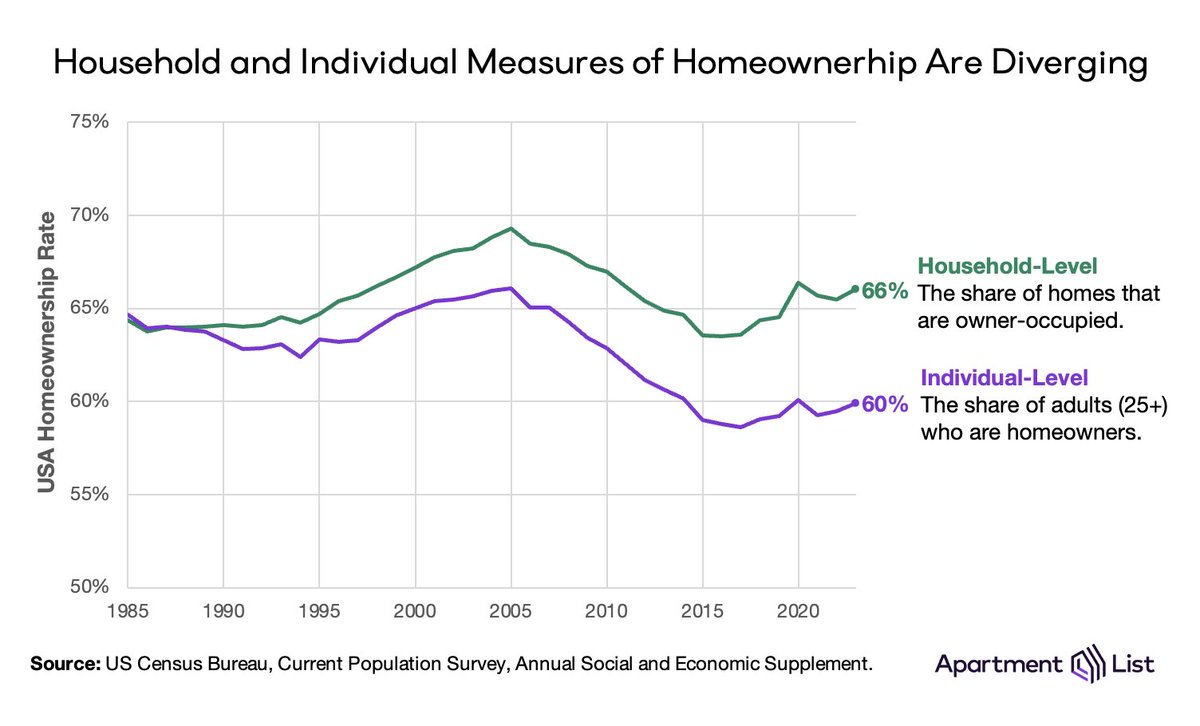
That detail makes a big difference! Here’s what the homeownership rate looks like if we base it on households 🟩 v. basing it on people 🟪.
By this view, the homeownership rate is just 60%, well below the official rate, and yet to recover rom the GFC.
But this is incongruent with how we naturally think about homeownership:
- One renter living alone = One non-homeowner
- Four friends renting an apartment together = Four non-homeowners
- A married couple that buys a house = Two homeowners
So according to the official calculation:
- One renter living alone = One non-homeowner
- Four friends renting an apartment together = One non-homeowner
- A married couple that buys a house = One homeowner
It all has to do with how the homeownership rate is calculated. Officially, it’s the percentage of homes that are owner-occupied.
Crucially: no matter how many people live in a home, each home contributes one to the denominator.
Since, the market has cooled and 5% rent increases are relatively uncommon. Today, Biden's plan would impact just a small segment of the rental market.
It's real impact would occur when tight market conditions return, which is expected in 2025-26.
Since Biden revealed his proposal for a 5% rent cap, we've had some questions about how common rent hikes of this magnitude actually are.
Today: not very. Only one big city (Madison WI) is averaging >5% rent growth. But in 2022, this policy would have had huge implications 👇
Then -- when demand was surging and supply was tight -- every major city was experiencing >5% rent growth. Some in FL/AZ/NC were upwards of 30%.
Biden's policy would have affected the vast majority of new leases signed during that period.