Personal update: I've joined Anthropic. I think the next few years at the frontier of LLMs will be especially formative. I am very excited to join the team here and get back to R&D. I remain deeply passionate about education and plan to resume my work on it in time.
The age of one-time token due diligence is over. A given "token" can easily involve 300+ changing contracts.
We've built a balance sheet graph for every token, so you can see all protocol/token dependencies and then model economic and operational risks.
always when you start learning something new its blurry. then you start to map some of the key concepts thinking "this is easy". and then you realize just how much you don't actually know. that's the filter. pushing through the unknown because you want to, not for clout, fame, a gold star, or a bag of money. all those motivations are weak and will inevitably leave you empty even as you acquire new skills. it will be the classic "i feel nothing, what's next" feeling. learn new things because you actually want to, not because of what learning the new things may signal or fleeting desire they may satisfy.
Euphoria is live!
I'm proud to finally release Tap Trading to you, after more than 1 year of development.
This is just the beginning of a long journey as we push the boundaries of what is possible on-chain.
Short-duration derivative platforms which are simple and fun to use are a huge gap in the market. Blockchain infrastructure has finally caught up to the point where we can deliver real innovation to users, rather than just copies of the same stale ideas.
Our goal is to make trading accessible to everyone and bring the next wave of mainstream users into crypto. The product you see today is the first of many experiences we have planned.
Many people have wondered why I chose to build this, after a background in MEV trading, P2P exchanges, DEX development, and various research/advisory work across the crypto space.
The truth is that this product deserved to be built. I have always loved difficult challenges, and this is the most sophisticated thing I have ever built.
Technically, it sits at the intersection of many separate innovations, including low latency on-chain oracles, multiple concurrent CLOBs, and probabilistic market making. On an psychological level, it has also been challenging to relentlessly optimise for the most simple and fun experience around trading which it is possible to build.
There are many challenges ahead, but if we succeed I believe this will propel the entire space forwards and open a new conversation about what is possible with on-chain derivatives and predictions.
It has also been incredibly fun to build something which connects directly with users to deliver them the most dopamine we possibly can.
I have had an incredible time building this, and I hope you will have an incredible time using it.
I welcome all feedback on how we can make it more fun.
I want to make you feel something.
I love you all.
I think a lot of people + companies are beginning to realize that what it took to be successful in crypto up until this point is not the same as what will make them successful into the future.
You're not a genius. You were early and survived.
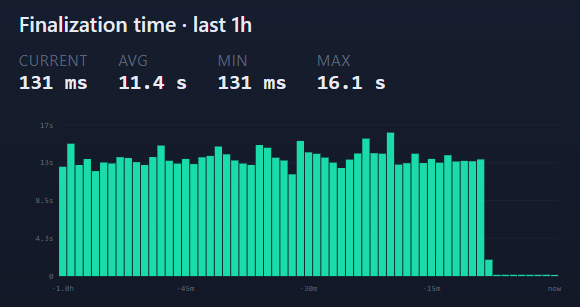
We just had the first successful Alpenswitch on our Alpenglow community cluster! The @solana finalization time improved 100x. Thanks to everybody participating.
Watch it live:
https://t.co/sb4wQkCsfd
https://t.co/WRQ6vE3AVd
@brian_armstrong@moo9000 >Non technical teams are now shipping production code
genuinely terrifying lol, already had my data leaked enough before this
Hey @evan_van_ness
The staking issuance for $ETH should reflect the actual cost of staking (security model, etc)
A market-based mechanism might make sense and could be lower than the current yield.
So, we are not opposed to idea that the staking issuance rate could change.
PS: please don’t interpret our statements as favoring or endorsing any specific idea.
PPS: This will also create opportunities to generate yield away from native staking
Most Solana users have never thought about who validates their transactions. However, that validator choice affects fees, MEV exposure, skip rates, and network decentralization.
It's worth thinking about. 🌞
If consolidations costs you 6-7 figures of investment, and staying on 32s costs you percentage points on 4-5 figures, you guys are shooting yourselves in the foot with this messaging.
It’s disappointing because >1 year in, you can now explain the problems, but I think mustn’t understand them if you’re putting forward the wrong solutions.
Companies won’t invest in a market you’re deliberately killing.
because the final allocation of losses between rsETH on Ethereum (which is technically "fully backed") and external chains is still tbd, i can only read this as a statement of Aave Labs' preference - they would rather rsETH on mainnet to have zero haircut, and for rsETH on L2s/external chains to bear the full loss (essentially zeroed out)
ultimately, the allocation of losses will be mostly decided by Kelpdao team (and lawyers)
but we can consider why this outcome would be aave labs' preference, and what would be the impact on users if this is how it ends up working out
# aave labs preference
aave core market on ethereum is covered by umbrella insurance module, and is also explicitly covered by aave dao backstop (eg dao committed to using treasury to backstop against bad debt). so if rsETH on ethereum ends up with no haircut, then not only are umbrella users completely unaffected (other than potentially GHO stakers to cover unbacked GHO on external chains), but the aave treasury remains intact
aave core is also the primary money-maker for the aave protocol, and preserving this is probably top priority for labs team
# user impacts
if rsETH on Ethereum has no socialized losses/haircut, users on Aave core would end up being mostly unimpacted
however, certain L2 networks would face an extremely heavy burden, with WETH suppliers taking a direct hit from unbacked rsETH
current rsETH collateral across external chains includes:
- Base: $71 million
- Arbitrum: $152 million
- Mantle: $116 million
- Ink: $21 million
- Linea: $1.4 million
in some cases, rsETH backed loop positions may comprise a large share of the backing of aWETH, meaning that any assets borrowed against ETH may also be at risk of a haircut (USDC and USDT0 markets)
mantle, arbitrum, and base seem to have the highest risk here, with mantle in particular having the majority of aWETH backed by potentially zero value rsETH. it is possible that Aave could successfully maneuver these chains into bailing out their markets (this may be part of the reason why Aave Labs prefers no loss socialization on Ethereum, to force the issue with relatively better capitalized chain ecosystems)
we also note that ethena has a material deposit amount in the mantle USDT pool (https://t.co/CXOGQR7OZu) which may face a haircut, potentially exceeding their excess capital buffer. if this is the case, then this would become another vector of contagion risk into Aave markets including Core and Plasma (which has been relatively less affected as it had no rsETH exposure at the time of the hack)
# comparison with full socialization
personally, i think that concentrating losses on external chains is actually a worse outcome for Aave
in the case where losses are spread evenly including Ethereum users, this would engage Umbrella ETH depositors (roughly $50 million) and also enable using rsETH collateral on Aave Core to repay part of the debt, likely reducing the uncovered loss on Ethereum mainnet to an amount lower than Aave's current treasury reserves
the loss levels on external chains would then be at much more manageable levels, with less risk of cascading spillover into large haircuts on stablecoin markets or impairment to other key aave collateral assets like USDe
awaiting further updates from the Kelpdao team to see how this will play out in practice
as of last friday, I no longer work at the EF
nothing but respect for the brilliant people i worked with over the last 5 years on network upgrades + funding efforts
I intend to continue working on @ProtocolGuild and Ethereum political economy as long as funding is available
Figment's Q1 2026 Solana Validator Report is now live.
$SOL staking metrics throughout Q1:
🟦 6.93% Staking Rewards Rate (SRR)
🟦 99.4% Voting effectiveness
Institutional-grade Solana staking. Optimized for every epoch.
Read the full report below for more details 👇
https://t.co/a1XzLBY3sI